Elton John today used his birthday to highlight gay rights. In particular he focussed on the case of William Hernández in El Salvador.
Hernández , 35, is the Director of Asociación Entre Amigos (Between Friends Association). He and other members of the organisation have received death threats, which seem to be aimed at stopping the work of the association, which provides sex education to lesbian, gay, bisexual and transgender (LGBT) people and the wider public, and speaks out against human rights violations against LGBT people.
On 1 June 2006, an unknown man approached William Hernández from behind, outside the office of the Between Friends Association, and pressed a gun to his neck, saying (in Spanish): ‘Don’t turn around. Stop f***ing in the Assembly. Stop doing stupid things in the street because I know you are organising some s*** for this month. I already looked inside but didn’t find anything. Here I’ll find what I’m looking for. Stop f***ing or I’ll kill you before you get married.’
The man grabbed William Hernández’ briefcase and ran off. Two days earlier, William Hernández and a colleague arrived at the office to find three windows had been broken and files had been searched. Two written threats were left: ‘‘fags die’, and ‘this is what you deserve’. No valuable office equipment was stolen, but a number of documents were taken, including a programme of the organisation’s planned activities.
Since the raid, the Between Friends Association has moved to a new office, but staff believe they may be under surveillance. A number of unidentified men have been noticed outside the office, apparently keeping watch, for four to five hours each day.
This is not the first time that the Between Friends Association has been targeted. They have reported seven raids on their offices to the authorities in the last five years, but investigations have been superficial and no-one has yet been brought to justice. William Hernández was given some police protection during working hours, after receiving death threats in 1999. He still receives this protection, but it is inadequate. The incident on 1 June occurred shortly after the police officer assigned to protect him left for the day.
Amnesty International believes that William Hernández and other members of the Between Friends Association are at grave risk.
Find out more
Send an appeal, by post or fax, to the El Salvador authorities calling on them to provide additional security measures to ensure the safety of William Hernández.
Thursday, March 22
'Stop f***ing or I’ll kill you before you get married.’
Anemic growth for podcast listening

The Corporate Podcasting Summit in London this week may have gotten off to a downbeat start after a research presentation by Tom Webster of Edison Media Research. Quoting from the yet-to-be-released "Arbitron/Edison Internet and Multimedia Study 2007," he said podcast listening isn't growing much.
Only 13% of the national random sample of people surveyed for the 2007 report said they had "ever" listened to a podcast. Last year's research put the number at 11%. And despite the media's enthusiasm for video podcasts, Edison found only 11% have ever watched one. In 2006, the number was 10%. (These statistics were reported by Jason Van Orden, a podcasting consultant, who was on the conference program.)
Paul Colligan, chairman of the event, put a positive spin on the numbers. He blogged that awareness of podcasting, or the percentage who had "heard" of it, increased to 37% in the latest report, compared to 22% a year ago.
Nice try, Paul, but it is not good news
How To Spy On Google
How To Spy On Google
FORBES
Brian Caulfield, 03.20.07, 6:00 AM ET
Burlingame, Calif. -
Is Google working on a phone? Seems likely, according to various reports.
But there's no need to rely on the rumor mill to find out what Google is up to. Just head to the company's online job listings, where the company declares that it is "experimenting with a few wireless communications systems," adding that "we are building a small team of top-notch logic designers and analog designers aimed at nothing less than making the entire world's information accessible from anywhere for free."
<>
A more recent spin through Google's own ads points to some intriguing possibilities. Among the 778 postings for work at its Mountain View, Calif., headquarters, for instance, is one seeking analog and logic designers. Many speculators point to this as yet more proof that Google is working on a mobile handheld device following the company's acquisition of a company founded by wireless designer Andy Rubin.
<>
Meanwhile, other nuggets can be gleaned from the job listings. Google is hiring a manufacturing manager who will be "part of new product introduction team that establishes new hardware platforms." This could mean Google will soon be cranking out anything from larger numbers of phones to living room set-top boxes. And Google is looking for software engineers who have experience dealing with "high-volume consumer devices" for a television technology effort. Could this mean a Google TV offering could be on the way?
Wednesday, March 21
Tekkie erases $38 billion project

Oops! Techie wipes out $38 billion fundKeystroke mistake deletes data for Alaska’s oil-funded accountUpdated: 10:04 a.m. ET March 20, 2007JUNEAU, Alaska - Perhaps you know that sinking feeling when a single keystroke accidentally destroys hours of work. Now imagine wiping out a disk drive containing an account worth $38 billion.
That’s what happened to a computer technician reformatting a disk drive at the Alaska Department of Revenue. While doing routine maintenance work, the technician accidentally deleted applicant information for an oil-funded account — one of Alaska residents’ biggest perks — and mistakenly reformatted the backup drive, as well.
There was still hope, until the department discovered its third line of defense, backup tapes, were unreadable.
“Nobody panicked, but we instantly went into planning for the worst-case scenario,” said Permanent Fund Dividend Division Director Amy Skow. The computer foul-up last July would end up costing the department more than $200,000.
Over the next few days, as the department, the division and consultants from Microsoft Corp. and Dell Inc. labored to retrieve the data, it became obvious the worst-case scenario was at hand.
Nine months worth of information concerning the yearly payout from the Alaska Permanent Fund was gone: some 800,000 electronic images that had been painstakingly scanned into the system months earlier, the 2006 paper applications that people had either mailed in or filed over the counter, and supporting documentation such as birth certificates and proof of residence.
And the only backup was the paperwork itself — stored in more than 300 cardboard boxes.
“We had to bring that paper back to the scanning room, and send it through again, and quality control it, and then you have to have a way to link that paper to that person’s file,” Skow said.
Half a dozen seasonal workers came back to assist the regular division staff, and about 70 people working overtime and weekends re-entered all the lost data by the end of August.
“They were just ready, willing and able to chip in and, in fact, we needed all of them to chip in to get all the paperwork rescanned in a timely manner so that we could meet our obligations to the public,” Skow said.
Last October and November, the department met its obligation to the public. A majority of the estimated 600,000 payments for last year’s $1,106.96 individual dividends went out on schedule, including those for 28,000 applicants who were still under review when the computer disaster struck.
Former Revenue Commissioner Bill Corbus said no one was ever blamed for the incident.
“Everybody felt very bad about it and we all learned a lesson. There was no witch hunt,” Corbus said.
According to department staff, they now have a proven and regularly tested backup and restore procedure.
The department is asking lawmakers to approve a supplemental budget request for $220,700 to cover the excess costs incurred during the six-week recovery effort, including about $128,400 in overtime and $71,800 for computer consultants.
The money would come from the permanent fund earnings, the money earmarked for the dividends. That means recipients could find their next check docked by about 37 cents.
Egov's disconnect from the Web
I posted earlier about a debate amongst eGov workers prompted by the arrival of NeighbourhoodFixIt.
The new site allows people to report common 'street' problems (like Potholes) on a map, via a simple interface. This fires off an email to the Council or Councils (sometimes two local councils share responsibilities for an area). The problem for eGov workers, as articulated, was simply that systems have been set up for people to fill in a form on the council website. Firing off emails reporting problems which don't follow this route throws people.
The debate about this has been raging on a Board I participate in. It's now pretty circular: the same 'issues' keep getting repeated and it became clear to me that many posters simply didn't understand the complete normality of a site such as neighbourhoodfixit and — as my earlier post explains — that this isn't the only site acting as an intermediary for reporting problems to the council.
My suggestion (actually a reversioning of an earlier point) was for people to consider creating widgets. These would send people directly down the correct reporting structure, only they'd start off on other sites.

Not only would this solve the issue which seemed to vex people the most ('please use our lovingly created form'), it would also promote electronic reporting ('transactions') directly to a key audience and undoubtedly result in far greater 'take-up'.
This is a completely 'left-field' suggestion though. Not something which would have been considered, or, more importantly, suggested by those driving eGov.
For years, everything pushed at local government web development has been tailored to our little 'walled garden'. Very little has come through from any direction (Whitehall, SOCITM, or favoured suppliers) about the reality of the web and almost nothing which keeps us up-to-date with web developments (e.g. widgets are common ecommerce practice).
What we get told is important is either very particular to us (metadata/our processes) or dated, basic stuff which should have been prioritised years ago ('your site must be usable').
- Much of the 'take-up' advice (what exists) is way out of date or misleading.
- 'Bibles' like Better Connected encourages stats use and comprehension — but where's the advice on that?
As far as I can tell there's another huge annual eGov shindig coming up at Excel where there's nothing about Google. The elephant isn't even in the room.
 At the rate eGov moves it'll be Summer next year before anything remotely addressing the vital and huge areas of Search or Ecommerce is organised by anyone in the entire sector. This is simply an enormous disconnect.
The rest of the web might as well be another planet as far as eGov is concerned — yet the demonstrable gains from even a bit more common understanding are enormous.
As far as I can tell, few local councils are doing serious work with something, for example, as important as Google but then we have no advice from the sector about how to deal with it — when Google is the key gatekeeper for 'transactional' content. This background explains to me why the reaction to NeighbourhoodFixIt has largely been, 'Why weren't we consulted?' rather than 'How can we take advantage of this?'
If eGov workers don't understand that this is how the web works or that this is how the web's developing, I blame Whitehall.
Postscript
neighbourhoodfixit seems to have received a good reception from web 2.0 practitioners in London, if this post and this post are anything to go by. And from what comment there is in the blogosphere.
Usability and culture

I gave a lecture today. Titled 'cheap'n'easy usability' [large ppd], it's one I've given before and covers discount aka guerilla usability testing.
It was great fun. I love talking about this stuff.
The students - it was at Westminster University - must have ancestors from every continent bar Antarctica, and I couldn't help but think what an enormous advantage that is / will be for London and the UK (something double underlined in a new New York magazine feature).
Anyway, several of the questions related to a statement I made about picking testers, which is 'don't fret'.
Yes, don't pick five geeks (or five attractive women)! But - beyond some variety - to get your 80% (most obvious) errors you don't need a demographically accurate sample.
The key determinant of success is basic skill level and ability to use the interface.
The questioners wondered about culture and how that impacts. They didn't quite trust my statement.
There was a bit more in Jakob Nielsen in China, which I didn't post before, which explains this a bit better:
We're testing both Chinese sites and Western sites, because we need to generate guidelines for theThe key bit here is 'build a fully localized site', because there are cultural differences when it comes to things like colour, icons and lots of other elements down to simple things like how Arabic websites go right/left or how Brazilian sites like more colour in general.
audience at our upcoming conferences in the U.S. and U.K.. It's actually more important to most of our clients how Chinese users use foreign sites than how they use Chinese sites, since most companies can't afford to build a fully localized site.
There are certainly interesting differences between Asian users and the American, European, and Australian users we test in most of our studies. Details to come at the presentations later in the year once we have analyzed the data fully. But the most interesting finding from our current tests is "the dog that didn't bark" to refer to Sherlock Holmes.
For most of the things we tested, there was NO DIFFERENCE in the usability guidelines between Asia and other parts of the world. This is similar to findings in our studies in Japan and Korea.

| Color | China | Japan | Egypt | France | United States |
| Red | Happiness | Anger Danger | Death | Aristocracy | Danger Stop |
| Blue | Heavens Clouds | Villainy | Virtue Faith Truth | Freedom Peace | Masculine |
| Green | Ming Dynasty Heavens | Future Youth Energy | Fertility Strength | Criminality | Safety Go |
| Yellow | Birth Wealth Power | Grace Nobility | Happiness Prosperity | Temporary | Cowardice Temporary |
| White | Death Purity | Death | Joy | Neutrality | Purity |
All interfaces will have small cultural differences - ATMs in Sweden have large buttons to cope with mittens.
But it's the actual interfaces and the way people use them - what elements you pick and where you put them, what choices make sites usable or less usable - which doesn't change much.
There are commonalities and there are bodies trying to create international usability standards, including for web interfaces. This isn't published but the model below shows the wider reference points for considering web interfaces.
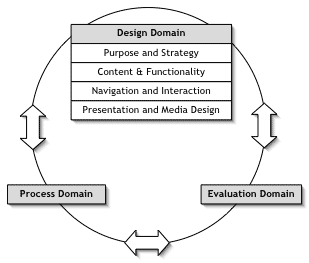
The standard will detail guidance in four main areas:
- Purpose and strategy. What is the purpose of the site and how is this made clear to its users?
- Content and functionality. What is the site’s conceptual model? How is content organised and how should the site deal with issues such as privacy and personalisation?
- Navigation and interaction. How should the content be organised so that users can navigate the site easily? How will users search the content of the site?
- Presentation and media design. How should individual pages be designed so that people can make use of the information? How should multimedia be used?

There's also the point that the technology itself can reflect one culture's norm - most obvious is the 'boysey' nature of some gadget and game design. Plus there are gender differences in the way people use the web.
But, my general feeling, though, is that - well - fretting on this can obscure the very discount basis of the testing — specific design issues need specific testing to get right (or as near as dammit/budget allows), just as with accessibility.
Discount testing is simply about getting you out of the woods, so to speak.
Plain Google home page gets facelift
More about this on John Battelle's blog
An example of a personalised Google home page. .
Sydney Morning Herald
March 20, 2007 - 2:29PMJazzing up its famously plain website, Google is offering a new option that places its internet search box in panoramic settings that change with the time of day and the weather.
The colourful graphics will be unveiled on Tuesday.
While most of Google's users remain content seeing little more than the company logo and the search box that has anchored its home page for nearly a decade, millions of others have created log-ins that enable them to select from a variety of features that appear with each visit.
The features, introduced nearly two years ago, include stock quotes, local weather and news headlines.
Google's new package of decorations, also known as "skins", are designed to make the home page feel even more homey, said Marissa Mayer, the company's vice president of search products and user experience.
"Google has become the doorway to the internet for a lot of people, so we want to make (the site) feel more like an online living room," Mayer said.
"We feel we are personalising things in a very tasteful and useable way."
Rival Yahoo Inc already has been experimenting with a broader selection of decorative themes as part of an upgrade of its "MyYahoo" service.
"This is a much bigger step for Google because they have always prided themselves on their plain white pages," said Dan Cohen, who worked on the personalisation efforts at both Google and Yahoo before recently becoming chief executive of Pageflakes Ltd, a startup that customises Web pages.
The use of more graphics illustrates Google's evolution from a once-pure internet search engine into an all-purpose website that offers email, news, photo sharing, instant messaging, shopping and mapping services.
The diversification over the past five years has raised worries that Google might be overextending itself, but the expansion has not hurt so far. Google more than doubled its profit to $US3.1 billion ($A3.88 billion) last year.
Reflecting its cautious approach, Google's first set of decorations consist of just six themes revolving mostly around landscapes. The settings include a Japanese tea garden, a beach, a city skyline and a bus stop. Google plans to introduce a few more themes each month and eventually may accept outside submissions, Mayer said.
Google has programmed the decorations to reflect what is happening in the outside world.
Users are asked to enter their post code so the digital drawings change from day to night and change with the weather.
The designs also will contain hidden surprises known as "Easter eggs" that will open up with an opportune click at the right time of the day, Mayer said.
She would not reveal any of the surprises.

It's not on my Google UK personalised homepage yet, but I jiggled it to google.com and - voila! I love the 'Sweet Dreams' theme and it took my UK location. let's see how it changes ...If you click on the "select theme" link, up comes a box of several themes you can choose. The list includes; Classic, Beach, Bus Stop, City Scape, Sweet Dreams, Tea House and Seasonal Scape.
I selected Bus Stop, which looks like this:
Google then asks you to enter in your zip code so that the theme you selected with dynamically change based on your currently weather. I suspect that if its snowing, there may be snow around the theme, and so on.


Here it is - at twilight. It's been changing gradually all day...

and at midnight

Tuesday, March 20
Historic origins of usability testing
The Usability Testing Central blog has an interesting, compact history of usability.
World War II was the starting point of electronics and electrical systems controlled by human operators through a "user interface". Industrial psychologists such as John Flanagan discovered that by reducing the amount of buttons, knobs, switches and control panels in new fighter aircraft- they could also dramatically improve operator performance.This led to something called the Critical Incident Technique (or CIT), used in the transition of the Supermarine Spitfire to the P-51 Mustang fighter cockpit.

The 50s + 60s established a lot of the basic hardware and software but the next key marker was the establishment of Xerox's PARC (Palo Alto Research Center)
Xerox is largely responsible for much of the innovation in user interfaces (still in use today!). Many know these as WIMP (Windows, Icons, Menus, Pulldowns). Xerox R&D work and resulting usability and user interface innovations propelled the current age of corporate usability research.This led to the Apple Mac and usability became the norm in computing R+D.

Then came the web and , in particular, the explosion of unusable websites during the dotcom boom. See the infamous boo.com, right.
Eventually the usability gurus Jakob Nielsen and Steve Krug prevail.
"In our first year we didn't spend a single dollar on advertising... the best dollars spent are those we use to improve the customer experience." - Jeff Bezos, Amazon.comNow we're at Web 2.0 and the phrase is 'user experience'.
Vote Different
This smart anti-Hillary vid - which directly steals from the famous Apple 'Superbowl' ad from 1984 - has already had 1,055,627 views in TWO WEEKS.
Better Connected, 'Accessibility' and all that

My fellow blogger Jack Pickard, who does a job not a million-miles dissimilar to mine, has commented on the controversy raging amongst UK eGov, focussing on accessibility.
It started with the annual SOCITM report on local government websites: Bettter Connected [parodied, right, by Public Sector Forums].
This report includes a section about accessibility, which uses a number of methods, including the universal standard devised by an organisation called WCAG , as well as the RNIB and Usability Exchange, to come up with a score — and herein lies the controversy.
The website Public Sector Forums reports very directly, exclaiming Why Better Connected 07 is garbage.
Another colleague Dan Champion weighs in with a more measured tone.
And now Jack:
This is the point. Who does it gain to dance around with one wrong line of code on one page out of several thousand? (Which is actually to a large extent what's at the back of this - one wrong line of code).Let’s stop saying that WCAG is a measure of accessibility. It isn’t. WCAG shows you things you can do that will likely make your site more accessible. But throw some real people at your site and it either will or it won’t be accessible to them, irrespective of what your WCAG conformance level says.
Remember: WCAG Conformance is not the same as accessibility.
Real people. Real tests. Real progress?
Move on: Getting input about the content from disabled people is something you can do whilst you fix that pesky code.
Because if people with disabilities are just gaining access to a whole lot of confusing councilese, what are they gaining? Frustration?
- Are you duplicating info that others provide?
- Are you directing people to the right sources (online + off)?
- Are the resources allocated in the budgets to get this right?
- Is your content of any practical use?
It would be a great help for eGov and disabled people if we focussed on usability, for one. Which we don't really do.
We do this where I work in a more formal way but, as well. here's a couple of things I've done:
- Sent things to disabled staff. In particular I have one blind staff member who I copy in occasionally. She looks at stuff and can tell me there and then whether it works or not. That simple fact has proven enough to get people to jump and move. Even without the blind person right in front of them. [accessify forum is another good place from practical guidance].
- Shown people the web from a disabled person's perspective. Done this twice with dyslexia (an-ex member of our team) and screen readers - that generally blows people away.
In 'Beyond Accessibility: Treating Users with Disabilities as People' he argued that:
It's time we moved beyond technical accessibility when discussing how to improve the Web for users with disabilities. We should consider these users as users: As people who have jobs to perform and goals to accomplish when they use websites and intranets. Once we've achieved technical accessibility, our new goal must be task support and increased usability of websites and intranets for people with disabilities.

Sure, users with disabilities are disabled, and many must use assistive technologies to access the Web. Obviously, websites must be accessible through alternative user interface devices, such as screen readers and screen magnifiers. If you can't get at the information or services that a website or intranet offers, then you definitely can't use it either. But, just because a design is theoretically accessible, doesn't mean that it's easy to use, simple to learn, or supports efficient job performance.
Nailed it, Jakob. In 2001.
Getting usability right means getting accessibility right.
Accessibility in eGov also sits within a wider context: where's the budget for content, for example? Where's the centrally produced, easily repurposable content? Is there policy?
We can buy feedback from differently disabled people but where's the simple methods and practical advice for real user input?
But the focus is so much on the technical - driven by both Whitehall, geek fascinations and commercial interests and exacerbated by living in our own, web bubble - that these sorts of, practical, questions are drowned out and non-technical people excluded
Here's a postscript from Bruce Tognazzini, talking to business:
Designing for the Differently-abled
Guess what? Designs for the disabled don't have to hurt usability for the normally-abled. In fact, if you are doing your job properly, your designs will help everyone.Lots of myths surround the whole disabled issue. First, you can give up thinking of yourself as permanently-abled. Most of us will end up with increasing disability, starting at age 40 when our eyes begin to go. If we live long enough, we can plan on a whole bunch of other systems to go, too.
We also tend to become temporarily disabled, and I'm not only talking about breaking your leg skiing. How about if you are trying to wheel a heavy suitcase down the street from where the cab abandoned you? Do you think that curb cut might turn out to be a good thing? When you get to the hotel, that silly ramp is going to look pretty good, too.
It is the same thing in software. Make an application usable by the blind and you have also given everyone else access to a powerful keyboard interface, particularly useful when struggling with an inferior pointing device on that cute little portable. (Nothing like a laptop or palmtop to make you temporarily disabled.)
Designs for the disabled can be screwed up. Apple created a special mode for the visually impaired in the early days of the Macintosh that would blow up a portion of the screen really big. It should have been useful for all users, but they had implemented it in such a way that you couldn't easily show and hide the expanded window. As a result, half your screen disappeared long-term. That was a reasonable price to pay for the visually-impaired. It was too high a price for the rest of us.
What to do
When you design for the disabled, do as Good Grips did:
• Design and usability-test extensively for the disabled.
• Also test across a broad spectrum of users as well, and keep a constant eye out for how your work can improve the lot of all users.
• Ensure that elements of your product do not actually impede its usability for the rest of us.
By the way, if you know the guy who is responsible for that toilet in the handicap stall with the seat four feet off the ground, how about passing this column on? I'd like to be able to leave my step ladder at home.

Geek heaven: Swivel

What is Swivel?
Swivel is a place where curious people explore data — all kinds of data.
Swivel lets you explore data and share your insights with others. Swivel has data about politics, economics, weather, sports, business and more.
Swivel is full of good stuff. We think of it like this:
- Explore popular data or obscure data. Search for it or have fun cruising all the colorful graphs, data sets and opinions.
- Compare gas prices to presidential approval ratings or UFO sightings to iPod sales. You might find a crazy coincidence or something more.
- Share your insights by posting a graph to your blog or emailing a link to your friends and coworkers.
- Upload the information you care about, describe it, pick a color scheme and even pick a cool photo to bring it to life.
If you're curious about data, Swivel is the place for you.

Thrown Out Onto the Street
Swiveler mikek highlights apartment evictions in San Francisco under the California state Ellis Act. The law allows apartment owners to evict residents, usually with the goal of repurposing units into condominiums. However, this data also demonstrates the ability to drop a raw list into Swivel and having our crunching power do the work for you!
Monday, March 19
US Prez election: Web Video Reviews Are Mixed

Interesting article from the Washington Post about how the US Presidential election is panning out on the web - since the article, MySpace has announced it's to launch an "Impact" Political Channel focused on the election now a mere 20 months away!
As elsewhere, article's about how video will dominate this election - only not the sorts of video which candidates have (had?) been producing, instead it's the 'Macacca'-type balls-ups, comedy-skits and other viral-types. [and maybe direct responses to voter's questions]
Article bigs up WebCameron, which I don't think has exactly set the YouTube generation alight ... what has - and by accident I think - is Tony blair's appearance on ComicRelief.
If you haven't seen it, don't miss - absolutely hysterical. Hate him, love him, it's just plain funny — this is the take of YouTubers from the masses of positive comments. [They also seem to love mash-ups, which are the stock-in-trade of shows like the BBC's Dont Watch That Watch This.]
So Blair and Catherine Tate's skit precisely hits the button for what works with users video-wise on the web. Damn.
Candidates Try Web Video, And the Reviews Are MixedBy Jose Antonio Vargas
Washington Post Staff Writer
Saturday, March 17, 2007; A01Sen. Hillary Rodham Clinton (D-N.Y.) posts regular "HillCasts" to talk about her positions on equal pay, health care and Iraq. Rudolph W. Giuliani treats YouTube as if it were C-SPAN -- a place for his 58-minute speech to the Churchill Club. Sen. Christopher J. Dodd (D-Conn.) put up a casual backstage interview before his appearance on "The Daily Show." And though Sen. John McCain (R-Ariz.) was the last of the presidential front-runners to jump on the online video bandwagon, he now has more than 25 videos circulating on the Web.
One after another, presidential campaigns are adding videos to their Web sites as well as to video-sharing sites such as YouTube, MySpace and Veoh. The reviews, however, are mixed. Production values are uneven -- a few videos look grainy; many are professionally produced; most seem downright misplaced. And so far, judging by the number of views on YouTube -- and the overall buzz on the blogosphere -- it's the candidate videos that the campaigns didn't make that get attention.
Not one of the videos made by John Edwards's campaign, for example, matches the popularity of the one showing the former senator combing his hair before an interview to the tune of "I Feel Pretty." That video has been viewed more than 135,000 times since it was posted on YouTube in November. Edwards's most popular official video, of his announcement in December that he's running for president, has been viewed about 116,000 times.
Similarly, Clinton's most watched HillCast, titled " Roadmap Out of Iraq," comes nowhere close in popularity to the video showing her singing " The Star-Spangled Banner" off-key at a rally in Iowa. The HillCast has been viewed more than 15,000 times since it was posted on Feb. 17, the out-of-tune moment nearly 1.1 million times since its posting on Jan. 27.
As fans of Web video know, YouTube is a place of irreverence, spontaneity, humor. And for the most part, candidates are giving their online audience the opposite of what it wants. Just ask James Kotecki.
Several times a week, Kotecki, a self-described "political geek" turned YouTube celebrity, advises presidential candidates on their campaign videos -- from his dorm room at Georgetown University. Equipped with a three-year-old laptop, a $60 Web camera and a $30 microphone -- and a small, dusty desk lamp as a light source -- the 21-year-old dishes out free, unsolicited suggestions (and the occasional compliment) to the candidates.
For Giuliani: "All of your videos so far are just recordings of your speeches. And two of them are marathons, clocking in at 45 minutes and 58 minutes."
For Rep. Dennis J. Kucinich (D-Ohio): "The ivy background, I'm-outside-but-I'm-really-inside thing, doesn't strike me as overly presidential. I'd also encourage you to make your videos a bit more intimate by bringing the camera closer in to you."
For McCain: "Maybe it's time to post a funny video."
Kotecki has one recurring message to the candidates and their expensive media advisers: "The Web isn't TV." As in, Web viewers don't expect to be spoken to, they expect to be spoken with. It's a passive experience vs. an interactive one.
Other students of the genre have similar advice.
"Look at how the candidates are talking in their videos. With a few exceptions, they're mostly looking sideways, not talking directly to the camera," said Jeff Jarvis, who heads the interactive journalism program at the City University of New York's Graduate School of Journalism and started PrezVid.com, a blog dedicated to watching the campaign through YouTube. "The important thing about this medium is it's very human and intimate. A voter comes across and clicks on you. You should talk to that voter and look at him in the eye."
Micah Sifry, co-founder of TechPresident.com, another blog that looks at how the candidates are campaigning on the Web, also makes a distinction between video online and ads on television. "There's something fundamentally different about video online," he said. "Viewers are looking for that rare, unscripted, revealing moment, to get a little sense of who these candidates really are."
For campaigns, Web videos are an instant way to reach voters, whether on the candidates' sites or on YouTube, which this month created You Choose '08, a channel specifically for candidate videos. They are a way to present Clinton sitting on a couch, sans microphone. A way to hear McCain talk uninterrupted about "honor," "courage" and "faith" (each one is a video clip). They are giving candidates a face, a voice and, most important, a personality -- at least if done right.
So far, none of the official campaign videos have been used to attack a rival candidate. And while the videos tend to be similar, there are differences in approach.
Some candidates are employing a "less is more" mantra. New Mexico Gov. Bill Richardson, for example, currently has three videos on YouTube. For others, such as Mitt Romney, more is more. "We're doing as many different kinds of videos as possible -- videos of him giving speeches, testimonials from families, et cetera," said Stephen Smith, director of online communications for the former Massachusetts governor.
All of the campaigns, however, are still experimenting, watching each others' moves.
Christian Ferry, McCain's Web manager, says bluntly: "We're only at the very beginning here, and our videos are still evolving."
As an early model, Jarvis and Sifry both point to British politics and David Cameron, the leader of the Conservative Party. Last fall, Cameron launched WebCameron, which includes a series of short videos starring the 40-year-old father of three. His first video showed him washing the dishes at home, his baby screaming in the background.
Looking directly at the camera, standing in front of his sink, he says, "Watch out BBC and ITV, we're coming after you."
That was an off-the-cuff, unscripted moment -- or at least it appeared that way. To Sifry and Jarvis, it seemed "authentic," and therefore effective.
Yet as in vogue as online videos are, no one is sure of the impact they will really have. Or whether, in this Web-based, heavily fragmented mediasphere -- in which everybody is competing for shorter attention spans -- they will eventually replace TV spots, the bread and butter of campaign advertising.
"These videos are a giant step forward from saying, just three years ago, 'Here's our latest blog entry,' " said Jim Margolis, a veteran Democratic media strategist. "But are people going to get sick of them? You'll get 23 videos on your inbox and you'll delete them all? Who knows? I don't. This is all new."
In the meantime, Kotecki is a new critic for a new medium. He has recorded 42 videos in his dorm room since Jan. 27 -- often late at night, sometimes in the afternoon between his quantum physics and Introduction to Logic classes.
His YouTube channel has more than 400 subscribers, and his videos have been viewed more than 71,000 times. He makes up awards and bestows them on candidates; Romney earned one half of a "YouTube Savvy Award." He also makes sound effects -- "Ding!" -- and, on occasion, sings and raps.
Some of the campaigns, including Edwards's, have contacted Kotecki via YouTube, and Smith, Romney's Web man, said with a laugh: "We appreciate the half of the award. We'll earn the other half. It's early."
James Kotochi
James' interests include 'Being quoted in the New York Times'Yesterday afternoon, Kotecki received his biggest reaction yet -- a video response from Kucinich himself, who called Kotecki "my adviser."
"I think you have some good suggestions," Kucinich told Kotecki, "and we're already taking them into account."
The video, only 50 seconds long, is a close-up shot.


Candidate links

 labels:
bill clinton,
daily show,
directgov,
egov,
hillary,
iraq,
ITV,
mccain,
media,
myspace,
new york times,
obama,
tony blair,
tories,
US politics,
video,
youtube
labels:
bill clinton,
daily show,
directgov,
egov,
hillary,
iraq,
ITV,
mccain,
media,
myspace,
new york times,
obama,
tony blair,
tories,
US politics,
video,
youtube
Tweet This! ♦ Add to del.icio.us ♦ DiggIt! ♦ Add to Reddit ♦ Stumble This ♦ Add to Google Bookmarks ♦ Add to Yahoo MyWeb ♦ Add to Technorati Faves ♦ Slashdot it ♦
Saturday, March 17
Voting systems company threatens Dutch state

Voting systems company threatens Dutch state
“Buy my company now or you won’t have provincial elections”
February 28th, 2007
After invoking the Dutch Freedom of Information Act, the "We do not trust voting computers" foundation has received a number of unnerving documents from the Dutch Electoral Council. These documents describe the wheeling and dealing of Jan Groenendaal, whose company is responsible for all the software sold by the Nedap/Groenendaal consortium that sells the voting computers used in over 90% of Dutch municipalities. Groenendaal's company writes the software that tabulates the election results on both the local and the national level. The Dutch government depends on Groenendaal's company to the extent that it currently cannot hold elections without his help. The Electoral Council concludes this in
(Dutch) to the responsible minister that are part of the correspondence now made public. worried letters
The letters also show that Groenendaal was more or less blackmailing the Dutch government at the time of the previous parliamentary elections. On November 10th, he sends an
(english translation) warning the ministry that his company will cease all activity if Rop Gonggrijp of the "We do not trust voting computers" foundation becomes a member of the independent commission that is investigating the future of the electoral process. This commission was instituted after earlier by the foundation Gonggrijp founded. Despite this intervention, Groenendaal probably senses that the commission's report (due in October 2007) is likely to negatively impact the value of his company. Therefore, Groenendaal makes a very straightforward business proposal in the same e-mail, : "The ministry buys the shares of our company at a reasonable price, [...] and we will still cooperate during the next election (the Dutch 2007 provincial elections to be held March 7th).
On November 22nd 2006 (the day of the national elections) he wrote
( ) which doesn't spell blackmail as explicitly to minister Nicolaï, in which he indicates his need to sell quickly because he would like to “abruptly” retire. But when that letter fails to elicit a fast response, Groenendaal writes an (Dutch) to the Electoral Council in which he says: "We are heading towards a very dangerous situation". Right in the heat of election preparation, he writes: "I have ordered my employees to halt all activity until we have received an answer that is acceptable to us", and asks the secretary-director of the Electoral Council to intervene on his behalf. As far as we know, the Dutch government never filed criminal charges in relation to this attempted extortion.
The mails also show that Groenendaal was contemplating going to court to force the public prosecutor to arrest Rop Gonggrijp, founder of the "We do not trust voting computers" foundation. Groenendaal writes: "After all, his activities are destabilizing society and are as such comparable to terrorism. Preventive custody and a judicial investigation would have been very appropriate." The company also contemplated suing Gonggrijp as well as the TV-program EénVandaag for damages. In their October 4th 2006 broadcast, EénVandaag showed that Nedap voting computers could easily have their software exchanged and that large numbers of these computers were stored in unprotected locations. Groenendaal would also like to see the foundation's two legally bought voting computers confiscated.
In the documents, one can also read how, before the November 22nd elections, Groenendaal sent a letter to all Dutch municipalities which use his system in which he criticizes the Ministry of the Interior for their handling of the crisis regarding the concerns over the verifiability of voting computer election results. In this
(Dutch) Groenendaal, on behalf of his company, rejects all responsibility for a well-run election. The minister deemed it necessary to quickly follow up with (Dutch) to try and control the damage. In general in his (Dutch) Groenendaal (sometimes signing as "generally acknowledged election expert") shows frustration over the way in which the Dutch state, after years of neglect, is re-taking control over the elections. Where possible, Groenendaal attempts to (Dutch) this process. When the Electoral Council informed Groenendaal that it would like to put a copy of the source code of his software at a so-called "escrow organization" for safe keeping, Groenendaal demanded a 100 Million Euro guarantee from the Electoral Council in case something would happen to the source code for which the escrow organization could not be held responsible.
Publicly to this day the Dutch government has always indicated to have a large amount of trust in Nedap/Groenendaal. Dutch election results are calculated using software made by Groenendaal that has never been inspected by any independent body, despite an
(Dutch) by the Dutch Electoral Council to subject this software to inspection. And when the Dutch government found out how easy it was to replace the software in Nedap voting computers, it ordered replacement and inspection of all the memory chips. These inspections were done by Nedap/Groenendaal, which was thus inspecting itself. These inspections prompted the Dutch government to issue a press release (Dutch) titled: "No doubts regarding reliability of voting machine".
According to Rop Gonggrijp of "We do not trust voting computers" the use of voting computers threatens the verifiability of election results, because the computers in use today do not allow for any post-election audits. “These e-mails shed new light on the relationship between Nedap/Groenendaal and the state, and thus also on the entire chain of events regarding voting computers. We too had the opportunity to wreak havoc regarding the election organisation. But that’s never been our intention, we’re merely here to campaign for elections with a verifiable outcome. Had we e-mailed the minister in this tone, we’d be at the police station now”, says Gonggrijp.
"We do not trust voting computers" has written an
to the new responsible minister Ter Horst calling on her to “take the necessary measures needed to restore confidence in the electoral process and in the notion that our government can not be blackmailed”.
Background information
The "We do not trust voting computers" foundation has been campaigning against the use of the current generation of voting computers in The Netherlands since the summer of 2006. As a result of this campaign, it was revealed that Dutch election legislation fails to address key issues regarding voting computers and that the voting computer inspection regime is faulty at best. Inspections by an independent party (a private company named Brightsight) are limited to a very small number of machines and the inspections mostly test for resistance against vibrations, high humidity and power failures. Resistance against wilful manipulation is neither part of the legal requirements nor of the actual inspections.
"When we started to think about demonstration software that would lie about election results (called “Nedap PowerFraud”), we kept in mind that the system should not lie after an election that was obviously a test of the system. We decided we needed to store the votes and only decide whether or not to perform the fraud at the moment the election was closed, so our program would have as much information as possible to make that decision."
From the security analysis (8M pdf, in English) of the ES3B voting computer, manufactured by Nedap/Groendendaal.
Slashdot thread - "security by obscurity?"In September the foundation legally bought two Nedap voting computers and showed it was relatively easy to create a version of the built-in software that manipulated the election results. It also turned out the chips that held the software could be easily replaced. Subsequently the Dutch government decided to have Nedap/Groenendaal inspect and seal all voting computers. Researching the voting computer also showed that voting computers emit radio waves that can be used to determine what is being voted, threatening the secret ballot.
As a result of the concerns raised over voting computers an independent commission led by ex-minister Korthals Altes was appointed in December 2006. This commission will report on the future of the Dutch electoral process in October 2007. A sub-commission led by ex member of parliament Loek Hermans will look back and examine the decisions made surrounding the introduction of voting computers. Nedap voting computers and Groenendaal election software are also used in parts of France and Germany, and both countries are said to be rolling out more computers. In 2004, Ireland bought 50M Euro worth of Nedap/Groenendaal equipment (sold as "PowerVote") and then decided not to use it in elections after doubts regarding system security were raised. The state of New York is currently contemplating buying 28.000 Nedap voting computers (sold as "LibertyVote") and accompanying software (appropriately named "LibertyControl").


Charity YouthNet repurposes content for mobile

Charity YouthNet repurposes content for mobile
Platform: Mobile | Author: Alex Farber | Source: nma.co.uk | Published: 16.03.07
Online charity YouthNet is re-purposing its online content for mobile in a bid to reach 350,000 16 to 24-year-olds each month.
The charity runs the portal thesite.org which offers lifestyle advice and help for young people.
Teenagers who access the site via their mobile will now be able to view content which is specifically designed and edited for the mobile phone rather than being presented with the full internet version.
"The site looked awful before when accessed on mobile but it's important our users have a good experience so we've now built three different versions," said Claire Easterman, new projects developments manager for YouthNet.
 Thesite.org now automatically detects if a user is accessing it from a mobile and then presents content in the relevant format.
It currently attracts 500,000 monthly unique users on PC and Easterman expects the mobile version to be accessed by 350,000 consumers by 2010.
One method Easterman will be employing to ensure this happens is leveraging the community aspect of the PC site on mobile. This challenge will form the second stage in the deployment of the mobile site.
The move is a slap in the face for the dotmobi initiative which attempts to convince content owners to publish on a mobile specific domain name.
Video game playing frequency 'Quite Staggering'
| MediaDailyNews The Games People Play: Nielsen Finds Reach, Frequency 'Quite Staggering' |
| by Joe Mandese, Friday, Mar 16, 2007 8:32 AM ET |
 IN A MOVE THAT IS likely to have significant implications for the way advertisers and media planners think about audience shares for traditional television dayparts, Nielsen Thursday released the first snapshot of a new measurement service tracking the burgeoning market of video game consoles, which finds much of the usage is taking place when people would normally be watching conventional TV programming. The report, "The State of the Console," finds that the penetration of video game consoles soared nearly 19% during the fourth quarter of 2006 and are now in more than 45.7 million homes account for 41.1% of TV households. The study suggests that while Madison Avenue has become transfixed by other digital media, especially online, DVRs, and personal media devices such as the iPod, video games already are having a profound impact on the way people spend time watching TV for a very simple reason: Most video game consoles are connected to the primary or secondary TV set in TV households, and they are used primarily during traditionally peak TV usage time periods - especially among some of the most important and elusive TV audience demographics. IN A MOVE THAT IS likely to have significant implications for the way advertisers and media planners think about audience shares for traditional television dayparts, Nielsen Thursday released the first snapshot of a new measurement service tracking the burgeoning market of video game consoles, which finds much of the usage is taking place when people would normally be watching conventional TV programming. The report, "The State of the Console," finds that the penetration of video game consoles soared nearly 19% during the fourth quarter of 2006 and are now in more than 45.7 million homes account for 41.1% of TV households. The study suggests that while Madison Avenue has become transfixed by other digital media, especially online, DVRs, and personal media devices such as the iPod, video games already are having a profound impact on the way people spend time watching TV for a very simple reason: Most video game consoles are connected to the primary or secondary TV set in TV households, and they are used primarily during traditionally peak TV usage time periods - especially among some of the most important and elusive TV audience demographics. While Nielsen has not yet released explicit audience shares for individual console systems and game titles - it will begin doing so later this year - the new data reveals that console usage peaks and ebbs in a pattern that is almost identical with traditional TV dayparts, rising during prime-time and declining during wee hours. Among men 18-34, for example, TV usage peaks between 9:00 and 9:59 at night with an estimated 10.9 million watching TV at that hour. Console usage, meanwhile, peaks between 10:00 and 10:59 at night, with 814,000 mean 18-34 active users between that hour. The new data also offers the first glimpse of the "unduplicated" reach among various demographics using conventional TV and gaming consoles, which also suggests that advertisers and agencies may soon begin planning the impact of consoles alongside other conventional TV platforms like broadcast and cable TV. "Among key console demographic groups, the reach and frequency is quite staggering," says the Nielsen report. "Three out of every four boys aged 2-11 (75.8%) used an in-home video game console for at least one minute in the fourth quarter of 2006. Those boys 2-11 averaged 2 hours and 30 minutes of usage per usage day. Almost half of all men aged 18-34 used a console at least once for a period of one minute or more during the fourth quarter (48.2%, or 16.1 million). Men 18-34 who did use their console, averaged 2 hours and 43 minutes per usage day." The report notes that consoles also are having a profound impact on the TV usage patterns of demographics "generally considered less significant in the video game market: "For example, half of all teenage girls (50.8% or 6.1 million) used a console at least one minute during the quarter." |
 Study: 50 Million+ "Senior" Video Game Fans Can't Be Wrong; Older Game Players Derive Mental Workouts, Stress Relief and Pain Distraction from Playing
Largest-Ever Survey Yields Surprising Data: 47% are Age 50+, and Nearly 20% Are Age 60+; Older Consumers Play for Different Reasons
SEATTLE, Washington – October 4, 2006 — Of the estimated 150 million consumers who play family-friendly, non-violent puzzle, word and simple action games on the computer regularly, almost half of them are age 50 or older, according to a new survey from "casual" games leader PopCap Games®. Among players of casual games who are age 50 or older, 74% cited cognitive workouts (mental exercise), 86% noted stress relief, and 62% chose memory strengthening, as benefits they'd experienced from playing such games. Further, fully 32% of respondents 50 or older said the games distract them from chronic pain/fatigue, and nearly one in ten subjects said they derive actual pain relief from playing. In addition to playing the games primarily for mental and physical benefits rather than pure entertainment, older game players had distinctly different views and habits relating to when, how much and which kinds of casual games they play. Of the nearly 2,200 consumers who took the survey, 1,040 were 50 or older, amounting to 47% of the overall respondents; fully 19% of survey respondents were age 60 or older.
Segmentation Analysis: Older vs. Younger Casual Games Players
Players age 50 or older enjoy casual games considerably more frequently and for longer periods than their younger counterparts; 65% of players age 50 and up say they play the games on a daily basis, compared to less than half of younger players. 31% of older gamers say they play for 10 or more hours per week, compared to 25% of younger players. In response to the question "when do you play casual games?" older players chose "in the morning, before the day begins" 23% of the time, while younger players selected that choice just 16% of the time. The most popular answer to that question, among both older (49%) and younger (52%) players, was "weekday evenings."
Motives For Playing:
While the percentage of older players who noted "stress relief" as a reason for playing casual games was slightly lower than that of survey respondents overall (86% vs. 89%), older players chose several other reasons more often than their younger counterparts. "Distraction from chronic pain/fatigue" (32% vs. 23%), "memory strengthening" (62% vs. 55%) and "cognitive exercise" (74% vs. 73%) were among the benefits cited more frequently by older players. Further, when asked to choose the single most important reason for playing, those age 50 or older chose "entertainment" even less frequently than younger players (16% vs. 21%); top responses to that question from among the subjects age 50 and up were "stress relief/relaxation" (39%) and "mental workout" (21%). In general, 86% of older survey respondents said that they felt playing casual games offered them physical and/or mental health benefits, compared to 74% of under-50 respondents.
"I am in my fifties and I use casual word and puzzle games on the computer as well as recommending them to my patients," said Dr. Carl Arinoldo, a Stony Brook NY-based psychologist of 25 years and an author and expert on stress management. "I find that these types of games are wonderful as a stress management tool, while at the same time providing excellent cognitive exercise." Dr. Arinoldo surmised that older players' motives for playing were influenced by a growing awareness of the importance of "mental calisthenics" for maintaining a healthy mind. "While they may not choose ‘entertainment' as the primary reason for playing, it seems reasonable to assume that older players of these games are likely to recognize the benefits of cognitive exercise more readily than younger consumers," he said. "When you're 65 or 70 and you play a game of Bookworm or Bejeweled, you're more likely to identify improvements in your mental acuity that might go unnoticed by younger people."
Leisure Time Priorities:
When asked to identify "important" leisure time activities from among nearly two dozen common activities listed, overall survey respondents picked "playing casual computer games" (75%) more than any other choice, including "reading a book, newspaper or magazine" (73%), "spending time with friends or family" (70%), "watching TV or movies" (69%) or "listening to music or the radio" (57%). While those top two responses were also chosen most often by older survey respondents (with 77% and 75% respectively), other leisure time priorities varied significantly between 50+ and under-50 players. The third, fourth and fifth choices of older players were "watching TV or movies" (68%), "spending time with friends or family" (65%), and "listening to music or the radio" (49%). Among under-50 consumers the three most popular choices were "spending time with friends or family" (74%), "playing casual computer games" (73%) and both "watching TV or movies" and "reading a book, newspaper or magazine" (tied with 71% each). On a related question, 16% of survey respondents age 50 or older chose "playing casual computer games" as their most important leisure-time activities, compared with 10% of younger respondents.
Game Preferences:
Finally, the types of casual games enjoyed by each age group were significantly different. Only 18% of subjects 50 or older selected simple action games as one of their genre preferences, compared to 50% of respondents under the age of 50. Likewise, 17% of under-50 survey respondents signified simple simulations like Railroad Tycoon as a genre they enjoyed, while only 4% of those 50 and older chose that category. On the other hand, 57% of older players listed card games as a game genre they like to play, compared to 46% of those under age 50. Puzzle (87%), Arcade (69%) and Word games (58%) were the top three genre choices among survey respondents under the age of 50, while the top three choices among those age 50 and over were Puzzle (84%), Word (66%) and Card games (57%).
 @PubSecBloggers