New blog

All new content on my restarted blog is here
Showing posts with label law. Show all posts

Tuesday, October 13

Mugging the rich bastard lawyers

If the famous media gaggers, the libel law firm Carter-Ruck, scourge of Private Eye, thought they'd scored another famous victory (these guys are big on bragging) suppressing news they hadn't reckoned with social media.

#trafigura is as I type the #1 trending topic on Twitter (that's in the whole world). The Spectator has already broken the wall between what the blogs will say and what the print media thinks it can get away with ... and many, many more people are now aware of the very story a very rich set of bastards running a polluting company is paying them - presumably - many millions to kill.

In a few hours American bloggers will start picking up on the story enmasse. What's Carter-Ruck going to do then? As @ElrikMerlin just pointed out to me 'this is Streisand Effect in action' - something which I have blogged about before.

When Uzbek billionaire Alisher Usmanov tried the same trick, and created the same effect, it generated this quote from Boris Johnson (one of those inadvertently whacked by Usmanov's 'take-down' action):
We live in a world where internet communication is increasingly vital, and this is a serious erosion of free speech.
This is what Carter-Ruck did:
The Guardian has been prevented from reporting parliamentary proceedings on legal grounds which appear to call into question privileges guaranteeing free speech established under the 1688 Bill of Rights.
Today's published Commons order papers contain a question to be answered by a minister later this week. The Guardian is prevented from identifying the MP who has asked the question, what the question is, which minister might answer it, or where the question is to be found.
The Guardian is also forbidden from telling its readers why the paper is prevented – for the first time in memory – from reporting parliament. Legal obstacles, which cannot be identified, involve proceedings, which cannot be mentioned, on behalf of a client who must remain secret.
The only fact the Guardian can report is that the case involves the London solicitors Carter-Ruck, who specialise in suing the media for clients, who include individuals or global corporations.
This feels like another significant turning point for social media.

My updates throughout today

Nick Clegg has tweeted 'Very interested concerned about this #trafigura / Guardian story the @LibDems are planning to take action on this'

Carter-Ruck to be Flash Mobbed.

Twitter panics over Trafigura:
Trafigura was deleted from trending topics, despite the fact it was obviously the top-trending topic. One minute it was top, the next it had vanished. Twitter’s trend explanations were also absent from any topics relating to Trafigura.

I don’t blame them, British libel laws are notorious for being swingeing, and Carter-Ruck’s efficacy in the area is well-know.
[#trafigua has now come back up trending topics]

@arusbridger #Guardian editor tweets: hoping to get into court today to challenge ban by #carterruck on reporting parliament. Watch this space

Wikileaks has updated on the report lying behind the attempted Guardian gag.

BBC finally reporting #guardiangag , fourteen hours after Guardian published.

Telegraph peeks out, surveys on #trafigura

Carter-Ruck are on Twitter (nb: could possibly be imposter). The tweets are unreal:
@carterruck is looking for a new slogan. "Defending the indefensible" #carterruckslogan
LibDems have tabled an urgent question.

The huge US liberal website Daily Kos is now onto #trafigura.
We want to put the Streisand Effect to work, and make hashtags #carterruck and especially #trafigura the top trending topics on Twitter. Please include these hashtags in your tweets of the next 24 hours.
First satirical take: Carter-Ruck successfully preserves Trafigura’s online reputation:
“We at Carter-Ruck are proud to be so effective in protecting such deserving clients, and look forward to working just as effectively for the reputations of similarly environmentally well-behaved companies around the globe,” said Carter-Ruck’s new directors of marketing George Monbiot and Julian Assange.
Guardian reports today's legal action by them.
MP, who Guardian is currently prohibited from identifying, said he would ask the Speaker to consider taking action against Carter-Ruck for contempt of parliament.

The media lawyer Geoffrey Robertson QC said Lord Denning ruled in the 1970s that "whatever comments are made in parliament" can be reported in newspapers without fear of contempt.

He said: "Four rebel MPs asked questions giving the identity of 'Colonel B', granted anonymity by a judge on grounds of 'national security'. The DPP threatened the press might be prosecuted for contempt, but most published."

The right to report parliament was the subject of many struggles in the 18th century, with the MP and journalist John Wilkes fighting every authority – up to the king – over the right to keep the public informed. After Wilkes's battle, wrote the historian Robert Hargreaves, "it gradually became accepted that the public had a constitutional right to know what their elected representatives were up to".
Ungag the Guardian twibbon campaign.

Sky News Niall Paterson blogs:
Should there be any restrictions placed on the reporting and analysis of what is said (and written) in the Palace of Westminster? I'd argue not, save perhaps for those rare occasions when national security is truly at risk.

Yet this "sensitive" question appears on the Order Paper and the answer will appear in Hansard.

Gagged? This journalist is gagging at the court's decision.
@arusbridger Guardian Editor tweets: Victory! #CarterRuck caves-in. More soon on Guardian. No #Guardian court hearing. Media can now report Paul Farrelly's PQ re #Trafigura
Carter-Ruck now under attack on Google Maps
Guardian report on lifting of gag.

journalism.co.uk commentary and background on past Carter-Ruck gagging attempts.

Number Ten petition to the Prime Minister:
We the undersigned petition the Prime Minister to enshrine in law the absolute right of the media to report the proceedings of The House in full at all times.
Plus campaign website on same set up:
Tell your MP to stand up for the media’s right to report on politicians in Westminster: e-mail them in two minutes, now.
BBC: Guardian claims victory on 'gag' :
Newsnight will report on this case and the prevalence of media laws being used by large companies to restrict information on Tuesday 13 October 2009 at 10.30pm on BBC Two.
BBC media correspondent Nick Higham for BBC website, When is a secret not a secret?:
In the anarchic, anything-goes world of the internet, where freedom of speech is a frequently heard rallying cry, injunctions banning publication of anything are unpopular. This one seems to have acted like a red rag to a bull.
Rupert Goodwins for ZDNet UK:
There is no doubt that the events of the past day have been profoundly democratic, entirely in keeping with the Bill of Rights' sweeping away of kingly powers and its assertion of the primacy of openness among the governors of the people. In a parallel universe, attempts to muzzle parliament might be seen as treasonable - but while we'll never have libel lawyers hearing the axe being sharpened in the Tower, the end result - a chilling effect on the silencers - is just as welcome, and welcomingly just.
Tweet from @wikileaks : Remember the UK press is STILL GAGGED from saying the toxic dumping report is on WikiLeaks HERE: http://bit.ly/v5rDJ

James Mackintosh for Financial Times, People power 1, Carter-Ruck and Trafigura 0:
Let’s hope Jack Straw, secretary of state for justice, listens: the trend towards ever-wider gagging orders gives big companies and the rich and powerful yet another way to strangle investigative journalism - as if the overly-restrictive libel and confidentiality laws were not bad enough.
Greenpeace blog on Trafigura:
Oil-trading company Trafigura knew that waste dumped in Ivory Coast in 2006 was hazardous.

Trafigura had persistently denied that the waste was harmful but internal e-mails show staff knew it was hazardous.
...
The chemical waste came from a ship called Probo Koala and in August 2006 truckload after truckload of it was illegally fly-tipped at 15 locations around Abidjan, the biggest city in Ivory Coast.

In the weeks that followed the dumping, tens of thousands of people reported a range of similar symptoms, including breathing problems, sickness and diarrhoea.
More Greenpeace background.
Mark Pack spots an unfortunate quote being served up on the Carter-Ruck homepage and says I think Carter-Ruck might be changing this quote, don’t you?.
NBC News' @AnnCurry tweets:
Victims of alledged toxic waste dumping by Trafigura Co. Its legal firm CarterRuck tried to stop this story: http://bit.ly/3jU0vD
Ian Douglas for the Telegraph, Context overcomes the law for Trafigura and the Guardian:
A search in Google News for Trafigura yielded the Guardian’s piece reporting the order, despite the word never being mentioned. So many people had linked to it using the name of the company that there was no need for the Guardian to break the order themselves, as the search engines determine the subject of a page by analysing those that link to it as much as the page itself.
Tweet from @BristleKRS:
Today's twictionary words: 1: to #CarterRuck up; vb tr, to fail in exponential relationship to invoiced fee
Tory Politico is reporting that The Independent has removed a story, published on September 17, relating to Trafigura’s dumping of toxic waste in the Ivory Coast. The story is still available through the google cache of the page.

Techpresident, The Internet as Toxic Avenger: Trafigura and the Ungagging of the Guardian:
Here you can see how the gagging of the Guardian was rapidly overwhelmed by mentions of Trafigura on Twitter, via Trendistic.


BBC Newsnight [Video], Dirty tricks and toxic waste in Ivory Coast.

Philippe Naughton for the Times, Twitter-power wins gagging victory over Carter-Ruck and Trafigura:

"Wow," said one Twitterer among the deluge of comments. "Never heard of Trafigura before today."

Tweet from Guardian Editor @arusbridger : Now support #Newsnight which is being sued by #Trafigura and #carterRuck over toxic waste expose http://tinyurl.com/pqf4dt

[Via PoliticsHome]: In the Commons this afternoon, Speaker John Bercow was urged to block future legal attempts to prevent the reporting of parliament, or to curtail MPs parliamentary privilege to speak freely.

Labour MP Paul Farrelly, whose question regarding Trafigura was the subject of the gag, asked Mr Bercow to investigate whether the Trafigura's reprentatives, Carter Ruck, had acted in contempt of parliament.

Other members, including Lib Dem frontbencher David Heath and former shadow home secretary David Davis, also raised concerns.

Mr Bercow told MPs he would reflect on the matter, but insisted that the moves to gag The Guardian, which were dropped this afternoon, "in no way inhibited" parliamentary procedure.

"There is no queston of our own proceedure being in anyway inhibited. If the honorable member wants to pursue this as a matter of principle there is of couse, as he will doubtless know, an established procedure of raising it with me in writing," he said.

#trafigura has now dropped off the top ten Twitter trending topics.

twittertrends

Marc Ambinder for The Atlantic Online, The Guardian Gets To Speak, But Britain Deserves A Free Press:

In practice, when compared to, well, almost every other country in the history of the world, Britain's press has flourished. But it has done so without the type of prior right that gives the press in the U.S. its moral force. While the press cannot print anything it wants in either the U.S. or Britain, it is much easier in Britain for an entity to obtain a pre-publication injunction, or for some to win a libel lawsuit, or for parliament to bottle up debate, or for government to prevent journalists from publishing secrets. It is much harder to obtain information from the government. Still, it should be remarked that, believe or not, the Supreme Court of the United States did not formally agree that the government could not prevent the press from revealing "scandalous and defamatory" matter until 1933, in Near v. Minnesota.

It's not so much that an expressed free press right would have resolved this dispute the right way.We're still debating the limits of the bill of rights in this country. And in the U.K., the right to report on what someone says in parliament -- or on the questions submitted to be answered by a minister of government -- is already established in statute. But the existence of a constitutional right would shift the burden away from the interests with relatively less power than the state, the lawyers and the company.

Ian Reeves for Centre for Journalism, The injunction that failed, thanks to Twitter:

The digital revolution is about to lead to a legal one.

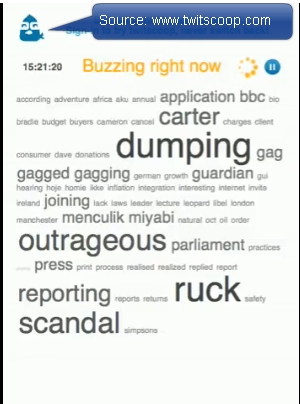
Tweet from @DistantHopes : Holy crap. Unless I miss my guess, check out how the disgraced #Trafigura literally had its name wiped from Twitscoop. [YouTube] #Trafigura on twitscoop.com
Associated Press, The truth is already out there: Twitter users thwart oil company's attempt to gag media.

LONDON (AP) — Bloggers and Twitter users thwarted a legal attempt Tuesday to stop Britain's media from reporting the questions posed by a lawmaker in a parliamentary debate, spotlighting the power of new media to influence public policy.

Alan Brookland, My advice to Trafigura – just wait it out:

Before everyone gets too self-congratulatory, does any of this brief flirtation with online interest ever actually change anything? True, right now, lots of people who had probably never even heard of Trifigura will now be reading up on the dumping story, but, come tomorrow or next week, how many will still remember much about it? The bloggers will chalk up a victory and in this case the gagging order was actually lifted, but this is still an on-going case and nothing will have actually changed.

Sites like Twitter are excellent for catching a wave and occasionally rallying a large number of people behind a cause, but it’s yet to become the force for social change that it’s being made out to be. Real issues sadly aren’t resolved in an afternoon and a normally more complicated than 140 characters. If social media is really going to make the impact that it could, then we all need to keep an eye on the issues which we find important and persue them, not just jump on while it’s in the news and let it quietly die. Nag your MP, pester the mainstream media and ask the annoying questions, not just when the issue is in the news, but repeatedly. It’s only by proving that we can stay interested in an issue that change happens, otherwise people will just wait till the dust settles and everything will stay the same.

[PDF] The letter Index on Censorship sent to the courts in support of the Guardian.

[PDF] Carter-Ruck statement on behalf of Trafigura.

Tweet from @pauloCanning : BBC #Radio4 news *finally (and briefly) reporting #gagcarterruck Fry gets quoted

Mike Butcher for Techcrunch, There’s nowhere to hide if your name trends on Twitter. Is there, Trafigura?

With the traditional media gagged, the new media had kicked in. That created a story which plenty of trad media outlets and blogs outside the UK could not ignore and started reporting on.

In other words, this kind of censorship is over. And I hope that British Libel law will change as a result. It must now move into the 21st Century and reflect new technology. After all, there is now a new defence. Feel libelled? You can defend your case just as much as the other guy online. Except of course if you are dumb enough not to register @carterruck, for instance.

Today's UK Parliamentary questions over #trafigura gag order [YouTube] http://www.youtube.com/watch?v=H_J4ypytxaE

Point of order on the injunction of the Guardian preventing it from printing a parliamentary question

Guardian, Trafigura gag attempt unites house in protest:

Labour MP Paul Farrelly told the speaker, John Bercow, attempts by lawyers Carter-Ruck to gag the media could be a "potential contempt of parliament".

The Liberal Democrat MP Evan Harris said there was a need to "control the habit of law firms" of obtaining secrecy injunctions, and his colleague David Heath told the Commons a "fundamental principle" was being threatened: that MPs should be able to speak freely and have their words reported freely.

On the Conservative side, David Davies criticised the rising use of "super-injunctions", in which the fact of the injunction is itself kept secret. He said courts should not be allowed to grant injunctions forbidding the reporting of parliament.

CharonQC, Lawcast 155: The Guardian Gag affair with Carl Gardner.

Catherine Mayer for Time: Twitter Triumphant: Attempts to Gag Newspaper Are Thwarted By Tweets:

Twitterers across the world colored their avatars green to show support for the protestors who took to Iran's streets after the country's disputed elections earlier this year. Users of the micro-blogging site might now consider overlaying their avatars with a film of sludge brown as a mark of their spontaneous, collective action to help undermine an attempt by the international oil traders Trafigura to gag a British newspaper reporting on a toxic dumping case.

Daily Mail, Law firm's 'Kafkaesque' bid to block reporting of Parliamentary question is defeated - makes no mention of either Trafigura or Twitter!

Professional journal The Chemical Engineer has also been served with an injunction by Carter-Ruck for Trafigura.

Channel Four News report, Parliamentary question ban lifted.
channel four news report

Jon Snow talked to Guardian editor Alan Rusbridger and asked him what had happened after the publication of this morning's paper.

He told Channel 4 News: "The blogosphere went berserk about a story that we published on our front page this morning, in which we said we can’t report a story for reasons we can’t tell you.

"After which there was about 16 hours of mayhem out there in the Twitter-sphere; and about an hour before we were due in court we received a letter from the lawyers saying 'we give in'.

"What has changed was that for the past six weeks we have been faced with an injunction – a so-called super injunction – which not only meant not only could we not tell anyone we had been injuncted, but that we could not mention the company involved either – I think this is a very dangerous phase in English law."

Tweet from @friendsofdarwin No mention of #trafigura or #carterruck on BBC 10 o'clock News. 5 minutes about racehorse's retirement. #bbcfail

Gillian Shaw on canada.com, Twitter backs Guardian newspaper in fight for free speech: A win for all:

Today marked a watershed moment in which social media stepped in to quash an attempt to gag a newspaper.

Guardian, How super-injunctions are used to gag investigative reporting:

Libel lawyers Carter-Ruck and Schillings have proved adept at persuading judges that injunctions should now be granted on privacy grounds. Some tabloid newspapers are being served with "a handful" of such orders each week, according to media lawyers. The Guardian has been served with at least 12 notices of injunctions that could not be reported so far this year, compared with six in the whole of 2006 and five the year before.

The motivation is straightforward, according to Mark Stephens, a partner at law firm Finer Stephens Innocent. "As the libel and privacy capital of the world, people are coming here [to London] to bully the media and NGOs into not reporting on their nefarious activities," he said.

Financial Times, Web’s effect on media law put to test:

Media lawyers, however, focused on the fact that the rulings of UK courts were not enforceable in the US.

Many of the servers hosting websites such as Facebook and Twitter are based in the US, meaning information cannot be suppressed.

Keith Ashby, head of litigation at Sheridans, said: “The difficulty is that injunctions cannot readily be obtained in the English courts against overseas internet service providers which would prevent them making the information available.”

Mr Ashby added: “If people get a whiff that publication of information has been injuncted in the print media, they are getting more canny about how to find the information on the internet.”

Michael Smyth, head of public policy at Clifford Chance, said: “We should not be surprised that the law finds it difficult to keep pace with technological advance and it is no answer in an era when judges are required to act proportionately to make a blanket order directed at the whole world.

“It is common practice for an injunction obtained against one newspaper to be copied to the whole of Fleet Street so that the market is aware of its terms and also bound by it. That’s the easy bit. What, however, of electronic publishers offshore about whom one knows next to nothing?” he added.

Mark Stephens of Finers Stephens Innocent agreed: “The issue with Twitter and SMS [text messaging] is that injunctions are not enforceable as you can’t stop people talking and in any case the servers which host these websites are in the US and outside the jurisdiction of the English courts.”

He pointed out that the order covering The Guardian was enforceable in England and Wales only, meaning that the Scottish and Irish media could report the parliamentary question.

Sunder Katwala on Liberal Conspiracy, Carter-Ruck:0 Guardian: 1… but what next?:

More broadly, wouldn’t it be a good idea to use this enjoyable moment of consciousness-raising to think about how we might sustain our attention and sort out a few deeper issues out too. Others may have a range of ideas. Here are three modest proposals of my own.

Mark Pack discovers that Trafigura have pretty dreadful website which says "This website and its contents are not directed at the general public.".

Tweets from @Danoosha Never seen a thin libel lawyer #newsnight #carterruck #trafigura #fb - @nuxnix BBCNewsnight #trafigura Slightly disappointing report I think this is the day where news media becomes less relevant to the real-time media

~~~~~

On the Wednesday Tory Politico reported Carter-Ruck/Guardian injunction revealed?

The bellow document is believed to be the secret injunction that would have prevented the Guardian reporting parliamentary proceedings yesterday.

Reblog this post [with Zemanta]

Saturday, August 22

Council blogging policy and self-censorship

chilledImage by zachstern via Flickr

Jack Pickard has a great post about policy on council staff blogging, which is sparked by Cambridgeshire making their Social Network and Blogging Policy (below) publicly available.

He notes that it is mercifully brief and written in plain English but points out that the bit which relates back to the council's general policy on how staff behaviour: it is full of hazy statements about 'bring us into disrepute' and 'being libelous'.

There’s a slight difference in implication here. Some [definitions] seem to suggest that any negative statement may be defamation, but it would only become slander or libel under other circumstances (for example, it not being true). I would assume that the Council would be using the term ‘defamation’ meaning ‘untrue and negative remarks’, but this isn’t entirely clear.

After all, if they were simply using it in the ‘negative’ sense only, this would mean that if I was a resident and an employee of a local authority, then I would have less rights to complain about something the Council was doing badly than some other resident would have. And surely that can’t be right.

I agree, it's not right. Council staff do appear to have less rights to voice their opinion of the council than other residents.

As a former journo I well understand that libel can indeed be read many ways and in practice it is the decisions of courts which set precedents.

There was a famous case in Australia where a fat rugby player successfully sued because being called fat would affect his income. I don't know if this precedent was overturned by another Australian court decision (and Australian law has its basis in English law) but we've all seen the rich use 'libel tourism' in English courts to slap the bothersome down.

I also know from my own experience that the vagueness and lack of clear examples of where exactly the council draws the line has a chilling effect - as libel law can - and in practice can mean that council staff become expected to be a-political in their own time, much like civil servants, despite this not being part of the contract they sign up for.

I first became aware of this problem at my previous council job when a manager spoke negatively about my posting comments on a local bulletin board. I was told this had been ‘noticed’ and I ‘had to be careful’. Then I was referred to the ‘code of conduct’ – after I asked what ‘careful’ meant.

This appeared to relate entirely to whether you could complain about the council in a letter to the local newspaper - like most councils I expect they had a neurotic co-dependent relationship with the local newspaper - and could easily be read as saying you couldn’t complain about the state of the flowerbeds.

This had a chilling effect on me because I could see how a manager could use it to threaten anyone who lived in the town as I did and took an interest in local affairs which they didn’t approve of.

In practice a couple of staff I knew were in fact involved in ‘political’ areas locally where clashes with the council happened and their manager’s were OK with it.

I’m certain - I know - that others weren’t either because the policy was so vague, or because it was assumed they shouldn’t get involved. And as almost any civic activity relates to the council in some way I’m sure it would put people off.

I'm sure staff thought of themselves as being policed and regarded in the same way that civil servants are when in fact that's not what the contract is between a council and its workers. I know I did. I simply stopped posting comments on local issues on the bulletin board.

I did point out the problem with managers, the union and even a councilor but none of them understood it as a problem (It probably didn’t help that most staff didn’t actually live in the city) so as far as I know this vague ‘code of conduct’ still exists.

Council staff can potentially have all sorts of comments they make online used against them due to the vagueness not of blogging policy but the age-old and undoubtedly identical contractual 'conduct' policies which they refer to.

As Jack says, yes, having a blogging policy is a great step forward but unless a lot more work is done most council staff simply won't feel free to express themselves online let alone talk freely about their work lives.

Cambridge Shire County Council social media policy

Postscript: In comments on Jack's post two useful additional points.

Richard Taylor notes that the blogging policy applies to staff and councilors and says "I would be very worried if councils tried to stop elected members from criticising their councils."

Karl Limpert comments on my cross-post (my highlight) to the Wardman Wire that:

Unfortunately for employees, disciplinary procedures are & always will be deliberately vague - it’s absolutely impossible to even imagine some of the incidents that do arise as a disciplinary matter.

The ACAS Code of Practice (employers are expected to take this into account when forming & going through a disciplinary process) makes clear that policies should give an idea of the types of conduct that may be minor, serious, or gross misconduct. The final assessment will always rest with managers, but if the employee could not reasonably recognise that their conduct was inappropriate, a warning & necessary training should follow.

“…unless a lot more work is done most council staff simply won’t feel free to express themselves online let alone talk freely about their work lives.” Unfortunately, this work will be in the form of disciplinary action - the policy will evolve as it is called upon, but until the first few cases arise & set precedent on what the treatment is (employers need to act consistently in these processes) the employees will have to venture into blogging unclear about the rules.

Matt Wardman suggests that the Civil Service Code of Practice, which he has written by Tom Watson but I'd tag Jeremy Gould more as author, be used as a model.

On GovLoop its editor says:
I think it can be scary for many to have employees participate online but there is an even bigger risk of us not being part of the conversation. And as the military analogy goes if they train and trust us with rockets and jets, can't they trust us to blog.
Michael Walsh reckons that:
The key here is that the individual cannot represent the organization or disclose legally protected information.
I agree and added that:
What I perhaps am not making clear here is the policy has a problem with what's written. It veers off into legalese to cover this area. The policy should provide here some encouragement and it should be possible to give some examples which 'set the stage'. One could be 'yes, you can link back to our website' or another 'yes, you can comment about services as a resident but don't discuss your job'.


Reblog this post [with Zemanta]

Thursday, August 14

Another UK blogger censored


Sensing a theme?

Matt Wardman has alerted me to the story of Phil Groom, who is yet another blogger being censored for free speech in the UK (where's that Bill of Rights?)

Phil used to work for the SPCK chain of Christian bookshops, which is owned by people not some benevolent, holy authority, and they appear to be behaving as many 'owners' do - i.e. like pigs towards the staff.

The Brewers then started screwing people’s contracts around, trying to impose new terms of employment that didn’t comply with UK employment law. They also started to narrow down the range of stock and stopped paying their suppliers.
Phil has been blogging about this and, like with Arsenal's suitor, The Brewers then started throwing the legal letters around.

Always a giveaway when there's something to hide.
Dave Walker and myself had each been independently reporting on the story on our websites and this year I set up a separate, dedicated blog to allow for more focused reporting and discussions. Unfortunately the Brewers didn’t like people talking about the way they were running things etc so they decided to try and nail us down by sending out ‘Cease and Desist’ (C&D) messages threatening legal action if we didn’t take down our websites.
Now there's a very obvious irony in me defending Christian bookshop workers right to whinge but ... what's that Voltaire line again? (Or was it actually Evelyn Beatrice Hall).

Wednesday, June 25

“I f****** hope he dies"


A few days a go a woman walked free from a Liverpool court after she'd killed her husband.

He hadn't bashed her.

He hadn't abused her.

He'd told her he was gay.

When I first saw this story on the PinkPaper website I started a Google Alert monitor and apart from the initial local BBC story nobody else has covered it.

This is the PinkPaper story (the local BBC story misses a few crucial bits), and the lack of coverage/interest says everything about the actual position of LGBT in the UK today.

Christine McGreavey, who told police: “I fucking hope he dies,” shortly after her arrest, stood trial for the murder of Barry Parkin after the incident in January.

She was also found not guilty of manslaughter at Liverpool Crown Court.

McGreavy, 48, formerly of Manorbier Crescent, Walton, Merseyside, denied the charges.

Prosecutor Richard Pratt QC told the jury Parkin had initially tried to cover for the mother of his daughter, but, as the 48-year-old realised he was dying, admitted to paramedics that McGreavy had “lost it” and stabbed him in the chest.

McGreavy said the incident happened during a row about his sexuality. Police were called to Parkin’s home at 9.20pm on 6 December after he staggered to a neighbour, covered in blood and requesting help.

Allegedly, he came out of the kitchen with a knife pointing towards his chest. She lunged forward and accidentally “bumped” the knife into his torso. The knife pierced his heart which slowly filled with blood. He died five hours later in Fazakerley hospital.

McGreavey later apologised at the police station, telling officers she had acted in self-defence. “I just flipped,” she said. “I just found out today that the father of my child is gay.”
Liverpool Echo has more, more.
Mr Pratt told the jury Mr Parkin initially told officers he had been attacked on Rice Lane. But as he travelled to hospital he asked the paramedic if he was going to die, and said it was his former girlfriend McGreavy who attacked him.
Sure sounds like gay men are fair game for murder to me.

Tuesday, June 17

Getty and copyright and threats


HT: Dom Latter

Some people on my local list are all of a tizz because they were getting threatening letters with £800 bills attached from Getty Images - Corbis also does this. Dom Latter reminded people that, no, Getty cannot 'name their price' (my precis of his points follows).

Because it's copyright infringement, all they can do is sue (for loss of earnings). To his knowledge - and feel free to correct me - this process has now been going on for many years without anyone actually being taken to court during this period.

As a layman, I don't see how an invoice for an abitrary amount can be made to stick in the absence of a contract; Getty are of course free to claim damages for the infringement of their copyright, but it would appear that they don't,

out-law
makes it clear that they cannot sue for "additional" damages, in the case of *unwitting* infringement.

In addition, Dom provides links to cases of people who "got caught and got out of it".

http://www.sitepoint.com/forums/showthread.php?t=390902
http://www.sitepoint.com/forums/showthread.php?t=445041
http://www.guardian.co.uk/technology/2007/feb/01/copyright.newmedia
http://finance.groups.yahoo.com/group/gettycrackdown/
http://groups.google.com/group/help-for-victims-of-getty-images?hl=en

Monday, June 16

Associated Press backs down

That was quick.

On Saturday, The A.P. retreated. Jim Kennedy, vice president and strategy director of The A.P., said in an interview that the news organization had decided that its letter to the Drudge Retort was “heavy-handed” and that The A.P. was going to rethink its policies toward bloggers.

The quick about-face came, he said, because a number of well-known bloggers started criticizing its policy, claiming it would undercut the active discussion of the news that rages on sites, big and small, across the Internet.
Apparently they will ...
attempt to define clear standards as to how much of its articles and broadcasts bloggers and Web sites can excerpt without infringing on The A.P.’s copyright.
Must be something to do with blogosphere's reaction. Oh, and this:
Timothy Wu, a professor at the Columbia Law School. Mr. Wu said that the case is not clear-cut, but he believes that The A.P. is likely to lose a court case to assert a claim on that issue.

More: Jeff Jarvis has a couple of good lines in a piece that sounds like a Family Guy script:
The AP is still trying to preserve its way. But, as I often say, protection is no strategy for the future. In the story - which, note, I’m only summarizing here, without the quotes from the AP that might better state its stance (ahem)

.......

Where’s my Reuters T-shirt?

Thursday, May 15

West Midlands Police finally apologise ...


... but only after being taken to court.

Last year I covered how Channel Four's 'Dispatches' sent undercover reporters into British mosques and filmed preachers saying amongst other things:

“Do you practise homosexuality with men? Take that homosexual man and throw him off the mountain.”

“If I were to call homosexuals perverted, dirty, filthy dogs that should be murdered, that’s my freedom of speech isn’t it? They’ll say: “No”, I’m not tolerant. But they feel that it’s okay to say something about the Prophet.”

"Whoever changes his religion from Al Islam to anything else – kill him"
And how, after a ridiculous 'investigation', West Midlands Police (and the Crown Prosecution Service) instead of prosecuting these people for inciting violence made a complaint to Ofcom about the editing of the programme claiming it was 'stirring up racial hatred'. A complaint which itself was technically odd.

I noted that this was the same police who had a fraught relationship with their local gay and lesbian community.

And how police in general had had to be forced into taking action against murder music, dancehall reggae which is all about how to kill gays and lesbians.

I even found myself on the same side as the Editor of the Daily Telegraph, Charles Moore, who said:

I do not know whether the Dispatches programme is right in every detail. But it clearly raises serious, important questions - about extremists in our midst, about the way apparently moderate organisations give them shelter, about the Saudi Arabian network that supports them.

What security agencies call "thematic analyses" show that, at present, the problems of Islamist extremism are particularly acute, especially in prisons and universities, in the West Midlands area.

Yet the West Midlands police and the Crown Prosecution Service decide that the target of their wrath should be not people who want to undermine this country, but some journalists who want to expose them.

Are they fit to protect us?

Late last year, Ofcom threw the complaint out and Channel Four then decided to launch a court action for defamation.

Andy Duncan, Channel 4 chief executive, said at the time:
West Midlands Police acted in a calculated fashion - they made no attempt to discuss their concerns about the film with us in advance of going public with their complaint to Ofcom knowing that an allegation of 'fakery' would generate significant media interest. Their action gave legitimacy to people preaching a message of hate to British citizens.
After being dragged to court, this apology and £100k payout is the result (half of the payout covers costs, the other goes to the Rory Peck Trust for freelance news gatherers and their families in times of need).
Following an independent investigation by the broadcasting regulator Ofcom, we now accept that we were wrong to make these allegations. We now accept that there was no evidence that the broadcaster or programme makers had misled the audience or that the programme was likely to encourage or incite criminal activity. A review of the evidence (including untransmitted footage and scripts) by Ofcom demonstrated that the programme had accurately represented the material it had gathered and dealt with the subject matter responsibly and in context.

We accept, without reservation, the conclusions of Ofcom and apologise to the programme makers for the damage and distress caused by our original press release.
[CPS apology]

I think they should apologise to the gay and lesbian community - infact the whole community - as well, for 'wasting police time'.

The people who were responsible and should suffer some consequences are:
  • CPS lawyer, Bethan David
  • Assistant Chief Constable of the West Midlands Police, Anil Patani
  • West Midlands Chief Constable, Paul Scott-Lee
Amongst others who weighed in against Channel Four were
  • The secretary general of the Muslim Council of Britain, Muhammad Abdul Bari
  • Press spokesperson of the Muslim Council of Britain, Inayat Bunglawala
I would also be interested to know who, if any, of Birmingham's MPs supported Channel Four.

And whether any prosecutions for 'incitement to violence' against the hate preachers exposed in the documentary will ever follow.

Monday, May 12

French legal shocker


This is bizarre. Richard Best reports that in an Out-Law podcast they carried the news that a French court has decided you're liable for libelous RSS feeds you carry.

The Court didn't agree that sites had no control over what was automatically updated, they didn't accept no 'editorial control'.

Richard says:

Under New Zealand law [which is based on English law], there is not necessarily a ubiquitous answer to the question of whether populating one’s website with third party content - via an incoming and automatically-updating RSS feed - that breaches someone else’s rights, will render the website owner liable to that “someone else”. It is likely to depend on the nature of the offending content, the cause(s) of action to which publication may give rise and the possible defences to those causes of action. So, for example, causes of action could include defamation, breach of copyright, invasion of privacy or breach of confidence. Also potentially relevant in some cases will be whether the website owner added the RSS feed to its site itself, or allowed site users to add an RSS feed (as is now possible with some web services).

He doesn't see the decision as a bad thing, more about the web 'growing up', and suggests that aggregators/website owners "seek warranties and/or indemnities from the feed providers" — I just can't see this happening until there's a US case.

Saturday, May 10

Google Reader clips catch up


Not on Reader:
  • barackobamaisyournewbicycle
    Neat timewaster — 'Barack Obama wanted you to have some cupcakes ... Barack Obama recited a poem that reminded him of you .... '
  • Barack Obama delegates wiki
    Not been done before - really. Another outcome of the Obama method, they did this themselves, learning from previous campaign efforts and nobody came from HQ and took them over ...
  • Ya Libnan Lebanon News Live from Beirut
    Breaking News Live coverage of the Situation in Lebanon - 'liveblogging', indeed.
  • Networks reportedly refused to appear on PBS' NewsHour to respond to NY Times' military analysts story; several continue blackout
    MediaMatters documenting just how the US TV News networks are trying to kill the story off, blogosphere is keeping it alive and kicking.
  • Killing by the numbers
    Shocking tale from Iraq
    'In 2007 elite U.S. snipers executed an unarmed Iraqi prisoner in cold blood. Have the insidious tactics that led to atrocities in Vietnam reemerged in Iraq?'
    'Top battalion leaders, who had to sign off on the charges, have faced no serious questions about whether their demand for more bodies, their vague rules of engagement or the confusion sown by the secret program might have contributed to the events of spring 2007.'
  • Political Commentariat in Group Circle Jerk
    Iain Dale, with top political bloggers list: 'The one thing which the report immediately provokes me into asking, is just who the Commentariat influences apart from its own members? How many 'normal' people are influenced by newspaper leader columns or indeed blogs? Do we all not feed each other in some amorphous way rather than be a crucial individual influence on a particular debate?'

  • Face to face with climate change
    The Sun is running a blog from Alaska in their Climate Change section. Stop spluttering. Good stuff and a great object lesson in Plain English.
  • The Visible Man: An FBI Target Puts His Whole Life Online
    HT: Stephen Colbert!
    Hasan Elahi is tracking his entire waking moments online at trackingtransience.net.Why? Because he was once mistakenly picked up by the FBI.
    'So it dawned on him: If being candid about his flights could clear his name, why not be open about everything? "I've discovered that the best way to protect your privacy is to give it away,"'
    'For now, though, Big Brother is still on the case. At least according to Elahi's server logs. "It's really weird watching the government watch me," he says. But it sure beats Guantanamo.'
  • When Democrats Go Post-al
    James Wolcott in Vanity Fair: 'The vicious Clinton-versus-Obama rupture at Daily Kos, the most activist site in the liberal blogosphere, reflects a party-wide split. What really rankles, as Democrats tear at one another, is the free pass they’ve given McCain—and the White House.'
  • Young Video Makers Try to Alter Islam’s Face
    New York Times: 'When Ali Ardekani started fishing around on the Internet a couple of years ago for video blogs about Muslims, he did not like what he found: either the world’s 1.3 billion Muslims were depicted as bloodthirsty zealots, or they were offering defensive explanations as to why they were not.'
    “Arabic sounds foreign and scary — you don’t know what is going on,” Mr. Ardekani said in an interview at his small Sherman Oaks apartment, its walls decorated with Koranic verses. “Or they show a woman with the veil, who doesn’t speak, and it is assumed if she did speak she would say, ‘Help me!’ ”

Saturday, May 3

Tesco's employs corporate muscle


After sicing the lawyers on Thai critics, Tesco is now suing the Guardian for having the temerity to discuss their tax arrangements.

The St Albans Stop Tesco Group says it all:

As we've said before about Tesco, and this applies just as much to its ongoing other libel suit in Tesco (here's the latest news on this), the issue for us isn't so much what Tesco does - it is the fact that it can afford to spend money on legal writs and tax avoidance that smaller shops can't.

Local newsagents, grocers and market traders would love to reduce their tax demands by using overseas companies and hiring expensive tax experts - but they can't afford to. Tesco can, and can then use the tax savings to both improve its massive profits, and cut prices to drive local competitors out of business. So there goes any sense of a level playing field...

Friday, April 11

Why suicide prevention charities are idiots


Another rubbish piece of web reporting from the BBC (and now all over) - only because it has a medical/doctor aura it's accepted as gospel.

People searching the web for information on suicide are more likely to find sites encouraging the act than offering support, a study says.

Researchers used four search engines to look for suicide-related sites, the British Medical Journal [BMJ] said.

The three most frequently occurring sites were all pro-suicide, prompting researchers to call for anti-suicide web pages to be prioritised.
'Frequently occurring ' means bugger all. The vast, vast majority of searchers don't get past the first ten results and most of those don't get past the top three

I cannot know what exactly their methods were because this information isn't in the public domain - it's behind a payment firewall. (NB: Postscript below - terms and full research is now available)

So unless they send me the research, I (or joe/jill public) has no way of countering this biased reporting and what appears to be shoddy research except what's in this article and what we can guess happened.
The researchers, from Bristol, Oxford and Manchester universities, typed in 12 simple suicide-related search terms into the internet engines.

They analysed the first 10 sites in each search, giving a total of 480 hits.

Altogether 240 different sites were found. A fifth were dedicated suicides sites, while a further tenth were sites that gave factual or jokey information about suicide.

Meanwhile, 13% of sites were focused on suicide prevention while another 12% actively discouraged it.
Well I just did a Google search - 70% of UK web searches, mostly to google.com rather than google.co.uk - on 'suicide' (NB: with 'safesearch' off) and Wikipedia was #1, as usual. Yes, this includes a link to a 'suicide methods' page - it's an encyclopedia. It also has a page about torture and one on necrophilia. What do they propose to do about that? Have Wikipedia be filtered through a charity? Or the government?
  • the next result directs people to the Samaritans
  • next is suicide.com, run by an author called Melody Clark - doesn't appear to be 'encouraging it' from what I saw
  • then news sites links
  • then Mind's website
  • then Stanford Encyclopedia of Philosophy
  • then a page from kidshealth.org
  • then a page from SOON Ministries (anti)
  • then a Times article
  • then netdoctor
Alongside this were a number of text ads from suicide prevention charities, including Samaritans but mainly small or religious ones, and one business ('Cremated ashes made into glass: "Keep the memory"'). I scanned Yahoo and MSN - almost exactly the same.

On google.co.uk, Mind is #1, some smaller charities appear as well as the BBC but otherwise it's similar to google.com. The Samaritans are way, way down - they need the text ad - and Sane not in the first 100 results.

The article isn't telling me what the other terms used were. But I can run a keyword suggestion tool. That gives me (for UK market) the number of daily searches for the particular keyword :

suicide 7788
suicide girls 4921 - a band
suicide girl 438 - fans of that band
teen suicide 429
how to commit suicide 408
suicide methods 375
assisted suicide 349
suicide poems 237
teenage suicide 205
physician assisted suicide 190

As you can see, searches on the simple term 'suicide' are far more prevalent and this list is almost identical to the USA's. As I don't have the details on these 'twelve terms' they researched I don't know what the prevalence/total number of searches on them actually are, let alone if that can be broken down by age group by any method. But I can guess that metric didn't feature in the research.

'How to commit suicide'

Again, Wikipedia, news and religious sites make up the top ten for 'how to commit suicide' on google.com. Only at #9 do I get a website about suicide methods. And this is a very long tract by anarchists. Further down there's the Hemlock Society and some others

These top tens change. Particularly because 'freshness' is more of a consideration than it used to be - hence news results. These researchers don't mention video, but that is now prominent in Google results (the ones in results are all jokey).

Notably, no UK charity like the Samaritans and with the exception of Mind shows up until way down the list on that search term on google.com or google.co.uk.

On both google.co.uk and google.com the Samaritans and some smaller charities and businesses advertise and survive.org.uk appears also in top ten search results on google.co.uk though these are dominated by news.
Lead researcher Lucy Biddle said that because of the law, self-regulation by internet providers and the use of filtering software by parents were the main methods used to try and prevent use of pro-suicide sites.

But she added: "This research shows it is very easy to obtain detailed technical information about methods of suicide."
Yes, if you are determined to find it you will find it. Doh! Just like bomb making recipies and rants against the Chinese government if you are Chinese in China. Filtering software is notoriously about sales and fear and only really 'works' with white lists or massive over-blocking/policing ('Great Firewall').

Her research did not demonstrate that finding pro-suicide websites is "very easy". Contrary to assumptions, I haven't seen evidence that shows that kids and teens are that much better, if at all, at finding things online using search engines than anyone else.

What I can say is that searches for 'suicide' are going down. This is a Google Trends search using the terms 'suicide -attack -Iraq -Afghanistan' to roughly exclude suicide bombers (I checked common keywords in news reports).


This does not include the press coverage of the Bridgend, Wales suicide cluster from earlier this year tied to peaks, because that volume is too low to display in that graph, but would likely be responsible for the early 2008 peak. See 'Bridgend' vs 'suicide' below.


For general searches for 'suicide', the general trend appears to be clearly down. Some good news you won't read in reporting.

Apart from no numbers on what the actual usage is of 'pro-suicide' sites, another point is whether the websites which charities and government create are actually helping kids and teens. I don't know but I'd like to - there's obviously nothing about that in this research, why some kids and teens might be turning to these sites they want to ban in the first place instead of 'official' ones.
She said internet service providers could pursue strategies that would maximise the likelihood that sites aimed at preventing suicide are sourced first.

Marjorie Wallace, chief executive of the mental health charity Sane, agreed something should be done.
Well
  • how about running your ads next to more search terms than just 'suicide'. (Only Sane isn't doing any in the first place.)
  • Or employing some Search Engine Optimisation specialists to make sure that your pages come up first. They might even do it for nothing or just the publicity.
  • Or working with other charities to make sure you cover every possible term and intervene via content and ads on other sites or through social networks (simply creating a page on Mind's website, already high-up results, which is titled 'How to commit suicide' would immediately help).
  • Or fixing your own website where the first result on a search for 'suicide' is 'The National Suicide Prevention Strategy report'.
Here's the beef - I would class the actions of such charities in making NO effort to ensure that their pages turn up tops on such search terms as 'How to commit suicide' as IRRESPONSIBLE. There are no excuses and to behave as if this is someone else's responsibility - let alone ISPs - is childish and pathetic PLUS it lets down kids and teens. Yes, this makes me very angry!
"We remain deeply concerned about the possible influence of the internet on suicide rates, not least the ease with which information about particular methods can be found with a simple web search."

"These sites are preying on vulnerable and lonely people."
And you, Marjorie Wallace, are not doing your job properly, you are failing the very kids and teens you claim to be helping and you are simply looking for someone else to blame.

As for the BMJ and these so-called researchers ... and as for the BBC. Who the heck do they think this actually helps? This is badly researched scare mongering.

This is exactly what happens when you set up walled gardens and fail to relate to the wider web - I am not seeing the NHS or government portal directgov anywhere in these results and that 'can't be bothered' mentality dominates the charity sector as well.

Hardly surprising when the 'National suicide prevention strategy for England' contains no mention of either the web, the internet or even chatrooms.

The same goes for health information for teens and kids on a wider scale than just suicide prevention - we're looking at an abdication of responsibility online and a willingness to blame others.

What Sane and other charities should do:
  1. Talk to the search engines, they are very interested in getting results right and can and do 'tweak' them. They won't 'censor' sites or stop indexing the whole web but they will help and advise on improving positioning.
  2. Don't talk to the ISPs! Talk to the search engine experts such as the Search Marketing Association.
  3. Talk to social networks about teaming up with them and others to create widgets and other tools so kids and teens can help others.
As well, these people would probably do it for free or cheaply. It would be very straightforward to out-manoeuvre the sites you hate online. What resources do they have vs. what resources do you have?

But for kids sake stop behaving with fear and horror about the web and start using it rather than expecting someone else to do your job.

I am afraid that none of these people are listening, though, (the news media is already known to be a bigger encourager of suicide than the web). What they are developing is an righteous effort, like has happened in Australia, which will result in a censored Internet for all of us - and no real help for those they claim to be helping.

~~~~~

Postscript: I have submitted a response to the BMJ, pointing them to this blog post. I have also written to Marjorie Wallace of Sane pointing her to this blog post and making plain that I would freely offer my help and contact others willing to help them improve their search positioning and online help for the suicidal.

Postscript: An anonymous commentator says that the 12 search terms were:
a) suicide; (b) suicide methods; (c) suicide sure methods; (d) most effective methods of suicide; (e) methods of suicide; (f) ways to commit suicide; (g) how to commit suicide; (h) how to kill yourself; (i) easy suicide methods; (j) best suicide methods; (k) pain-free suicide, and (l) quick suicide.
And those showed:
Top 4 sites were Alt Suicide Holiday, Satan Service, Suicide methods.net and wikipedia. In that order first 3 were catigorised as pro suicide wikipedia as Information site: factual.
But as you can see from the keyword search numbers above only 'how to commit suicide' and 'suicide methods ' are frequently used search terms and both are dwafted by searches on 'suicide'.

The daily search numbers for 'how to kill yourself', 216. But for 'suicide poems', not a term they used, 237. 'Suicide sure methods' (Used), 0. 'Most effective methods for committing suicide', 0. 'Methods of suicide' is exactly the same term as 'suicide methods'. 'Ways to commit suicide' 158. 'Easy suicide methods', 11. 'Pain-free suicide', 0 (But 'painless suicide methods', not used, 53). ' Quick suicide', 4.

'Suicide', 7788.

If these are indeed the variants, by what method were those twelve search terms picked? It doesn't appear very scientific, unless I'm missing some additional information.

And none of this lets charities (or government) off the hook because churches and others are already in there topping results by generating links and picking page titles which put them at the top for terms which are searched on.

Postscript: The full text of the article has now been made available on the BMJ website.

This says:
Search strategy
We sought to replicate the results of a typical search that might be undertaken by a person seeking information about methods of suicide. We conducted searches using the four most popular UK search engines and 12 broad search terms—a total of 48 searches. The terms entered were those likely to be used by distressed individuals, determined partly from interview data collected in an ongoing qualitative study of near-fatal suicide attempts and by using search suggestions provided by the engines upon entering terms such as "suicide."
There isn't any further detail on just how they could know what search terms were actually entered 'by distressed individuals' as opposed to ones without distress or how relevant 'interview data' would be in working that out. My look at keywords suggests that they picked the wrong ones anyway and to include both 'methods of suicide' and 'suicide methods' is just inept.

I repeat that the conclusions of the study don't match any real data on what 'distressed individuals' might search on, let alone which terms are most frequently used (a metric which was clearly irrelevant in this study), let alone what we know about search patterns - the sort of information which has been researched to death because it has commercial value, let alone which search engine they probably used. The tenth in a top ten of search results is far less likely to be clicked on than the first, just to pick one example, yet their 'results' are predicated on them having the same value. There is clearly very little understanding of search behaviour by these researchers and this renders all the rest of the study entirely meaningless.

If they had even bothered to ask some of the search marketing/search optimisation specialists probably around the corner from them, or possibly even within the same universities, they would have realised that their methodology doesn't show anything. But as a result of this article being in the hallowed BMJ we now have headlines around the world.

I would suggest that this article devalues the BMJ itself as a source of scientific information unless it is withdrawn. There was nothing scientific about this study.

This is not to say that analysis of how search may contribute to actual suicide isn't valuable, but it needs to be done by specialists who can use the tools established by the industry to track and analyse which sites are the most dangerous and where the traffic to them is coming from - it may well not be primarily search. That could be done. As well, as I have explained at length, the best course is a concerted effort by charities and government to direct 'distressed individuals' to websites which can really help them.

Postscript: I actually got Google search share wrong. It's not 70%, it's 86%. And most of those are to google.co.uk rather than google.com - which has changed dramatically from the last time I looked at this, presumably because Google is getting better at presenting more relevant results and presenting .co.uk because it knows that's where you're searching from.

Postscript: In a comment, Graham Jones who runs the Internet Psychology web site, says that he met some people who were connected to the research and "they were suitably embarrassed in private when I pointed out the simple flaws in the research". Another critic of the research is John M. Grohol, Psy.D. at the PsychCentral website.

Wednesday, April 2

Google Reader clips catch up


Way behind with a catch-up, so a long list :[

Also: This was released on April 1st, but is apparently serious! Antarctic Polar Bear Relocation to Begin on Earth Day. Some Americans want to move thousands of them to the edge of the Ross Sea near Emperor Penguin colonies trapped by recent movement of giant icebergs . Nothing on the site about unexpected impacts - like happened with rabbits and foxes in Oz. Project is supported by oil drillers ('we're fed up being attacked') and 'Americans for tax reform' ... and lots and lots of American 'liberals'. Gore has his work cut out.