This is a stunning graphic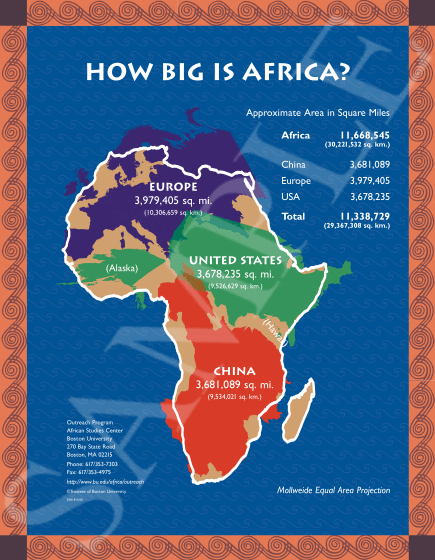
HT: Owen Barder
Showing posts with label maps. Show all posts
Showing posts with label maps. Show all posts
Wednesday, September 9
Tuesday, May 19
Your emissions are killing me

These two maps show, firstly, the world in terms of carbon emissions and, secondly, the world in terms of mortality as a result of climate change.
They come from a study published in the Lancet (pdf / more).
Humbled somewhat?
In an editorial (registration required) the Lancet identifies:
- an astonishing lack of knowledge about how we should respond to the negative health effects of climate change
- we have an immense task before us to address the inadequacies of health systems to protect people in countries most at risk
- technologies have to be developed out of greater research investments into climate change science, better understanding about how to deliver those technologies in the field, and a more complete appreciation of the social and cultural dimensions into which those technologies might be implanted
- there is a political challenge in creating the conditions for low-carbon living
And it says:
Too many doctors have been silent for too long about the importance of climate change to the future of health and health services.HT: Ezra Klein
Thursday, March 19

Tuesday, January 27
Change you can believe in

Obama promises 'transparency'. Obama delivers 'transparency'.
At least as far as Google Maps is concerned.
Cheney (aka 'Dr Strangelove') has spent the past few years under a blur. His official residence, the Naval Observatory, hidden from close, satellite inspection.
No longer.
Google announced yesterday:
Our most recent update, which went live last week, included updated imagery of the Washington D.C. area from several providers. The imagery of the Naval Observatory comes from Digital Globe.And they're unblurred.
Remember, this is the guy who - secretively (he thought) - invented his own logo.
Tuesday, November 18
"I think we should kill Obama"

Not a good sign. The election is bringing out the racists. As black people feared, way back in the primary.
From Mudflats, reporting from a town next to Palin's Wasilla:
The event was supposed to be for all parties, for all people, but it didn't feel like it. I was shocked and offended. The event was supposed to be for supporters of Senators Obama and McCain and no one paid respect to President-elect Obama's historic moment. Finally, another step toward complete equality and it seemed no one cared.From the Christian Science Monitor:
So the next day I borrowed my mother's Obama shirt and walked into school wearing my pride on my chest. Finally the campaign was over and I was actively supporting our new president, even though I knew I would be vastly out numbered at school. I expected complaints and qualms about the new president, but I was not prepared for the flat-out racist remarks said openly in the halls and classrooms. I was appalled. While I sat at my desk trying to do my work I could hear my fellow classmates:
"I think we should kill Obama," one said.
"I hope someone comes up and shoots him in the head," another would say.
"I hate Obama ... he's black."
On went the racist words for the full 80 minutes of that class. Angered, I began to think of the injustice of it all and the ignorance of the students I was surrounded by. I wondered where they learned to be so hateful, and I wondered why the teacher never stepped in - why no adult, no student, including myself, had the guts to cut in and say it was not OK. Because it's never OK for intolerance. It is never OK to cut someone down and dehumanize them because they do not look like you, or think like you, or talk like you, or worship the way you do.
The election of America's first black president has triggered more than 200 hate-related incidents, according to the Southern Poverty Law Center – a record in modern presidential elections. Moreover, the white nationalist movement, bemoaning an election that confirmed voters' comfort with a multiracial demography, expects Mr. Obama's election to be a potent recruiting tool – one that watchdog groups warn could give new impetus to a mostly defanged fringe element.Don't say you weren't warned ...
Most election-related threats have so far been little more than juvenile pranks. But the political marginalization of certain Southern whites, economic distress in rural areas, and a White House occupant who symbolizes a multiethnic United States could combine to produce a backlash against what some have heralded as the dawn of a postracial America. In some parts of the South, there's even talk of secession.
"Most of this movement is not violent, but there is a substantive underbelly that is violent and does try to make a bridge to people who feel disenfranchised," says Brian Levin of the Center for the Study of Hate and Extremism at California State University, San Bernardino. "The question is: Will this swirl become a tornado or just an ill wind? We're not there yet, but there's dust on the horizon, a swirling of wind, and the atmospherics are getting put together for [conflict]."
At least two white nationalist websites – Stormfront and the Council of Conservative Citizens – report their servers have crashed because of heavy traffic. The League of the South, a secessionist group, says Web hits jumped from 50,000 a month to 300,000 since Nov. 4, and its phones are ringing off the hook.
"The vitriol is flailing out shotgun-style," says Mr. Levin. "They recognize Obama as a tipping point, the perfect storm in the narrative of the hate world – the apocalypse that they've been moaning about has come true."
"We're not looking at a race war or anything close to it, but ... what we are seeing now is undeniably a fairly major backlash by some subset of the white population," says Mark Potok of the Southern Poverty Law Center's Intelligence Report in Montomgery, Ala. "Many whites feel that the country their forefathers built has been ... stolen from them, so there's in some places a real boiling rage, and that can only become worse as more people lose jobs."
In an election in which barely 20 percent of native Southern whites in Deep South states voted for Obama, the newly apparent political clout of "outsiders" and people of color has been unnerving to some.
"In states like Mississippi, Louisiana, and Alabama, there was extraordinary racial polarization in the vote," says Merle Black, a political scientist at Emory University in Atlanta. "Black Americans really do believe that Obama is going to represent their interests and views in ways that they haven't been before, and, in the Deep South, whites feel exactly the opposite."
But for nonviolent secessionist groups like the League of the South, the hope is for a more vigorous debate about the direction of the US and the South's role in it, says Michael Tuggle, a League blogger in North Carolina.
Mr. Tuggle says his group isn't looking for an 1860-style secession but, rather, a model that Spain, for one, is moving toward, in which "there's a great deal of autonomy for constituent regions" – a foil to what is seen as unchecked, dangerous federal power in Washington.
"To a lot of people, the idea of secession doesn't seem so crazy anymore," says Tuggle. "People are talking about how left out they feel, ... and they feel that something strange and radical has taken over our country."
Sunday, June 1
Scrapbook clips catch up
Scrapbook is the Firefox extension I use to quickly capture either a whole page or a text selection. It's not, yet, online - meaning that I can't access clips anywhere - but much more useful for my needs than del.icio.us.
Accessibility, two new useful resources.
- Shape Shed on How to make websites more accessible for users with Intellectual Disabilities.
- Jack Pickard on WCAG 2.0 and Accessibility for older users.
Epilepsy charities condemned Russell Barth andChristine Lowe's YouTube seizure video as a "freak show". Not so, say the couple: the movie has saved lives.What is it with charities and the web?
Since posting this footage, we have had over 254,000 views (23 times more hits than the next-most-viewed clip), and have received dozens of emails from people asking for advice in reducing seizures, and hundreds of positive comments about our bravery and compassion.
This footage has been used in medical schools and presentations around the world, and a prison in New Mexico has even used it to help new guards recognize real seizures. Another man in Fort Worth, Texas emailed us to say that our video helped him save another person who had a seizure while at his place of work. Our video has saved lives.
Wired's Wiki on how to set up an online pirate radio station.
From the US, UK egov read this and weep:
More than 400 government Web managers from across the country are meeting this week at the fifth annual Government Web Managers Conference, co-sponsored by the U.S. General Services Administration (GSA) and the Federal Web Managers Council. This year's conference focuses on new collaborative technologies that allow agencies to work together to create and deliver better Web content for citizens. The Web Managers Best Practice Awards were presented as part of the conference on May 5, recognizing six exemplary federal Web sites.From Public Sector Forums (.gov.uk only):
The Cabinet Office is currently embroiled in a huge behind-the-scenes row with the Treasury who they are accusing of failing to sort out tax rules on VAT on shared services for the last two years. Although some public bodies are VAT-exempt, buying shared services incurs 17.5% VAT which they cannot recover. The Cabinet Office, along with many other departments, believes this is one of the two single biggest barriers to shared services, is wrecking business cases for shared services and costing the public sector more than £200 million per year in lost potential efficiency savings.Others have reported how Gordon Brown talked up the Internet at a Scottish faith gathering. Here's how the Express reported it:
To many it is a talking shop or a playground for perverts. But for Gordon Brown the internet is a new force for global good.Gordon Brown's speech to Google Zeitgeist:
Churchill once said that those who try to build the present in the image of the past will miss out entirely on the future. And he also warned about people who were facing change, resolved to be irresolute, he said, adamant for drift, solid for fluidity, and all powerful for impotence - and that is a warning to all of us.What was clear from his speech and answers to questions, though, was that although Downing Street will be webbie he doesn't understand how this isn't flowing down through Whitehall and local government. Now why is that?
Chairman: So am I right in paraphrasing that that you expect the web to drive more responsibility and accountability to our elected leaders?
Prime Minister: Yes.
Chairman: And will we see a lot more 'coups de blogs' and 'coups de social networks'?
Prime Minister: 'Coups de blogs' and 'coups de texts', yes!
Those new online maps from DEFRA showing noise in the UK managed to crash on their first day.
On FutureMajority a neat explanation of the ancient rules which stop the US Congress from doing anything on YouTube or social networks.
Franking Rules state that unless you're in the leadership you can't use anything outside the House/Senate firewall. So, YouTube is technically not ok (even though most members are pushing the envelope), no Facebook, or Myspace... nothing…The article points out how far behind Downing Street the US is.
The Atlantic magazine on how Obama's use of the web has produced The Amazing Money Machine.
Whenever I think about the quarter billion dollars he has raised so far, the image that leaps to mind is Scrooge McDuck diving joyously into his piles of gold.Picking up my Google Reader clip on being aware of sadists at the US border - Taking your laptop into the US? Be sure to hide all your data first, The Guardian reported.
They can take your computer and download its entire contents, or keep it for several days. Customs and Border Patrol has not published any rules regarding this practice, and I and others have written a letter to Congress urging it to investigate and regulate this practice.When the New York Times reported on the Pentagon's use of retired generals as 'experts' to push propaganda onto US TV networks, they did so from FOI releases of thousands of documents and audio. This huge archive was then put on dailykos for others to hunt through and it's turned up gem after gem, such as this one from audio of Donald Rumsfeld:
But the US is not alone. British customs agents search laptops for pornography. And there are reports on the internet of this sort of thing happening at other borders, too. You might not like it, but it's a fact.
RUMSFELD: [Iraqi militias] know the center of gravity of the thing is here in the United States. It isn't out there. And they're designing their attacks to have maximum effect politically, to weaken the will of the American people. Doing a pretty good job. Hell of a lot more skillful at it than we are. Have a lot greater flexibility. They can lie. Don't have bureaucracy. They have media committees that they operate to manipulate the media. And they do it very skillfully. (mp3)In the wake of the earthquake, Shanghailist carried the Chinese government's order for websites to 'go dark' for three days national morning:
To all propaganda departments, online propaganda units and foreign affairs offices, and to the various bureaus and websites in all cities and counties:
The State Council has gazetted May 19-21 as national days for mourning. In line with the spirit of the Central Foreign Affairs Office's emergency notice, the requirements are as follows ...
Ethical Corporation Magazine on how the exposure of Yahoo's complicity with Chinese censors has had a positive effect
Former Chinese dissident Harry Wu is administering the new Yahoo human rights fund. As John O’Reilly, a leading human rights commentator, said of the letter to Condeleeza Rice: “This is the first time a company has been so explicit in its condemnation of human rights violations and this, together with the establishment of the new fund, is pretty ground-breaking stuff.”Same magazine has a feature on Olympics 2008: Beijing games – Sponsors enter rings of fire
Sponsoring companies have difficult choices. They have paid huge sums for rights to global marketing. Limiting that marketing to China seems like a safe last resort, but will undermine their investment. Meanwhile, the moment can be seized by their competitors back home.Africa is definitely going digital.
Speaking up for human rights, as campaigners want, could now be very risky if the Chinese authorities took it as a “loss of face” and retaliated by making life in China difficult for the companies.
For veteran wildlife ranger Joseph Kimojino, the traditional tools of his trade -- binoculars, off-road jeep and a rifle -- have been supplemented by Twitter, Flickr and a blog.A ranger in Kenya's acclaimed Mara Triangle wildlife park, Kimojino is a member of the Masai tribe. He first learned how to click a computer mouse in November. Now he blogs about the Mara Triangle and posts wild animal photos on Flickr nearly every day.
WhiteAfrican had more on startups in Nigeria and Techpreneurs in Kenya.
Marco Cantu reports on how Microsoft Blames Users for Vista ProblemsAn article covering "Five Misunderstood Features in Windows Vista" claims that all Vista problems are only perceived by users and blames their judgment of the OS. You can get upset, or have a good laugh.Joe Lieberman tried to hustle Google into censoring YouTube, here's Google telling him to get lost.
Larry Page criticising a potential Microsoft takeover of Yahoo:
Now, if you put 90 percent of communications all in one company ... that's really a big risk, especially one (Microsoft) that has a history of doing bad stuff.Scott Schmidt used Google AdWords to discover many Americans Searching for Hilary (it's 'Hillary'). He also discovred a method for Republicans to waste Obama's millions.
Search for either candidate and their own website is the sponsored link that returns - at a cost of somewhere near $3 each time someone clicks on the link, a fortune in click-through ad rates.Slate details why although Microsoft's new 'cashback' scheme for boosting LiveSearch looks radical on the surface, underneath the hood it's actually all about the same old - limited and hence hardly useful for users - dealmaking.
Google search results can now be tweaked to provide top categories and in-site search. Yahoo has announced the general public availability of their SearchMonkey program. This is a program that has been in beta testing with limited partners. It allows the partner to provide Yahoo with structured data that provides advanced information about a web page. This information is then used by Yahoo to influence the presentation of organic search listing results for that page. This includes building apps into the search results.
From Bootstrapper (no, not a gay porn site) : 50+ Google Reader Productivity Hacks. Keyboard shortcuts, firefox add-ons and time-savers. Very useful.
The generation gap defined:
Ralph Nader showed up at the Google offices to talk about his presidential campaign. About 5 minutes in, he says the Internet has been a "disappointment," and then, "don't get me going on the Internet." He goes on to say that "it hasn't shown much by way of mobilizing, except on Internet issues..."Here's a gem from Master Miliband's recent trip with Condi to Mountain View:
In a damned radical move, Comedy Central said it will soon start streaming full episodes of The Daily Show, Colbert Report and South Park. As you might imagine, this raises some eyebrows with cable companies, in this case, Time Warner. “They can’t have it both ways. If they put content they ask cable companies to pay for online for free, they are making it less valuable and we should be expected to pay less for it.”Finally, Rice and Miliband came out of the auditorium and walked over to the microphones at the edge of our grassy pen.
Miliband remarked that he was thankful that Secretary Rice rescued him from the chilliness of the United Kingdom for the warmth and sunshine of "Southern California."
"Northern California!" Rice corrected him. "Oh, sorry!" Miliband said. Scattered laughs.
Great cover story in Prospect Magazine about the moral panic surrounding Gaming.
A generational rift has opened that is in many ways more profound than the equivalent shifts associated with radio or television: more alienating for those unfamiliar with new technologies, more immersive for those who are. How do lawmakers regulate something that is too fluid to be fully comprehended or controlled; how do teachers persuade students of the value of an education when what they learn at play often seems more relevant to their future than anything they hear in a classroom?Unintentional laugh of the week, from an article about 'lifting the ban' on US soldiers in Afghanistan having sex:
So far, the dire predictions many have made about the "death" of traditional narratives and imaginative thought at the hands of video games have at best equivocal evidence to support them. Television and cinema may be suffering, economically, at the hands of interactive media. But literacy standards and book sales have failed to nosedive, and both books and radio are happily expanding into an age that increasingly looks like it will be anything but lived on-screen. Young people still enjoy sport, going out and listening to music. They like playing games with their friends, and using the internet to keep in touch and arrange meetings rather than to isolate themselves. And most research—including a recent $1.5m study funded by the US government—suggests that even pre-teens are not in the habit of blurring game and real worlds. This finding chimes with an obvious truth: that a large proportion of "problem behaviours" in relation to any medium or substance exist for resolutely old-fashioned reasons—lack of education, parental attention, security, support and experience.
According to Helixon's staff, 28 soldiers from the 173rd Airborne Brigade have been punished for having sex in Afghanistan or for violating the no-entry rule in the past year. Those punishments ranged from letters of reprimand to field-grade Article 15s.
1 comments

 labels:
accessibility,
africa,
bytes,
California,
censorship,
china,
colbert,
egov,
firefox,
google,
gordon brown,
kenya,
maps,
marketing,
miliband,
new york times,
obama,
pr,
ralph nader,
SEO,
social networks,
twitter,
youtube
labels:
accessibility,
africa,
bytes,
California,
censorship,
china,
colbert,
egov,
firefox,
google,
gordon brown,
kenya,
maps,
marketing,
miliband,
new york times,
obama,
pr,
ralph nader,
SEO,
social networks,
twitter,
youtube
labels:
accessibility,
africa,
bytes,
California,
censorship,
china,
colbert,
egov,
firefox,
google,
gordon brown,
kenya,
maps,
marketing,
miliband,
new york times,
obama,
pr,
ralph nader,
SEO,
social networks,
twitter,
youtube
Tweet This! ♦ Add to del.icio.us ♦ DiggIt! ♦ Add to Reddit ♦ Stumble This ♦ Add to Google Bookmarks ♦ Add to Yahoo MyWeb ♦ Add to Technorati Faves ♦ Slashdot it ♦
Monday, May 26
Web power: Avaaz beats the Burmese colonels

This is a pretty amazing demonstration of how the Web is able to respond and deliver in ways unimaginable a decade ago.
In the days since a catastrophic cyclone struck Burma and killed over 100,000 people, Avaaz members have donated $2 million (almost 1.3 million Euros) to the aid effort. Our community has given more than many governments, and our aid hasn't been stopped at the border like theirs -- we've supported Burmese monks and other aid groups who have worked without their brutal government's permission.Avaaz.org is an international civic organization that promotes issues such as climate change and human rights. Its stated mission is to "ensure that the views and values of the world's people inform global decision-making." The organization operates in thirteen languages, and claims more than three million members from every country in the world.
It's been a challenge to get such a lot of money in. Most Burmese groups can safely move only a limited amount of money each day through informal networks. So far, we know that $550,000 has arrived in Burma and been spent, and an additional $1,000,000 is en route and may have arrived. We are currently working with the International Burmese Monk Organization and 7 other Burmese organizations, including monk groups, educational groups, and medical clinics, who have asked not to be named for their own security.And this is where that money's ended up.
The way the money moves is through informal transfers between bank accounts and by hand. Sometimes it is as simple as a deposit in one country that is then withdrawn inside Burma by the account holder and then carried to a monastery or aid group. Because many merchants do this, the Burmese government cannot tell the difference between commercial funds and aid money.
This work carries some dangers; Burmese junta has harassed and, in one case, attacked the groups we are working with. But in the vast majority of cases, soldiers simply arrive, warn our partners that their work must be authorized by the government, and leave. Once they are out of sight, the aid work continues.
It is a challenge in such circumstances to exercise complete oversight over how the money is used -- most of the work is in secret. But we have chosen to work only with the most universally respected institutions, and we have asked them to provide detailed lists of monasteries and groups who receive it. These details allow us to verify receipt of the funds.
View Larger Map
Here's their donation page.
Wednesday, April 30
Google Reader clips catch up
 V2 Day - how social media is helping roil Italian politics
Colin McKay plugs a new movement in Italy to change their dire politics and media. Featuring the fabulous Beppe Grillo ("Imagine Robin Williams, but with a lot more impact on the electorate."). and numerous links.- CellBazaar: A SMS Marketplace in Bangladesh
Imagine you're in Bangladesh and you want to buy a cow [I know, just so easy to imagine]. You pull your mobile phone out of your pocket and start sending text messages to 3838, the shortcode for CellBazaar, a mobile phone marketplace which some have called the "Craigslist of Bangladesh." You look through the relevant ads and look at the ages, locations, and number of teeth of the 187 cows that are currently for sale. After another SMS, you are connected with the phone number of the the seller, ready to make your new purchase. - BBC Homepage Two Months On
Widgets are a'coming. Better not be endless Gavin'n'Stacey promos ... - The Best Copyright-Free and Government Video Libraries
From the US, quality variable but some of very high production values. They seem to have some sort of corporate deal with RealPlayer though and nothing's embeddable (except Condi's greatest hits), or copied to YouTube ... they're behind Gordon Brown! - Customer insight and technology
The eGov Minister puts his size 12 in it by pushing NHS choices and ignoring PatientOpinion. At least he's blogging about it so he can told. That's progress. - Pentagon Suspends Military Media Analysts Program
The power of the New York Times when it girds its loins. - A paper to sum up the discussion on this blog
Not the best title in the universe but interesting stuff on Benchmarking in gov 2.0. - Murdoch The Google Monger?
"There's a very interesting dynamic going on there in that world where Google is going forward, marching forward, with tremendous momentum," Murdoch said. - Obama Supporters Using Wiki to Reach Superdelegates, Text Messages to Reach Your Momma
- A Google Prototype for a Precision Image Search
They're throwing a lot at it but it appears to be an unreachable goal. - Press releases: spin and propaganda
HT: Mr Gould. The public aren't fools, most PR assumes they are. - Answers to the judge’s questions
James Ball re-asks a Judge's questions to journalists on how they understand the real nature of crime in the UK - it's usually widely wrong. - Google Maps Now Offers Traffic Predictions
- What the world (and his dog) is thinking about the London Mayoral elections
Really good but very late tool from Delib which is tracking blog opinion - a UK first I think?
OpinionTracker
Not on Reader
- B
 ill Vs Barack
Really bitchy yet oddly touching overview from the New Yorker on the spousest with the leastest who's 'out of time' in a 15' soundbite era. - Last week's Jeremiah Wright interview on Bill Moyers (PBS) (part 1 of six, other parts)
Gives a proper context and background. The more I see, the more I like. Wonderful line to Moyers about 'you go to Nigeria and they're wearing a tie in 140 degree Fahrenheit weather because they think that's what it means to be a Christian' - take that (Nigerian Anglican Bishop) Peter Akinola. He also says there have been death threats and bomb threats (which I haven't read). - Wright At National Press Club This I didn't like. Neither did previous Wright defenders.
- Linden Labs is developing a hands free interface (inspired by the Segway. yes, I laughed) and Ren Reynolds sees sexual implications. The dirty bastard. HT. J. Gould.
- Chinese execute Tibetans - "they're shooting them like dogs". NSFW video.
- Also NSFW video, Amnesty International's new anti-waterboarding advert
- World Leaders. From FirstPost. Far, far funnier 3D than Headcases.
- TES: Liberate and disseminate. How Parliament is handling access to Hansard - you must pay! HT: Radio 4.
- Among the archives: America does it bigger and better Guardian reviews Photography museum websites.
'In the Science Museum, for example, you will find the best selection of photographs online in the Science and Society Photo Library under the heading Doing Business with Us.' - How children’s rights are violated on Facebook Mail & Guardian (CapeTown) - just one form letter after another. Crap customer service kills companies in the end.
- Remaining posts from TechPresident from the Politics Web 2.0 conference in London (all fascinating):
- The Rise of Trickle-Up Politics
- Lessons from Dean, John Kerry and Beppe Grillo
- Visibility Reach, Participation, & Peer Production
- Facebook and Clustering of Ideological Types
- Rating Candidate Sites, Dealing with Communication Overload
- And finally, is this not the classic example of a Moral Panic? From the Daily Mail: 'How the web stole our children: Chilling report reveals under-16s spend more than 20 hours a week online'
0
comments
labels:
accessibility,
blogging,
bytes,
facebook,
google,
gordon brown,
italy,
maps,
media,
mobiles,
murdoch,
new york times,
nhs,
obama,
pr,
science,
video,
widgets,
youtube
labels:
accessibility,
blogging,
bytes,
facebook,
google,
gordon brown,
italy,
maps,
media,
mobiles,
murdoch,
new york times,
nhs,
obama,
pr,
science,
video,
widgets,
youtube
Tweet This! ♦ Add to del.icio.us ♦ DiggIt! ♦ Add to Reddit ♦ Stumble This ♦ Add to Google Bookmarks ♦ Add to Yahoo MyWeb ♦ Add to Technorati Faves ♦ Slashdot it ♦
Tuesday, April 29
Eggs, potholes and Robert Mugabe's last days - we hope

The Zimbabwean underground Civil Action Group Sokwanele is proving the best source for online news about what's going on.
They are:
A civic action support group driven towards the use of non-violent actions to bring democracy, justice and freedom to Zimbabweans.Sokwanele means 'enough is enough' in Ndebele. The non-violence is very important with comments regularly deleted or edited. They are not affiliated with the MDC.
Yesterday they posted a telling story about the Zimbabwean International Trade Fair - yes, such a thing exists and went ahead at the weekend. The sole news about the event was that local hotel managers ended up arrested because inflation is so unbelievable that they had to put up prices, which in the Alice in Wonderland economy is illegal.
Prices of eggs double in one day, from Z$100mil to Z$210mil. For a shop owner, just keeping two out-of-date yogurts on the shelves can drive them out of business. Once ended, businesses are taken over by the state and handed to Zanu-PF's allies.
Roads outside the shiny Bulawayo hotels don't have potholes, around the corner there's potholes and traffic lights which don't work. The potholes themselves are one way for starving Zimbabweans to make some money. Kids fill them in with sand and then clamor for tips when drivers slow down.
Sokwanele's blog was the first to report on the Chinese arms-carrying ship - which they now say is being shadowed by a British nuclear submarine.
And they have also set up - as happened in Kenya - a whole series of online tools.
A Google Map is marking locations of the terror campaign currently going on.

As well as a contacts database for taking action in support - currently aimed at the UN and South Africa. And a terror photo album on Flickr. And a cartoon gallery.
These last three I don't recall seeing in Kenya, although Joseph Karoki was posting lots of photos there.
Thursday, April 17
Monday, April 14
Gordon B on the bleeding edge

Hat tip to Simon Dickson for what can only be his work/influence in making the PMs current US visit a bleeding edge tech/web event.
Checking out the #10 website and page created for the visit, it's just about the most bleeding edge web coverage by a Great Leader out there in - oh - the world?
It simply uses Flickr, Twitter, RSS and Google Maps. No outsourcing or farming out to IBM or MS or god knows who. It's 'bleeding edge'. And actually simple.
As for the content and the politics ... another story. But the tech. two thumbs up. No wonder the US website following their campaign, TechPresident, keeps raving about this.
Sunday, April 13
One year on: Ten answers for Minister Watson

I wrote a response to egov Minister Tom Watson's latest speech, dissecting the interim report into The Power of Information report by Tom Steinberg and friends: Leadership in egov: what's missing? And Tom challenged me to, well, put up!
What should we be doing that we're not?I usually imagine these challenges coming from between gritted teeth and with arms crossed (I am picturing actually seeing this from others), but Tom has already shown himself actually dialoguing with stirrers like moi so here goes.
The timing is neat and slightly spooky - it's one year since I started this blog, something I should have done much earlier. And so I have one year's worth of egov posts to scour for the missing ideas which Tom wants to hear but actually it just pops out because, as my egov friends know, I am the proverbial 'stuck record' on this stuff. This also may explain my occasionally ragged and cynical tone. Please forgive me.
Here's a top ten but #1 just leaps out from my latest post on online suicide prevention.
~~~~~~
Ten things not happening in eGov
1. Findability
Search is the prime route to content and is followed by links from other websites. How government addresses this is through newspaper ads - see DirectGov - or, slowly, very limited textads and rare banner ads. I'm not aware of any strategy which looks at how people find services or information in the real world online. Most pages are not optimised for search, most top results are by fluke rather than design and most links by legacy. All of that is and will continue to end - there is competition online. If they can't find you, what's the point?
2. Disengagement from the wider web and those damned walled gardens
This is part and parcel of the reasons why findability is so bad for services and information - like suicide prevention. Links into government sites aren't there due to any effort, they're there because of luck - we're government so people sometimes refer to us. But as you can see with the growth of health websites, this isn't a given. We tend to still live in the world of 'build it and they will come' or 'look at our sexy website'. Not good enough any more. There seems to be no understanding of how to drive traffic, let alone how to target the audience online. It's offline strategy pasted onto online, largely. This all comes from a disengagement, possibly a mistrust, of the wider web. And it's about way more than just sexy social networks and 'engagement' with them.
3. Engaging the industry
How many government seminars and conferences include people from the wider web industry? If the people aren't there and if webbies in government have no power (Jeremy Gould has a recent rant about this) and if web development in government isn't by webbies and if a self-reinforcing circle exists whereby public servants just talk to public servants, how will #2 ever evolve? In Australia, very early on, they brought the guru of usability, Jacob Nielsen, in to give a speech at the big annual shindig. That one speech reached the key people (Al Gore's strategy on climate change) and set the trend and embedded usability thinking in Aussie egov people. Outside engagement just isn't happening and it should. It's vital.
4. Marketing
Online marketing is increasingly sophisticated but it's also very basic. Asking for links, giving people content - anyone can do this, small websites do it all the time and it gets them traffic which has a reinforcing effect. Banner ads are the norm on the rare occasions when government does it (some rare, clunky, textads), but I would say this is the pick simply because it's comprehensible to Communications. Wider industry has been there and done that and is changing its attitude. Unfortunately, banner ads aren't anywhere near as efficient as other methods, such as search marketing. The failure around marketing is no more clearly shown than in the complete waste of millions than is e-citizen. Again, if they can't find you, what's the point?
5. Widgetising services
This is my particular bugbear because, to me, it's all about going to where people are online rather than forcing them through hoops to you and hence losing them on the way. That's the reason that widgets are all over the web nowadays - they work. The classic idea (well, mine) is to offer a widget which tells you when the bins are emptied - and slips in messages you want, such as recycling tips - to the local newspaper. Or the local social group. Or the specialist website. Or whoever the heck wants it. This still takes people back to you but it's a win-win. Any Google Maps work can be shared as well. Free content for them, traffic for you. Transport Direct already do one (though it's not promoted) but otherwise they're no-existent - we're still stuck in old methods.
6. Engaging the local
The general trend will be for local websites, including hyper-local and localised versions of services like Google Maps, and we already have targeted websites - the proverbial NetMums - but also ones most disabled people would pass through. What engaging means is things like offering free content such as guides - you have links for 'more details' at the end back to your pages, rather than ageneral link so they end up lost in your site. And widgets. You can even offer politician's best wishes to satisfy the enablers. This is another win-win because they'd all like the engagement, you help their users find your stuff, including services, and you both look good and get more traffic.
7. Cheaper usability methods
Usability is still thought of as tied into hiring professionals and mastering very complex ideas - that's rubbish. Cheap methods work in straightforward ways and this has been proved. Yes, professionals are needed and they are worth their weight, but most government websites cannot afford them or can't keep using them. Simple methods should be proselytized through government - like they are through the wider web - but they're not, it's still seen as a 'black art'. And do I have to explain why ensuring usability is absolutely essential?
8. Content
This relates back to other issues which we do do well. I'm particularly thinking of accessibility, which egov is very good at beating itself up about. Yes, there are some issues with disabled people being able to use our sites (though that's as nothing compared to the disaster that is commercial website accessibility) but what's the point of being able to more easily click through to content when that content makes no sense. Much content, both Whitehall and local government remains all about Ministers, Councillors, programs, what we're doing - It doesn't answer the question, the task which the user is there for. Website content isn't 'user-focussed'. It's usually 'rah rah, look at how brilliant we are and, oh, here's some complex routes to some content you might actually want'.
9. Fixations on 'engagement'
This particular 'bleeding edge' is all very well but it has lead to a severe imbalance in both resources and interest. I am actually quite fed up with being seemingly the only government webbie who has a basic grasp of stuff which webbies in the wider world take for granted like search engine optimisation or online marketing or usability methods - or any of the other issues above. Simply put, politicians love this but what good is it for users compared to the preceeding issues? From the outside looking in, do you really think edemocracy or finding out every last detail of the council's budget or whether we're adding comments to social networks is the #1 priority for citizens? This isn't to say it's not important or interesting or shouldn't happen, it's just way, way over prioritised.
10. Utilising reputation
With all of the above the difference with us is - we are government. We are generally trying to help people (no, really) and in many areas - like, for example, suicide prevention - services are pretty much politically neutral. This means we can ask for and get help, very often for free, from a wide range of the rest of the web. We also come with a built in online reputation simply because of who we are which, most clearly in search, is a solid foundation on which to build.
~~~~~~
There could be more but ten is enough. Correct me if I'm wrong, but I don't think The Power of Information covered any of these points, although implementing it would help with some.
0
comments
labels:
accessibility,
australia,
BarcampUKGovweb,
blogging,
directgov,
egov,
google,
maps,
marketing,
SEO,
social networks,
tom watson,
usability,
widgets
labels:
accessibility,
australia,
BarcampUKGovweb,
blogging,
directgov,
egov,
google,
maps,
marketing,
SEO,
social networks,
tom watson,
usability,
widgets
Tweet This! ♦ Add to del.icio.us ♦ DiggIt! ♦ Add to Reddit ♦ Stumble This ♦ Add to Google Bookmarks ♦ Add to Yahoo MyWeb ♦ Add to Technorati Faves ♦ Slashdot it ♦
Thursday, April 10
A new view of London

e-society classification
UCL has developed a fantastic new tool, still in Beta, which uses Google Maps and has a pretty good interface.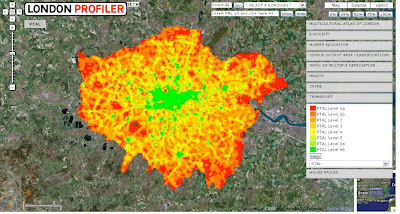
PTAL - Public Transport Accessibility Level
London Profiler builds up a picture of the geo-demographics of Greater London from data on population attributes such as cultural/ethnicity, deprivation, the extent of e-literacy, level of higher education, and health related problems.
London's Welsh
You can "visualise themes at different scales, search by postcode or zoom at borough level, to change the layer's transparency and to add KML layers". Loads quickly and all it's missing is a 'how to use' link.
Index of multiple deprivation
It's amazing, really, that the BBC covered this solely as about 'Mapping London's immigration', which is actually wrong. I don't see a map showing how the early C20th Jewish emigres landed in the East End then moved to North London ...
Wednesday, April 2
Google Reader clips catch up
Way behind with a catch-up, so a long list :[
- "Hidden Costs" of Watching TV Online?
BBC swipe at The Torygraph, containing this gem: "Content providers, if they find their content being specifically squeezed, shaped, or capped, could start to indicate on their sites which ISPs their content worked best on (and which to avoid). I hope it doesn’t come to this." - Forget Everything You've Learnt About Project Delivery, Part 8: Benefits Measurement
- The Secret to Successful Project Teams
Couple of good pieces from CIO; first is part of a very useful series. - Searches for 'tibet' quadruple
- Court Backs Craigslist in Discrimination Brouhaha
Big implications. possibly. They can carry discriminatory housing ads ("no blacks, irish, dogs"). Odd when that's where all classifieds are moving to. - No 10 Twitters and Flickrs into life
- New Foreign Office website
Which Emma doesn't want my thoughts about ... - Power of Information: New taskforce and speech
- Military Report: Secretly 'Recruit or Hire Bloggers'
- Election breaches in Zimbabwe
Tom Watson picked up on another Google maps link-up, as happened in Kenya. Here's more about how Zimbabweans are using blogs to get around media censorship. - Obama's YouTube Speech Tops TV Ratings
That's 24hr news shows. - The online fall-out of the Daily Express apology to Madeleine McCann's family
Martin Belam spots a lot of hangovers from the apology on the Express' crap website. - The Daily Express is back on the McCann case
- What if Hillary Clinton gave a speech about gender? (And why she won't.)
- Galloway's Iranian propaganda?
Peter Tatchell on CIF. The comments on this were crazy. - Reader and ARIA: A new way to read
That's Google Reader and a Screenreader - The Royalty Scam
That's Billy Bragg editorialising for the New York Times. - The all-seeing eye
Nicholas Carr sort-of losing it. Again. - Texting-on-the-go injures 6 million Brits
They walk into lamp-posts en masse. Includes funny video. - This blog is garbage!
Seeing is believing. - Online video traffic up 178% in a year
- The Foolishness of Crowds (and certain erudite New York City professors)
Andrew Keen makes a useful point. Shock. - Not getting it may be a worldview thing
It is still early days ... - Firefox Goes "Organic"
Mozilla is green. - Super-Regulator’ Sharpens Focus On Accessibility
Ofcom sharpening its threats. - OurPress: websites for the rest of us
Neat project from Dave Briggs. - The Free Our Bills Campaign launches
Another plug :] - 1M+ Donations to Obama in March
Now 2m individuals. This campaign is changing lots of old ways of doing politics. - Set the Census data free
Simon Dickson yells at the Office for Stats about the 2011 census. - China unbans the Beeb
As the Dalai Lama keeps saying - what happens after the Olympics? - RSS to Newsletter Maker - A pitch to the Social Innovation Camp
Very neat idea from Tim Davies.. - Cyber attacks target pro-Tibetan groups
- In the Guardian: ‘we’re now in sight of victory’; so what next?
Charles Arthur for Free Our Data on Another Power of Information impact. - Municipal Wireless Success Demands Public Involvement, Experts Say
All going pear-shaped in US cities - but there's 'ope. - Links, libel and law
Emma Mulqueeny wants to be off Milliband's blogroll. - Google Sees Surge in Web Use on Mobile Phones
- Network to explore "civic function of news"
David Wilcox on another 'walled garden', this time at the RSA. - Morocco's Facebook faker is freed
- Web Technologies Scotland
JackP details great stuff about this event. - Secret Guide to Social Media in Government
Incredibly useful new guide. - [Roy Greenslade] Resign! Resign! Resign! Resign! Why four editors who libelled McCanns should go
- Web creator rejects net tracking
Sir Tim isn't a happy bunny. - Spare a thought for the people of Adelaide…
The hottest since records began. This is why Aussies take global climate change seriously - and vote accordingly. - BBC 'opens floodgates' to iPlayer hackers
- The high cost of a good reputation
eBay demolishing 'the wisdom of crowds', says Bill Thompson. - What is web science?
- Do Internet Ads, Content Effectively Reach All Ages?
Older users think websites are designed for the young. - Poll: Most Americans don't read political blogs (Reuters)
... but fully one quarter of all American adults do.
 Also: This was released on April 1st, but is apparently serious! Antarctic Polar Bear Relocation to Begin on Earth Day. Some Americans want to move thousands of them to the edge of the Ross Sea near Emperor Penguin colonies trapped by recent movement of giant icebergs . Nothing on the site about unexpected impacts - like happened with rabbits and foxes in Oz. Project is supported by oil drillers ('we're fed up being attacked') and 'Americans for tax reform' ... and lots and lots of American 'liberals'. Gore has his work cut out.
2
comments
labels:
accessibility,
Andrew Keen,
bill clinton,
blogging,
bytes,
censorship,
china,
Dave Briggs,
facebook,
firefox,
google,
hillary,
kenya,
law,
maps,
media,
mobiles,
new york times,
obama,
science,
stats,
tom watson,
TV,
video,
youtube,
zimbabwe
labels:
accessibility,
Andrew Keen,
bill clinton,
blogging,
bytes,
censorship,
china,
Dave Briggs,
facebook,
firefox,
google,
hillary,
kenya,
law,
maps,
media,
mobiles,
new york times,
obama,
science,
stats,
tom watson,
TV,
video,
youtube,
zimbabwe
Tweet This! ♦ Add to del.icio.us ♦ DiggIt! ♦ Add to Reddit ♦ Stumble This ♦ Add to Google Bookmarks ♦ Add to Yahoo MyWeb ♦ Add to Technorati Faves ♦ Slashdot it ♦
Tuesday, April 1
BBC News redesign: Can someone powerful please yell at them?

The BBC News website is extremely popular, so it's not surprising that yesterday's BBC Internet blog post about it's redesign attracted over 1000 comments - this must be a record?
The News Website Editor, Steve Herrmann, explains the changes in terms of doing some research and asking people what they wanted changing (and heard what it appears they wanted to hear):
But it was also clear from the feedback we got that there were others who thought the site design could do with a bit of a revamp – something we’d been thinking about doing for a while.The specific changes he focuses on are:
- the changed width - because 95% of screens are wider
- more open design - to make it easier to scan
- new masthead - which is about cross-site branding
- bigger images - from user feedback and 'the power of pictures in telling stories on the web'
- space for adverts - for the international audience
- space for embedded media
- incorporation of TV and radio current affairs content
A number of comments from other developers than me point out that the accessibility was obviously not a factor in the redesign, not just in terms of requiring that it meet WC3 but that it appears it wasn't cross-browser tested. A redesign should be improving accessibility.
This is truly unacceptable and I hope the accessibility movement and organisations for disabled people scream their tits off about it. The BBC is in a leadership role with its website and it has huge resources. Someone, somewhere decided to ignore this. Who were they? Was it Herrmann?
I had a quick look at the very prominently featured 'accessibility help' and it's a link to 'my web my way', which is about 'the web', not the BBC News website.
This features a 'change colours and text size' button - absent on the website and a lot of 'rah rah' for the BBC from selected disabled comments. I understand that it is better than other websites and that many disabled users are grateful for some attention, but when most commercial websites pay no attention and - for me - when Council + Whitehall websites (which are the best) get hauled over coals when they're not 100% perfect the BBC can indeed 'do better' (as they would undoubtedly put it).
A number of other comments point to a design-led rather than user-led process, such as the choice of the Verdana font, unfluid design and the wasted top banner space.
I would add a couple of things to what others have already said which add to the design-led feeling.
1. Because of the redesign, the left-side navigation bars are now too close together. Combined with the on-focus colour change this would definitely cause issues for users who have trouble using a mouse - it fails 'the mom test'. I don't know what's gained from keeping the on-focus, either.
2. Removing links from the page is design-centred rather than user-centred. This pushes people towards search, which is an issue for most sites to do well and certainly is not very good on the BBC site. This is why you always need alternative navigation routes, like a site map. I know from doing this process that there is always pressure to remove links but when you test you can easily make both an 'uncluttered' look'n'feel, which is really about removing visual distraction, as well as providing more options both for navigation and content. Look at the Guardian's recent redesign - does that look 'cluttered'? Everything about the redesign process as explained appears to be dominated by this idea.
Overall, I'm disturbed that, from the BBC's presentation of it's News site redesign it's fairly clear that it wasn't led by usability - making the website more useful - but a whole lot of other factors which pushed user-focus aside. Changes aren't explained in terms of testing results and rarely about becoming more useful. I can imagine what actually happened from the mentions in the BBC blog post about some of those other factors, as well as from previous blog posts which mention terrible ideas like coding from photoshop designs - the very essence of being 'design-led'.
In the first response to the blog comments by the head of 'design and user experience', none of the accessibility issues are responded to and the 'technical' issues are referred to the 'technical team'. She also gives the very strong impression of being prepared to change design elements from blog responses and this response in particular really makes me think they're 'design-led':
We added the extra white space because a number of users told us, through surveys, listening labs and usability tests, that the previous design was starting to look "cluttered" and "busy".This isn't the language of someone responding to test results and producing a user-led redesign - or even, to cut her some slack, of someone communicating process to non-tekkies.
Unfortunately, I am all too familiar with how this happens and how this works having fought too many losing battles - power and who has it is an real issue in defending the bloody user in web design.
That an organisation the size of the BBC is still behaving in web development this way in 2008 requires someone powerful outside the BBC to yell at them to do this stuff properly. Perhaps Cameron could add this to his BBC websites critique? And perhaps someone could do a FOI request for the process documentation so we can see exactly who's responsible rather than make educated guesses?
Dan G has more:
Something very strange is happening in the BBC webdesign department.~~~~~~
One of his comments takes him to task for his own coding and design - so I expect something similar.
Just to say, I don't care. It's a bit ad hominem ... (although I am interested to know if something plain isn't working, which I understand can be the case with some video servers).
I had one of these to my post 'BBC Blogs: Why bother?', which got hundreds of visits via the BBC Blog post which specifically mentioned it.
Please have a Flash bypass (you do not have it now) as there are many businesses, mine included, that will not allow Flash. Without the bypass we will not be able to see your videos.I will investigate this but it's news to me (I don't read all the technical news all the time), so it's not about disrespect. Further, the past design was Blogger off-the-shelf. This one is 'off the shelf' tweaked. Did I ever claim it was perfect? And I'd rather spend time researching posts than - basically - fussing with design or coding in order to impress, who?
Flash tracks, by IP address, every use of it and puts the information together into a report for its subscribers. Please show some respect for the intelligence and privacy of your readers.
I am glad to see you finally got rid of the 3cm wide blank band near the top.
I would say that a business blocking Flash is stupid. Video is a business tool and to over-block (to stop YouTube time-wasting) is short-sighted. Sounds like someone was sold a filter package and they didn't tell them what the side-effects would be — all too familiar.
More about that in this post: How to disable web filter software.
Update: The BBC Sports Editor has commented further here.
Our audience research cannot just be confined to this blog. We have been working for months to develop an approach that works for our users and gives them a more dynamic sport website, now and in the future. This was considered research and usability testing - which was used by a team of technical, design and editorial experts to help define this new-look website.But how was it used? And what happened with accessibility?
And this post is sitting prominently in the 'blog reaction' column next to the reactions post on the BBC Internet Blog, sending me hundreds of hits again. And I'm not getting any furiously disagreeing readers ...
Tuesday, March 11
Google Reader clips catch up
- Helping funders find you online
Dave Wilcox interview with US-based consultant John Kenyon on nonprofit fundraising. - The power of information
V. interesting speech by egov Minister Tom Watson. - Attacking the great digital divide
Sydney Morning Herald explains the difficulties and opportunities in providing IT for remote communities: bugs and floods. - Oops! 'Ferry crash' unstitches Google maps
The perils of 'stitching' in GMaps. - To Aim Ads, Web Is Keeping Closer Eye on You
New York Times front-page on the developments in ad targeting. - Can you blog away the blues?
Psychological benefits of blogging. - Rainbow over Palestine
Palestinians now have an LGBT organisation. - Off the Record? Not Unless You Agree Ahead of Time
John Battelle's take on the Scotsman/Obama campaign episode. - How Are Candidates Spending Their Money Online?
From TechPresident. - Search within a site: A tale of teleportation
New tweak from Google. - Richard Pope’s GroupsNearYou.com launches
Another bit of MySociety genius. - Newsweek Advances Andrew Keen's Ignorance
It lives! - Download: The True Story of the Internet
New Discovery Channel documentary. - Countering British Government Paranoia
Americans liking anti-camera actions. - Facebook study group equals cheating?
Scary story from a Canadian University. - “The web and I” - a reflection
Amusing speech from an old-time Civil Service Head. - Local search in the UK
Apparently, Google has taken this over too. - Watchfire WebXact and Bobby Online are dead!
- Botanicalls Twitter
Reaaally loving your plants. - Justine Lam on Ron Paul's Networked Campaign
"We didn't coordinate that at all". - Labourspace: great idea, awful execution
Say it, Simon. - Error message
Tekkie take on Obama vs. Clinton. - No10’s new recruit is a geek
Sloooow progress. - Blogging While Female: 5 Conservative Women Bloggers Talk
- Chris Kelly: McCain Sex Scandal Blonde Missing -- Day 12
Very, very funny. - mySociety’s Freedom of Information site goes live
Yet more MySociety genius. - Bespoke vs Off-the-shelf - watching the BBC blogs comment problems
Really why it isn't working. - New Media Awards 2007 Finalists
From the New Stateman. - Web lifeline for mums is big business
Onto a winner. - Obama's Million Donors: Why They're Important
Changing the ballpark. - the Missing proof
Twitter @ work. - Info links for government communicators
Useful links. - Tories need friends
.. on Facebook. - Automated killer robots 'threat to humanity': expert
Be very afraid ... - Rupert Murdoch's black sheep
Is the WSJ pushing it's luck? - What gov webbies can do to improve awareness of their published consultations
Jeremy Gould on the ball.
0
comments
labels:
blogging,
facebook,
google,
maps,
mccain,
media,
new york times,
obama,
tom watson,
tories,
twitter,
women
labels:
blogging,
facebook,
google,
maps,
mccain,
media,
new york times,
obama,
tom watson,
tories,
twitter,
women
Tweet This! ♦ Add to del.icio.us ♦ DiggIt! ♦ Add to Reddit ♦ Stumble This ♦ Add to Google Bookmarks ♦ Add to Yahoo MyWeb ♦ Add to Technorati Faves ♦ Slashdot it ♦
Monday, March 3
Ushahidi - Help make a global product out of an African initiated project

From White African:
We’ve entered Ushahidi (background story here) into the $100,000 Netsquared Mashup Challenge for further development. We’re really excited about this opportunity for a number of reasons.
- First, we’d love to get experts involved to help us with planning and development work.
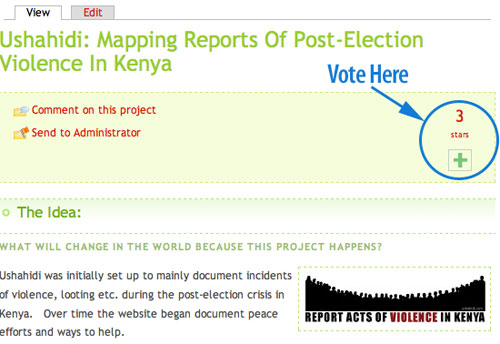
Second, if you go help vote up our application (LINK), we have a stronger chance of being selected. Going and voting for us at this point is the biggest help you can be at this point.
Third, even though the crisis in Kenya appears to be over (thank God), we’re continuing to build out Ushahidi in order for it to be used in future crisis related situations around the world.
Here’s their explanation of the challenge:
This year’s NetSquared Conference will bring together a unique mix of people from the public and private sectors to develop and release Mashups designed to provide deeper insight into the social issues affecting communities around the globe.
Those “people” are you — members of the NetSquared universe working on behalf of communities everywhere and the technical experts who care about these issues.
If we’re successful, we’ll learn something about cross-sector collaboration, meet new and interesting people, and build a unique gallery of Mashups that citizens, schools, and community-based groups everywhere can learn from, replicate, and build upon.
So, there you have it. Head on over to Netsquared, register and vote. I know it’s a hassle to have to register before you vote, but we would greatly appreciate it if you did. Better yet, if you’re interested in helping to extend Ushahidi even further, let us know!
Let’s see if we can make a global product out of an African initiated project…
Hat-tip: Kenya Pundit
Thursday, January 24
Blow me away travel maps

Absolutely stunning project from MySociety, a bunch of geniuses, on truly useful travel maps.
This mapping work was very important because it provides a potentially revolutionary new way of working out the best place for people to live and work.You can see some examples here.
This one shows which areas it makes more sense to get public transport to work in Edinburgh, and which areas it makes more sense to drive.

They compare car vs cycling and one allow users to set both the maximum time they’re willing to commute, and the median house price they’re willing or able to pay.
There are two ways in which you can get a travel map of this sort centred on a location of interest to you.
If you’re a interested user, you can contact your local transport journey planning organisation, for example Transport for London or San Francisco BART, and encourage them to work with us to get a system like this working interactively on their websites.
If you’re a rich user, or company, you can commission us to create bespoke maps – we’re a non-profit after all and all the money will help run our other projects. And if you’re really rich, you can work with us to develop a real-time service of the sort that the transport agencies should be doing. Francis Irving from mySociety has written a technical review on the challenges of developing a real-time map generation system.
If you’re interested in working with us on this, email karl@mysociety.org.
Subscribe to:
Posts (Atom)
 @PubSecBloggers