New blog

All new content on my restarted blog is here
Showing posts with label africa. Show all posts

Tuesday, September 29

The Eight Stages of Genocide

Crossposted from my new outlet, Cosmodaddy


How can we predict and prevent genocides? Greg Stanton outlines his groundbreaking theory on the eight stages of genocide: classification, symbolization, dehumanization, organization, polarization, preparation, extermination and denial.

Genocide in Darfur, he argues, has proceeded through these stages before our eyes. Genocide could have been prevented by means of intervention at any one of a number of critical points in the past, but the international response has amounted to too little, too late.

This has always been the case and I don't see this changing anytime soon, despite the best efforts of fantastic groups like Avaaz though groups like them remain our best hope, as does the work of people like Stanton who help people understand that - yes - things can be done and that genocide is not some 'natural, unstoppable force' like an earthquake or a tornado.

One starting point would be for those responsible for doing nothing to be seen to learn lessons and admit their errors. For 'never again!' to mean anything, it's essential. This is why the campaign around Belgium, for example, to own up to its horrific history in the Congo is so important, as important as for Serbia to own up to its role in the Balkan's genocides in the 90s.

It's also close - very close - to home. This is from a post of mine last year about Hillary Clinton's claim that she tried to stop the Rwandan genocide.

Rewriting history over Rwanda

The Americans weren't alone. The British, the French, the Belgians and much of the rest of Africa all either didn't do anything or actively stopped aid. They all looked for their own interests and none had any interest in stopping genocide.

It was Britain's ambassador to the UN, Sir David Hannay, who proposed that the UN reduce its force. A year after the slaughter, the Foreign Office sent a letter to an international inquiry saying that it still did not accept the term genocide, seeing discussion on whether the massacres constituted genocide as "sterile". Then Ministers John Major, Douglas Hurd, Malcolm Rifkind and Lynda Chalker have never even been asked about their role.

Virtually no-one emerges heroically (Canadian peacekeeper Roméo Dallaire is one and his view on Clinton's claims would be interesting to hear). In fact I would urge anyone to make themselves read the harrowing background as an object lesson in international power politics and its victims - a million of them in Rwanda. There's a blog which covers the 100 days before and during the slaughter in detail. 'A People Betrayed' by Linda Melvern is very good.

For Hillary to now try to adopt that heroic mantle is, as commentators have noted, worse than 'monstrous'.
Almost - almost - as monstrous as this comment from Gordon Brown:
"You cannot have Rwanda again because information would come out far more quickly about what is actually going on and the public opinion would grow to the point where action would need to be taken."
Where is Twitter on the genocides happening right now in the DR of Congo? Or the slaughter of indigenous people in Peru? Where is Brown? Where is Sarah Brown!?

Here is a list of the genocides taking place now in the world.

The media doesn't give a damn and, unfortunate but true, neither do most Twitter users.


HT: Domino


Reblog this post [with Zemanta]

Wednesday, September 23

PayPal still thinks Africa is the 'dark continent'

PayPal Inc.Image via Wikipedia

I just got an email from a friend in Austria. Inspired by a post on LGBT Asylum News he wanted to make a donation to the Sex Workers Outreach Program (SWOP) in Nairobi.
The people there are wonderful, and intelligent, and courageous and open-minded people indeed, and they deserve our help and solidarity. Tears are forming in my eyes when thinking of the women and men with HIV infection and AIDS living in poverty there.


But my friend found out that whilst sending money via PayPal is possible for people in Kenya receiving money is not.

When he contacted PayPal customer services by email they claimed that receiving money is not allowed by the legislation of Kenya. Yet he was able to send the money to Kenya via Western Union — for the transmission of Euro 100 he had to pay a fee of Euro 17,50 which is far higher than PayPal's charges.

Jonathan Gosier, a software developer, writer and social entrepreneur, explains on appafrica how:
PayPal, intentional or not, are sending a very strong message to the rest of the world about Africa.
Prior to moving to Uganda, Gosier had used PayPal for four years and estimates that he's transferred over $100,000 during that time

Bu this counted for nothing once he'd moved to 'the dark continent'.
Apparently PayPal’s way of ‘policing’ their service is to simply flag various IP addresses as being ’suspect’ . hrmm. I have a few Iranian and Indian friends who could tell you a bit about what it’s like to get profiled based on where you appear to be from. (And if they won’t suffice as anecdotal evidence, I’ve got a few million mexican and black american friends who’d double down on the sentiment.)

So Africa remains a high-risk zone as the sheer number of comments like these from paypal users indicates:

I am in the process of trying to sell a laptop. i have posted ads on comtrader and ebay. So far the item has been bought off ebay by a mother who wants its for a present for her daughter in AFRICA. Two people have expressed interest through comtrader, one wishes to buy it for a business associate in AFRICA, and the other wants it for himself, and guess where he lives….. AFRICA. Sorry for all the capitals, but am i missing something here. I’ve replied to the ebay purchaser who is going to pay through Paypal, which i know is covered by ebay so i feel safest. Just wondering if this obsession with me posting it to AFRICA is anything i should be sketchy about.

Or this person’s thoughtful reply:

Anything from africa is a scam so stay well clear. Re-list the item if you have too.

Wow. Anything from Africa is a scam. I better take back this computer I just bought from GAME!

The unintentional effect here is that by blanketing the whole region as suspect, it reduces the number of viable alternatives for legitimate businesses and professionals who want to use services like PayPal for trade. I use PayPal for some of my payroll now (for people who don’t live near me). However, whenever I do, PayPal flags my account and shuts it down temporarily ‘because I accessed it from a suspicious location’. To unlock it I have to call them, from Uganda and do a bunch of other stuff that’s inconvenient. I suppose this is the price of admission for using the service in country it wasn’t intended to be used in. So no complaint here either.

But what it does mean, is that from every angle legitimate African businesses are smacked in the face by measures put in place to police the one’s that are indeed abusing the system. But this affects even expatriates and NGOs that might want to use the service. If it’s accessed from a certain IP there’s a red flag, especially if that IP is not where you registered to use the service.
Once again, the message perpetuated here is to be cautious when dealing with Africans, Africa or anything you suspect of being related to the aformentioned. This is nothing new. Most people here have been dealing with such mentality their whole lives, why would it stop now that the medium has changed? To be fair, there’s truth to this stereotype. There is indeed a huge problem of scams here. There is some truth to most stereotypes, the word itself simply implies that those truths are applied where they don’t necessarily belong.

Unfortunately, there are a lot of people here who are just like consumers everywhere else in the world. They want to buy things, they want the conveniences of online shopping, they want to do business…and they want their neighbors to stop scamming you so they can have those things.
I realize that the problem can’t be solved entirely by Paypal alone but I would appreciate at least an option to flag my account in advance for what might be mistaken for ’suspicious activity’. I’d be happy to leave this to PayPal’s discretion but my problem is they aren’t using any. African transaction? Banned! Banks will allow customers to indicate that they will be abroad for a certain period so that they don’t shutdown accounts by mistake. Why doesn’t PayPal? You’d be surprised at how damaging these blanket policies can be to an organization like mine that simply just wants to pay employees and be paid by clients.

I suppose the complaint is that PayPal doesn’t give me an option to avoid my account getting bricked. It costs me money everytime they do it. they give me no alternative to prevent it from happening and when I talk to them, somehow it’s my fault for existing ‘in that country where The Last King of Scotland took place‘.
My Austrian friend says:
To me this is a kind of discrimination, and neo-colonialism, and racism towards African people, and it reminds me of the inhuman politics of the pharmaceutical industries not to reduce their prices for medicaments for HIV and AIDS in poor countries, but to accept the death of lots of people who could not afford these high prices. If you are living in a rich country of the European Union you survive, if you are a poor woman and a poor man in Africa you die. We must not accept it!
I thought of his experience and Gosier's whilst reading about the coming of broadband to East Africa (which includes Uganda) via the BBC's excellent series of reports.

This did warn of and catalogue the whole raft of other challenges to Africans other than the lack of broadband, which puts its arrival in context, but they missed this one.

Theresa Carpenter Sondjo notes that there are alternatives for African entrepeneurs to PayPal, however they are all more "more expensive and less flexible". That seems to be a running theme for Africa - lots of stuff to build a business is way more expensive, Africans have a stack of hurdles to jump over.

Maybe Oxfam, Mr Bono and Mr Geldof should get onto this one and start shaming PayPal?

Reblog this post [with Zemanta]

Wednesday, September 9

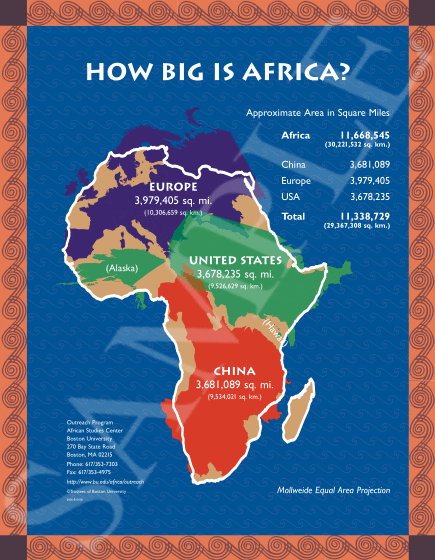
Africa is bloo*y enormous

This is a stunning graphic


HT: Owen Barder

Monday, June 8

Socially responsible outsourcing

15 million Africans ready for work. Got tasks?

I posted recently about mobile developments in Africa and how they are being used in a number of imaginative ways - many of which which we're yet to see in the 'West'!

As well as being used to organise day labour they're also used by people to do small jobs such as translations. In Kenya, with its many languages, this is how help resources for mobile companies' customer services are being built - word-by-word

Nokia being used for translation job

Samasource is a fantastic new San Francisco non-profit that partners with small, talented, tech companies and nonprofit training centers in poor and rural communities (currently Kenya, Cameroon, Uganda, rural India, and Nepal) to find them clients.

It derives its name from the word sama, Sanskrit for “equal”.

Their partners must meet stringent social impact criteria - fewer than 20% of applicant firms are selected - and they specialize in services ranging from data entry to advanced software and website development.

It's about giving work, not aid to people in the world's poorest countries.


Here's a profile of Ann Wangui, a graduate with honors from Nairobi's Methodist University. She is an example of the sort of person who is struggling to find a job in Nairobi despite her qualifications and who Samasource aims to help.


This is certainly a much better approach than the one being adopted by the world's large tech companies. Erik Hersman recently posted Microsoft vs the Open Source Community in Africa.

If Microsoft developer communities do emerge in Africa, Erik writes, even with the massive hurdle of paying for expensive access to developer tools, "we’re still left with what one person wrote: …they will be formed from programmers who are completely dependent on American software for the livelihood: it’s neo-colonialism, pure and simple."
In Africa organizations have a lot of hurdles to overcome, not least of which is the straight cost of doing business. Where it might be simple for some organizations in the US and Europe to wave off a couple thousand dollars worth of licensing fees, the same is not true in Africa. The margins are lower, so every cent counts.

In a region where cost is so important, it’s amazing then that the most lucrative deals go to the Western organizations that have high costs for ownership and maintenance. These outside organizations use backdoor methods to gain contracts where in-country options are available, usually with less expense and with greater local support.
Hersman also reports that Microsoft are trying to muscle in on the African-developed Ushahidi crisis reporting social software with a new product called Vine. He says "if they really are about creating emergency and disaster software for use by normal people, then I would encourage them to not charge for it and to make it as open as possible for others to work with it."

Fat chance, I suspect.

HT: Owen Barder
Reblog this post [with Zemanta]

Sunday, May 31

In a major victory for LGBT asylum, Ugandan John Bosco defeats the Home Office

Cross-posted from LGBT Asylum News

Following an eight year ordeal the Ugandan gay asylum seeker John 'Bosco' Nyombi has finally won asylum in the UK.

Despite a well-documented media and government anti-gay campaign in Uganda, which has included articles and photos of Bosco, he was deported in September last year. The UK Border Agency making it usual claim that LGBT can be safe in such countries if only they are 'discreet'. However the method of his deportation, which involved deception, violence and rule breaking, led to a historic decision by a British court following which the Home Office was forced to return him to the UK in March, where he was immediately put into a detention centre due to an 'error'.

As Bosco feared for his safety if he was returned, and also because the Home Office might use any publicity about his case against him, a court ruling meant that subsequent media reports referred to him Mister X.

On his return to Uganda, Bosco has been dumped by UK officials with no support (LGBT asylum seekers are regularly returned without their mobile phones, clothing other than what's on their backs or other basic items or given any opportunity to put their affairs in order) and was arresred. He managed to escape after paying a bribe.

As his face and situation was known through the local media's anti-gay campaigning he went into hiding. Twice during this time he was caught by Ugandan police and put into prison where he was violently beaten by both staff and inmates because he is gay.

Bosco won his return because a judge Sir George Newman, said the Home Office was guilty of "a grave and serious breach" of the law. He had an outstanding judicial review but despite this he was deceived into a meeting at a removal centre where he was instead bundled into a van and taken to Gatwick airport.

At the airport, when he resisted leaving the van, he was handcuffed, punched in his private parts to make him straighten his legs so they could be belted together. Crying, he was lifted on to the plane and flown out of the country. (Jacqui Smith has ordered an inquiry into widespread reports of violence during removals).

His mobile phone had been taken from him and he was given no chance to contact friends or lawyers, even though Home Office rules required that he should have 72 hours' notice of removal to give him a chance to make calls.

Judge Newman said he was also satisfied that the actions of the Border Agency officers were "deliberately calculated to avoid any complication that could arise from Mr Bosco 's removal becoming publicly known."

Lawyers for the Home Secretary conceded in court that his removal was carried out illegally.
But they argued flying him back to the UK was pointless because the 38-year-old was bound to lose the fresh asylum claim he now wanted to make.

Rejecting their arguments, Judge Newman said: "I find it impossible to conclude, on the basis of the evidence as it now is [Nymombi's situation on retruning to Uganda], that there is not the real possibility that a judge might find that he is at risk if he is returned (to his homeland) by reason of his homosexuality."

As with the Ugandan lesbian Prozzy Kazooza, who was raped and tortured by the police and won asylum last year, this has now proved to be the case.

Bosco will now be able to return to the job he had held for seven years as a carer supporting vulnerable adults in the community in Southampton. His job has been held open by staff who had previously testified to his outstanding work.

In an email to the author Bosco said:

I was worried to death not knowing where my future will be other than death but now I can put a smile on my face.

Please I ask you kindly to pass on my sincere love and word of thank you everyone you know that supported me and prayed for me.

I will never say Britain is bad because I will include those good people helped me but Just Home office as a department they tortured me and can't understand why they had to do this to me when I obeyed all the rules.


Reblog this post [with Zemanta]

Friday, April 24

Tech lessons from Africa

Ushahidi: Crowdsourcing Crisis Information

Ushahidi, which means ”testimony” in Swahili, is an open source engine. The project was developed in the effort to better map out reports of violence in Kenya. This was after the post-election fallout at the beginning of 2008.

The aim of Ushahidi is to create a platform that any person or organization can use to set up his or her own platform for collecting and visualizing information. They explain that, ‘the core Ushahidi platform allows for a plug-in and extensions that can be customized for different locales and needs. The tool is open source allowing others to download, implement and use the engine so that they can bring awareness to crises in their own region.’

The core engine is built on the premise that gathering crisis information from the general public provides new insights into events happening in ‘near real-time.’

Ushahidi is also being utilised in the Indian election by Vote Report India.

screenshot of Vote Report India

Users contribute direct SMS, email, and web reports on violations of the Indian Election Commission’s Model Code of Conduct (PDF). The platform will then aggregate these direct reports with news reports, blog posts, photos, videos and tweets related to the elections from all relevant sources, in one place, on an interactive map.

Vote Report India aim is to not only increase transparency and accountability in the Indian election process, but also provide the most complete picture of public opinion in India during the elections.

Vote Report India is a non-partisan all-volunteer collaboration between software developers, designers, academics, and other professionals.

Here's Erik Hersman, aka WhiteAfrican, talking to TED about Ushahidi:


Here's a paper on the use of the Ushahidi platform in the Gaza war. Scroll to sec.5 for new media.

Recent research from ResearchICTAfrica reveals that Kenyans are spending incredible amounts on mobile communication as a proportion of income.

Here’s how it breaks down. The average Kenyan spends over 50% of their disposable income on mobile communication. For the bottom 75% of the population, that figure goes up to 63.6%. In terms of total individual income, the average Kenyan spends 16.7% of their income on mobile communication. That figure rises to 26.6% when looking at the bottom 75% of the population.

Africans are paying for mobile communication in spite of how expensive it is, not because of how affordable it is and because access to mobile communication is critical for people. Even if you are digging a ditch by the side of the road, day labour is now organised via SMS.

Nathan Eagle of MIT recently gave a talk to eTech where he explained about the mobile scene in Africa.


Entrepreneurs are constantly finding new uses for the technology.

A Kenyan water pump manufacturer combines an mobile-mPesa-enabled, solar-powered metering system with their water pumps. They give water pumps away for free and then make a profit by selling access to water via Safaricom’s mPesa service. Send the pump 20 Kenyan Shillings and it pumps 20 litres of water for you. This has increased the water pump companies business and made water more accessible to those who need it.

However, as Steve Song points out:
When a single mobile operator is a gatekeeper to water supply, something is wrong. For any village in this situation, [Kenya's largest mobile network]Safaricom can charge whatever they like.

If we accept the premise that, in places like Kenya, no one can afford not to have access to a phone, then one cannot help but feel that something needs to be done. A flour milling company in South Africa was recently fined more than 45 million Rand by the Competition Commission for price fixing and collusion. I think it is time to take a serious look at mobile operators.

Imagine an alternate reality where Africans paid less than 5% percent of their income on mobile communications and all phones operated on an IP-based network so that any new African innovation might be unlimited in terms of scope. Then we would see mobile-enabled social and economic innovation taking off in Africa.

As Nathan explains, African colleges and universities are turning out a lot of entrepreneurial tech talent. Unfortunately, much of this then migrates. Things like his work and the establishment of companies like Google Kenya is helping to stem this flow. Barcamp's have been held in Kenya and are coming up in Nigeria.

London is hosting a chance for sponsors and African innovators to meet up this weekend at Africa Gathering.

WhiteAfrican's blog is full of tales of tech innovation in Africa. Here he talks about the problems facing the next generation of techies in Liberia. Here's his list of African tech events.

Here Jonathan Gosier explains about his work in developing a tech hub in Uganda.


The rest of the world has a lot to learn from Africa, most obviously in developments around mobile phones.

HT: Kenya Pundit, WhiteAfrican

Tuesday, July 15

'Interference' + Zimbabwe


Vitaly Churkin, the Russian Ambassador to the UN, was quoted as justifying their veto of the recent UN Resolution on these grounds: “This draft is nothing but the council’s attempt to interfere in the internal affairs of a member state.”

Now although I know there are strong arguments against sanctions (Simon Jenkins made some excellent points in the Guardian), 'interference' is already happening, only it's not being reported.

Quite apart from the opinion of (and attempts at securing 'interference of) a number of neighboring states, primarily Zambia and Botswana, today's Independent reports that foreign mercenaries are part of the terror campaign - the most ruthless part. Someone is allowing this or turning blind eyes.

Mugabe already hosts another dictator (Ethiopia's Mengistu). Now comes news that some of the Hutus who engaged in the Rwanda genocide are there too, such as Protais Mpiranya, the former head of the presidential guard during the 1994 genocide. He is on the wanted list of the International Criminal Tribunal for Rwanda, but is suspected to have strong business links with senior Zimbabwe army officers.

[The mercenaries] dress in army fatigues, carry Russian-made guns and are accompanied by interpreters when out with the militias.

Patrick Chitaka, the MDC chairman in Manicaland province in the east of the country, said the foreigners had been identified in the past two to three weeks supporting government-backed men.

Mr Chitaka said: "We have observed that some of the people leading the violence are foreigners because they speak a different language and they do not understand our local languages.

"Also the tactics they are using are not peculiar with Zimbabweans because they are cutting out the tongue, removing eyes and genital parts. We are not sure where they come from."

"There are between six and 10 foreigners in each base, and there are 20 Zanu bases in the two constituencies. They wear military uniform, carry guns especially shotguns which we think are Russian. They are cruel and brutal. Each unit has an interpreter who tells them what to do. People here live close to several borders and they know Portuguese from Mozambique and languages from Malawi and Zambia. [These people] don't speak any of those or English.
There have previously been reports of Chinese soldiers:

The Chinese, together with about 70 Zimbabwean senior army officers are staying at the Holiday Inn, in the city’s central business district.

There are about 10 Chinese soldiers. “We were shocked to see Chinese soldiers in their full military regalia and armed with pistols checking at the hotel,” said one worker.

“When they signed checking-in forms they did not indicate the nature of the business that they are doing and even their addresses.”

And news as well that in order to boost its jamming operations against the UK based SW Radio Africa and Voice of America's Studio 7, Mugabe's regime recently received another shipment of the latest in radio wave jamming equipment from China.
Landing records, shown to us at the Harare International Airport by port authorities, confirmed that the government received the equipment on May 17. The equipment was among several other items the Chinese delivered, including an assortment of sophisticated military surveillance hardware.
They are also looking to 'block' web news sources, whether they are using the Chinese expertise for that the article doesn't say.
“The independent media, has made our lives difficult,” one official, working in the ZANU-PF information department, said. “The strategic leaks into the independent media of our plans by enemies within ZANU-PF, has meant that the world knows everything we about to do, hours before we do it.”

"With the list at hand, the task of the CIO, with intelligence officials from the military, will indentify, and eliminate all journalists working for these pirate news organizations," officials privy to the details said.


More Zapiro

Meanwhile the Zimbabwean economy is hitting another technical brick wall:
The bigger problem is the mess in the banking computer systems, which can only handle a maximum payment of Z$999 999 999 999.00 per transaction.
'Interference' is already happening, China and Russia and South Africa and all the others who shout about it. Only it's on Mugabe's side. This is hardly surprising. The BBC has uncovered hard evidence that China is militarily backing Sudan in Darfur.

Thursday, July 10

Our shame: official, imposed destitution


Protest by Zimbabwean refugees - the banner reads 'you take our nurses but not our wounded'

In a story buried in almost all the media, Gordon Brown has misled people on his government's attitude to Zimbabwean refugees.

According to the Press Association:
The deportation of failed asylum seekers to Zimbabwe has now been halted, Gordon Brown said.

The Prime Minister told MPs that while officials continued to deal with the issue on a case-by-case basis, no returns were currently taking place.

“No-one is being forced to return to Zimbabwe from the United Kingdom at this time,” he said.

Mr Brown, who has been under pressure to stop the deportations in the wake of the violence surrounding the disputed presidential election, said that ministers were also looking to help failed Zimbabwean asylum seekers who were unable to work.
It is noticeable that the story fails to quote press statements such as by the Refugee Council's Donna Covey.

They were not deporting anyway because of a legal challenge - it’s not news, it's not some great act of charity, source G.Brown, which might please his Minister father.

What’s desperately needed is that the Zimbabweans in the UK are granted ‘leave to remain’ so they can work.

At the moment 11,000 are officially destitute. Many are homeless and begging. All are reliant on charity. This is intolerable.

What Brown said was, frankly, a lie.

This is what the Refugee Council said:
The Refugee Council will tomorrow accuse the government of “utter hypocrisy” as its Chief Executive, Donna Covey, addresses a rally outside Parliament calling on the government to give Zimbabwean asylum seekers leave to stay in the UK and allow them to work.

Thousands of Zimbabweans have been refused asylum in the UK, yet the government admits it is not safe to send them back. They are left homeless and destitute, with no entitlement to any support or the ability to work and support themselves.

It comes close to a charade for the Foreign Secretary to applaud the courage of refugees from Zimbabwe in South Africa, while in this country Zimbabwean refugees are being left to rot.

“The current situation amounts to a policy of saying to Zimbabweans, we won’t return you but our protection will amount to you being allowed to stay and beg on our streets.

“If the government had a shred of decency it would act now, to give Zimbabweans some temporary status in this country, allowing them to work and indeed to reskill so that they are better placed to help rebuild their country when the Mugabe regime falls.”
Unfortunately we have a strong anti-refugee movement led by the media outlets which aren't covering this or quoting the Refugee Council, and this is why it's so difficult to get pressure on G. Brown to do something about the situation of the Zimbabweans.

The government hides behind blatant falsehoods about their system's supposed 'fairness' but the reality is as I explained: official destitution.

They have merely suspended deportations to Harare but only after being forced to by being taken to court.

I and many Brits find this shameful. We live in the fifth biggest economy and most other European countries - or for that matter African countries - do not behave this way. At least they let people work.

And it's not just Zimbabweans. We are now sending refugees back to Darfur. And because the system which creates this is getting no media coverage, British people haven't a clue about what's being done in our name.

Wednesday, July 9

Web power: From the Zimbabwe underground to the G8


Two days ago the Zimbabwean civic organisation Sokwanele published this photo on their blog.

It is of the mutilated and burnt corpse of Joshua Bakacheza, MDC driver for Mashonaland West and discovered late on Saturday. Many people apart from the 103 confirmed dead are also missing. It had taken his family two weeks to find it.

Joshua and another MDC supporter, Tendai Chidziwo, had been assisting murdered MDC activist Tonderai Ndira’s wife to move her furniture and personal belongings as she no longer felt safe at her home in Mabvuku, a sprawling township on the outskirts of Harare.

Their truck was ambushed by 16 Zanu-PF thugs, leaving Tonderai’s widow and her two children standing by the roadside, trembling from fright and crying.

Joshua and Tendai was taken to a torture centre and tortured and then shot. Tendai miraculously survived, he directed the family to where the corpse might be found.

Sokwanele have a Flickr page which hosts this photo and many others, and a Google Map, as well as the blog, where they are documenting the terror campaign.

Yesterday Gordon Brown used this photo at the G8 summit to convince his fellow leaders of the need for action against Mugabe's murderous regime.

The meme is that he was producing it from his back pocket. (It was also mentioned on his Twitter feed).

From determined family to Sokwanele to the G8 - this is an amazing moment in web history.

I have read many comments on Sokwanele's blog about whether their documentation is worthwhile, whether people elsewhere can make any real impact. Today showed that they could and the web is enabling this; this is worth noting and I am amazed that none of the news reporting about Brown's actions have sourced the photo back to the web and the heroic people behind Sokwanele.

Postscript: What is more, well, amazing is that in my correspondence with Sokwanele they do not care if credit is given.

These people are my heroes.

Tuesday, July 1

Zimbabwe economic collapse very near


Sokwanele:

The new week dawned with even more dramatic news. The USD, trading at over 30 billion to 1 on Friday opened the day at over 60 billion.

As the cash crisis grows, the disparity between the street and the business rates widened as the former relies on the availability of hard cash. When it is in short supply, desperate relatives of economic exiles compete for the ever diminishing ZWD by reducing the price.

As it stands now, no matter the size of the corporation or business, the limit on daily cash withdrawals still remains at ZW $25 Billion, enough to buy 6 fresh eggs!

Likewise, employees do not have enough days in the month to withdraw sufficient cash to pay for their groceries as the financial sector nears collapse.

The OMIR sits at 66 Billion to USD1 and the Hard Boiled Egg Index Fair Value Rate has risen to 28 Billion which is just above the street rate.
Mugabe may literally run out of money - protests have started at the Munich based printers, Giesecke & Devrient, who produce Zimbabwe's money, including, finally, by the German state. Because the trade is a tiny fraction of the company's income, as with Tesco they may well decide to stop the bother and the supply.

UPDATE: Pressure pays, they've stopped supplying notes.

A visibly rattled Mugabe at Sharm el-Sheikh

Sunday, June 29

And the winner is ...


All MattWardman's work - he has more versions ...

Saturday, June 28

"The suffering... You can't describe it"


Report filmed undercover by SBS Australia's 'Dateline'.

Video Journalist Ginny Stein has reported from the African nation several times, defying a government ban and possibly risking jail time. However her local fixer deems it too dangerous for her to enter - so he borrows her hidden camera and journeys into his homeland to record the pre-election violence.

“I think everybody has to do his own bit,” he tells Stein before he crosses the border. “I happen to be working with the media and that’s my way of fighting for change in Zimbabwe.”
This is a very graphic, powerful and moving report.
DEE: Now we are going to Manica bridge, an area where most MDC people here have been victimised. The guy I am going with here is telling me that there has been a lot of arson, burning down of property, beatings, lootings and even rape, to innocent victims. I'm just going to show you a little extent of the violence being meted on the opposition by the ruling party.

So few are vehicles in rural areas, each one that passes through is noticed. To stay too long is to attract attention.

DEE: The driver I am going with makes sure he turns around the car so that if we have to escape it will be easy.

In this village, the men have come together to offer each other protection. Albert - not his real name - is the MDC's ward chairman. But it was his role as an election observer that brought him to the attention of Robert Mugabe's loyalists.
ALBERT: They started to throw stones in my house, so, fearing that they would injure my family I come out and faced them then they started to beat me using different weapons - they were holding metal axes and logs and ties of rubber strips. Ah, they've made me even braver. Because all these injuries they've inflicted on me - they've branded me - I am even braver and I am going to vote for MDC and I am not going to change my mind though they've beaten me.

At a local hospital, Dee finds most patients too scared to speak. This man, a polling officer, a public servant who was beaten in front of his entire village, was brave enough to talk but too fearful of retribution to be identified.

Just heard Chris Patten promoting the Avaaz petition "there is something you can do". if you haven't already, please sign this.
Petition to Thabo Mbeki and other leaders of Southern Africa:
We call on you to hold an emergency meeting of Southern African leaders, to work by all means necessary for a legitimate Zimbabwean government that reflects the will of its people, and to decisively isolate those who stand in the way of a peaceful, democratic future for Zimbabwe.

Postscript: I neglected to give a hat-tip to The Sowetan. The SBS report has now been picked up from my post by Sokwanele, which will hopefully lead to a much wider viewership.

Thursday, June 26

Ready for Change


From Sokwanele

Sowetan editorial: Stand up to tyranny

Almost everyone who has watched this tragedy unfold knows what is happening. Tsvangirai knows it, Jacob Zuma knows its, and so do the AU, the UN and everyone else calling for the farcical so-called run-off poll in Zimbabwe to be called off.

But it still took inordinate guts for Tsvangirai to withdraw from the election. Participating would only have lent credibility to a sham.

Only a few isolated politicians in South Africa and slightly further afield believed anything good could come out of Mugabe’s pantomime. He stole the 2002 election in a similar fashion.

Now the world must follow up on its bluster. Mugabe and his henchmen must be isolated economically, politically and morally – the way apartheid politicians were.
And the already battered folk north of our borders have one last battle to endure and stand up against his tyranny – just as we did here.

Wednesday, June 25

Save Zimbabwe from Mugabe


Avaaz has a new petition - they're the ones who organised relief via monks to Burma and a flying banner above the UN when they last considered Zimbabwe.

Their call:

The United Nations Security Council unanimously held on Monday that free and fair elections are now impossible in Zimbabwe. The UN Secretary-General spoke out. But it is African leaders, most of all Thabo Mbeki, who hold the key. Even Mugabe cannot cling to power without their cooperation. Today, we're launching an emergency campaign, petitioning these leaders to call an immediate summit, isolate Mugabe, and broker a legitimate government for Zimbabwe. Our call will be published in big newspaper advertisements in South Africa, Tanzania, Angola, and Mozambique this week -- click here to see the ads and endorse their message

Help us raise 250,000 voices this week, including a great roar from every country in Africa, to be delivered in an immediate multi-country ad campaign. Click to see the ads, sign, and then forward this to friends.

Tuesday, June 24

Thank you BBC


The BBC has a long story about reactions from Zimbabwean bloggers to Tsvangari's resignation - with links.

It's been disappearing down the Zim stories through the day but it's there as a feature. Sokwanele is also described as a 'Civic Action Support Group, which is good. The BBC is the world's biggest news source, so the link is important.

The group is also now being picked up across the blogosphere.

Mentions by Day
Posts mentioning sokwanele per day for the past 30 days.


Today they covered a terrifying statement issued by Genocide Watch:
ZANU-PF’s hate speech, torture, and murder have terrorized Zimbabwe since the Movement for Democratic Change defeated Mugabe and the ZANU-PF in March’s elections. Now ZANU-PF has stepped up its violence to openly kill leaders of the MDC and their families. Such acts are prelude to every politicide or genocide.

A sign of the gravity of the danger is the phenomenon of “mirroring,” a strange but common psychological mechanism of denial used by mass murderers. ZANU-PF spokesmen accuse their victims of being traitors or terrorists, when in fact ZANU-PF is the real perpetrator.

President Mugabe’s open declaration that his followers would go to war rather than accept defeat in the election is a sign of the high probability that Zimbabwe is headed for a bloodbath. His termination of relief aid to his own starving people shows his complete contempt for human life.


Monday, June 23

Zimbabwe is about Africa and African solutions


More Zapiro

Lester Holloway has a spot-on piece in today's Guardian:

Clegg's wrong on Zimbabwe
Calling for military action risks dividing Africa just as its leaders appear to be uniting against Mugabe

The west can spend its time comparing Mugabe to Hitler, but the real answer is African solutions to African problems", he argues.
African civil society is taking a stand and following their lead and supporting them is the most effective action. Clegg and many other 'useful idiots' haven't a clue. Zimbabwean civil society and South Africans are standing against those, like Mbeki, who are enabling Mugabe.

In a statement signed by a large group of African dignatories and published in many newspapers before Tsvangari's pullout, some hope that those African solutions will eventuate took form.
African civil society must make a clear stand. Our voice must be clear, precise and loud enough to be heard by our brothers and sisters in Zimbabwe.
  • We stand for free and democratic processes in Zimbabwe
  • We regret and condemn violence and intimidation
  • It is unacceptable to harass and detain presidential candidates.
We Africans are no longer willing to accept lower standards of governance than the rest of the world.

Great sacrifices were made during the liberation struggle. To live up to the aspirations of those who sacrificed, it is vital that nothing is done to deny the legitimate expression of the will of the people of Zimbabwe.

Whatever the outcome of the election, it will be vital for all Zimbabweans to come together in a spirit of reconciliation to secure Zimbabwe’s future. We further call upon African leaders at all levels -- pan-African, regional and national -- and their institutions to ensure the achievement of these objectives.
This is the list of signatories:
  • Abdusalami Alhaji Abubakar former president of Nigeria (1998-1999);
  • Kofi Annan former secretary general of the United Nations (1997-2007), Nobel Laureate and member of The Elders;
  • Professor Kwame Appiah, Laurence S Rockefeller University professor of Philosophy at Princeton University;
  • Boutros Boutros-Ghali former secretary-general of the UN (1992-1997);
  • Lakhdar Brahimi former UN special representative for Afghanistan, Haiti, Iraq and South Africa, member of The Elders;
  • Pierre Buyoya former president of Burundi (1987-1993, 1996-2003);
  • Joaquim Chissano former president of Mozambique (1986-2005);
  • John Githongo former permanent secretary for governance and ethics in Kenya;
  • Richard Goldstone former judge of the Constitutional Court of South Africa;
  • Mo Ibrahim founder of Celtel International and founder of the Mo Ibrahim Foundation;
  • Sam Jonah former chief executive of the Ashanti Goldfields Corporation;
  • Angelique Kidjo musician and Unicef goodwill ambassador;
  • Wangari Maathai founder of the Green Belt Movement and Nobel Laureate;
  • Graça Machel president of the Foundation for Community Development and member of The Elders;
  • Ketumile Masire former president of Botswana (1980-1998);
  • Moeletsi Mbeki deputy chair of the South African Institute of International Affairs;
  • Benjamin William Mkapa former president of Tanzania (1995-2005);
  • Festus Mogae former president of Botswana (1998-2008);
  • António Mascarenhas Monteiro former president of Cape Verde (1991-2001);
  • Elson Bakili Muluzi former president of Malawi (1994-2004);
  • Ali Hassan Mwinyi former president of Tanzania (1985-1995);
  • Kumi Naidoo secretary general of Civicus;
  • Babacar Ndiaye former president of the African Development Bank;
  • Youssou N’Dour Musician and Unicef goodwill ambassador;
  • Njongonkulu Ndungane former Archbishop of Cape Town;
  • Moustapha Niasse former prime minister of Senegal (1983, 2000-2001);
  • Loyiso Nongxa vice-chancellor and principal of the University of the Witwatersrand;
  • Karl Offmann former president of Mauritius (2002-2003);
  • Mamphela Ramphele former managing director of the World Bank and former vice-chancellor of the University of Cape Town;
  • Jerry John Rawlings former president of Ghana (1993-2001);
  • Johann Rupert chair of Remgro Limited;
  • Mohammed Sahnoun former UN/OAU special representative for the Great Lakes region of Africa;
  • Salim Ahmed Salim former prime minister of Tanzania (1994-1995) and former secretary general of the OAU (1989-2001);
  • John Sentamu Archbishop of York;
  • Nicéphore Dieudonné Soglo former president of Benin (1991-1996);
  • Miguel Trovoada former president of São Tomé and Príncipe (1991-2001);
  • Desmond Tutu laureate and chair of The Elders;
  • Cassam Uteem former president of Mauritius (1992-2002);
  • Zwelinzima Vavi general secretary of the Cosatu;
  • Joseph Sinde Warioba former prime minister of Tanzania (1985-1990);
  • William Kalema chair of the Uganda Investment Authority;
  • Kenneth David Kaunda former president of Zambia (1964-1991);
  • Thabo Cecil Makgoba Anglican Archbishop of Cape Town;
  • Domitien Ndayizeye former president of Burundi (2003-2005).
Who turns out for Mugabe's coronation will be a sure marker of whether Africa will work this out for themselves.

~~~~~

Sokwanele
remains the best source for news. Today they report on legal opinion arguing that Zimbabwean electoral law means that Tsvangari should be confirmed as President.

Sokwanele
also carries details of numerous ways in which you can practically help.

As well as this brilliant insider view (by 'Hope') of what Sunday's events meant.

Today is the day democracy died in Zimbabwe
It isn’t simply about voting: the fact is that the changes in Zimbabwe’s legislation which made it possible for the opposition movement to thwart Mugabe’s tried and trusted rigging tricks unfortunately also handed Mugabe and his thugs a roadmap to all his victims. By displaying the polling results on the walls outside the polling stations - the scores on the doors - the world and Zimbabwean citizens knew the result before it had been processed by Zanu PF’s creative number-crunching team, and made it difficult for him it to rig. But it also told Mugabe, right down to the wards WITHIN towns, who voted against him, and where they lived.

Those people who crave the images of bravery I mentioned before should hold this picture in their minds: a poor person standing in a polling station, casting a vote against a violent dictator, despite the fact they live in a rural area. There’s your man courageously facing a bullet with dignity!

On March 29th the gun was being held behind Mugabe’s back, ready to whip out and use against a civilian when he needed it to be used. The June 27th elections are different: this time the gun would have almost literally been held to civilian heads because those brave people were being asked to cast their votes before the hard cruel eyes of the Zanu PF loyalists that the government has recruited and flooded the polling stations with.

...

There is still a chance that violence might spiral out of control as brutalised people grow more desperate, but if it does happen, it happens under SADC’s watch. They can stop it and they can also restore democracy to Zimbabwe and give us a new lease of life; the question now is whether they have the political will and moral fibre to do so.

As for the rest of us, we will struggle on as we always have done.

Sunday, June 22

Full Statement from Morgan Tsvangirai


“We in the MDC cannot ask them to cast their vote on the 27th when that vote would cost them their lives.”

The MDC won the March 29th elections despite conditions that were far from free and fair. Our party’s message of peaceful, democratic change and rebuilding a New Zimbabwe enjoys the support of the vast majority of Zimbabweans.

Our election victory confirmed this to Mugabe and since that date, he and his supporters have been waging a war against the people of Zimbabwe.

This violent retributive agenda has seen over 200 000 people internally displaced and over 86 MDC supporters killed. Over 20 000 homes have been destroyed and over 10 000 people have been injured and maimed in this orgy of violence.

For the record, there are eight broad reasons why a free and fair election is impossible. Zanu PF has already subverted the run-off through the following:

STATE SPONSORED VIOLENCE

The police have been reduced to bystanders while Zanu PF militia commit crimes against humanity varying from rape, torture, murder, arson, abductions and other atrocities.

Zanu PF militia dressed in army regalia have been deployed to spearhead the terror campaign in the rural and urban areas. Armed Zanu PF youths are waging a terror campaign and have vowed that the MDC will not rule the county even if it wins.

The Joint Operations Command (JOC) is engineering a violent campaign to subvert the will of the people. The Central Intelligence Organization (CIO) has designed covert operations to destabilize the nation.

Zanu PF has set up over 3000 militia bases across the length and breath of the country in order to cow and intimidate MDC supporters into submission.

Death and hit squads are on the loose in all the provinces.

War veterans and Zanu PF youths are manning illegal roadblocks with impunity in complicity with the police.

The use of guns and arms of war by Zanu PF militia and war vets to campaign for Zanu PF has virtually militarized the election atmosphere.

All this is being done as State sponsored ploy to tilt the vote in favour of Zanu PF.

MDC PRESIDENTIAL CANDIDATE’S CAMPAIGN

The regime has crippled the MDC Presidential Candidate’s campaign. MDC rallies have been banned. Court orders have been ignored. Today, Sunday the 22nd of June 2008, a mere five days before the run-off date, police refused MDC permission to hold its only Star Rally at the open space across the Harare Show Grounds. We successfully sought a High Court Order which granted us permission to proceed with our rally. Regrettably, armed Zanu PF thugs occupied the venue in order to prevent us from gathering. MDC supporters were attacked and cars were stoned at the venue. This happened in full view of the police.

Unlawful arrests of the MDC Presidential Candidate have been going on unabated. The public media has flatly refused to flight MDC adverts. To date, no single commercial has aired by the Zimbabwe Broadcasting Corporation. There is a total blackout of the MDC in the public media in clear contravention of the SADC guidelines and standards governing a free and fair election.

The hate language and the vilification of the MDC Presidential candidate by the public broadcasters and public media is unprecedented. By denying us access to the media the regime has managed to deny the MDC access to the people.

DECIMATION OF MDC STRUCTURES

The MDC Secretary General, Hon. Tendai Biti and MP Advocate Matinenga are illegally detained. Over 2000 MDC supporters including our polling agents are in illegal detention. The arrests have targeted members of Parliament, Councillors, the MDC structures and election agents. Over 200 000 people have been internally displaced. The whole game plan is designed to cripple the MDC campaign.

THE ZIMBABWE ELECTORAL COMMISSION (ZEC)

The MDC is shocked by the level of partisanship of ZEC. We have lost confidence in ZEC. The organization has been staffed by war veterans and Zanu PF militia. In fact, as it stands now, ZEC is not in charge of the management of this election.

THE MEDIA

The media is under attack. There is a complete blackout of the MDC’s campaign. Journalists are being harassed and intimidated and foreign journalists barred from entering the country.

THE ZANU PF PRESIDENTIAL CANDIDATE

The Zanu PF candidate has no respect for the MDC, observers, the regional and international community. He has made public pronouncements to the effect that he will not accept defeat. He has declared war by saying that the bullet has replaced the ballot. The statement by General Chiwenga and Commissioner of Prisons Zimondi that they will not respect and accept the will of the people is regrettable and is a clear manifestation that a free and fair election is impossible.

PLANNED ELECTION RIGGING BY ZANU PF

The MDC has unearthed an elaborate and decisive plan by Zanu PF to rig the elections through the following measures:

1. Commandeering the uniformed forces to use the postal ballot and forcing them to vote in front of their superiors.
2. The prevention of MDC election agents to get to the polling stations through roadblocks and arrests.
3. The three Mashonaland provinces have been identified as rigging centres where ballots are going to be stuffed.
4. Villagers are having their national identity cards confiscated denying them their right to vote.
5. There is a plan to record the serial numbers of ballot papers so as to intimidate voters.
6. The holding of forced pungwes (overnight meetings) where MDC supporters are beaten and forced to undergo “re-education”.
7. The abuse of traditional leaders.
8. The use of massive violence as a weapon to influence the ballot.

CONCLUSION

Given the totality of these circumstances, we believe a credible election, which reflects the will of the people is impossible. We remain unreservedly committed to free and fair elections in the country. The conditions prevailing as of today do not permit the holding of a credible poll.
The militia, war veterans and even Mugabe himself have made it clear that anyone that votes for me in the forthcoming election faces the very real possibility of being killed.

Zimbabweans have also shown how brave and resilient they can be. They have withstood years of brutality, impoverishment and intimidation. They are dedicated to a New democratic
Zimbabwe.

But, we in the MDC, cannot ask them to cast their vote on June 27th when that vote could cost them their lives.

Therefore, we in the MDC have resolved that we will no longer participate in this violent, illegitimate sham of an election process.

The courageous people of this country, and the people of the MDC have done everything humanly and democratically possible to deliver a New Zimbabwe under a New Government.
We urge SADC, AU and the United Nations to intervene urgently in this unprecedented situation to restore the rule of law, peace, and conditions for a free and fair election.

We are going to articulate our vision and the way forward to the people of Zimbabwe and the world, after further consulting the people.

Finally, we salute and thank all the suppressed masses of Zimbabwe who have been maimed, raped, tortured, lost homes and properties in the pursuit of a noble cause of wishing to see a free and democratic Zimbabwe. I sympathize with you over the loss of your loved ones in these final phases of the struggle. Victory is certain, it can only be delayed.

I thank you.
President Morgan Tsvangirai

~~~~~

The pressure should now be on SADC and especially Mbeki.

Three ways to support Zimbabwe


1. Help a Zimbabwean return home to vote


A diaspora focussed campaign is aiming to help Zimbabweans return home to vote on Friday next week. It is being coordinated by the Peace and Democracy Project (PDP) and the Southern African Women’s Institute for Migration Affairs (SAWIMA).

Sponsorship options include assisting an employee with a return ticket, paying for one or more seats on a bus via the www.votezim.com website, or even sponsoring an entire bus.

Contact these numbers for further information:

Peace and Democracy Project of Zimbabwe:
Mr Mathula Lusinga, Programme Officer
Cell: 084 744 7272
E-mail: mlusinga@yahoo.com

Or:

Mr Gilbert Moyo, Project Co-ordinator
Cell: 079 665 8870
E-mail: gil.shel@yahoo.co.uk

Southern African Women’s Institute for Migration Affairs:
Mrs Joyce Dube, Director
Tel: (011) 339 3900
Cell: 079 873 9021
E-mail: sawima2003@yahoo.com

2. Protect the Vote

People who wish to donate money to pay for on the ground infrastructure, like petrol for getting to polling stations, promotional material etc, please send it to:

Acc Name: Protect Your Vote
Standard Bank 025609 Blue route
Ac no 270055045
Swift SBZAZAJJ

3. Amnesty International: Petition on the crisis in Zimbabwe to the Governments of Angola, Mozambique, Namibia, and South Africa

Amnesty International (Canada) have launched an appeal calling on Angola, Namibia, Mozambique and South Africa to take action on the crisis in Zimbabwe. The text of the petition in below and you can sign it at this link here. Please use the feature on their website to invite everyone you know to sign it as well.

Sunday, June 15

Track Zimbabwe Human Rights using the Interweb

Matt Wardman has followed up on my post, Mugabe, al-Qaida links alleged and very helpfully reviewed Zimbabwean information sources from my list. NB: these are all 'civil society' sources, there's also a host of expat media sources. Here's the media sources which Robb Ellis (aka 'the bearded man') uses:


GUESTPOST
: Matt Wardman

The BBC has published evidence that abuses, beatings, intimidation and undermining of the democratic process are being co-ordinated in Zimbabwe by the police and army (via Paul Canning).

It is possible to keep track of what is happening on the ground via Net Feeds provided by various civil liberties bodies. This is an updated version of a Wardman Wire post “Scrutinise the Zimbabwe Elections using Twitter and Flickr: Sokwanele” from a few days ago.

The situation appears to be getting worse, so please do what you can to keep the spotlight on it.

Key Points

There are a number of organisations and resources listed here. This is a summary.

Map of Incidents

Sokwanele (”Enough is enough”) have a map of all the incidents they have reported here. Worth a look. More about Sokwanele below.

20080615-mapping-the-election-conditions-in-zimbabwe-sokwanele-www-sokwanele-com

Zimbabwe Lawyers for Human Rights

This one is on a Zimbwbabwe internet domain, and is “suspended”. I wonder why?

Zimbabwe Lawyers for Human Rights website - currently suspended.


20080615-zimbabwe-lawyers-for-human-rights-suspended

Eyes on Zimbabwe: Soros Open Society Institute

Eyes on Zimbabwe publishes video of the situation inside Zimbabwe.

Eyes on Zimbabwe Website.

WOZA: Women and Men of Zimbabwe Arise

200807615-woza-headerWOZA, the acronym of Women of Zimbabwe Arise, is an Ndebele word meaning ‘Come forward’. Now with a countrywide membership of over 35,000 women and men, WOZA was formed in 2003 as a women’s civic movement to:


  • Provide women, from all walks of life, with a united voice to speak out on issues affecting their day-to-day lives.

  • Empower female leadership that will lead community involvement in pressing for solutions to the current crisis.

  • Encourage women to stand up for their rights and freedoms.

  • Lobby and advocate on those issues affecting women and their families.

Blog Link: Women of Zimbabwe Arise (RSS Feed)

Solidarity Peace Trust

The Solidarity Peace Trust is a non-governmental organisation, registered in South Africa. The Trustees of the Solidarity Peace Trust are church leaders of Southern Africa, who are all committed to human rights, freedom and democracy in their region.

20080615-solidarity-peace-trust-logo

The co-chairpersons are:

* Archbishop Pius A Ncube; Catholic Archbishop of Bulawayo, Zimbabwe
* Bishop Rubin Phillip; Anglican Bishop of KwaZulu-Natal, Republic of South Africa

Solidarity Peace Trust (Reports, Images, Videos)

Zimbabwe Human Rights NGO Forum

20080615-hrforumzim-logoThe Zimbabwe Human Rights NGO Forum (also known as the “Human Rights Forum”) has been in existence since January 1998. Non-governmental organisations working in the field of human rights came together to provide legal and psycho-social assistance to the victims of the Food Riotsof January 1998.

Zimbabwe Human Rights NGA Forum. (Press Release Page)

Media Institute of South Africa

20080615-media-institute-of-southern-africa-logoThe Media Institute of Southern Africa (MISA) is a non-governmental organisation with members in 11 of the Southern Africa Development Community (SADC) countries. Officially launched in September 1992, MISA focuses primarily on the need to promote free, independent and pluralistic media , as envisaged in the 1991 Windhoek Declaration.

MISA seeks ways in which to promote the free flow of information and co-operation between media workers, as a principal means of nurturing democracy and human rights in Africa

The role of MISA is primarily one of a coordinator, facilitator and communicator, and for this reason MISA aims to work together with all like-minded organisations and individuals to achieve a genuinely free and pluralistic media in southern Africa.

Sokwanele: Enough is Enough

20080615-sokwanele-violence-photosI have been running a Flick-R photo feed about abuse and violence meted out by Robert Mugabe’s followers and thugs to those opposing his regime in the elections in Zimbabwe for several weeks, from the Zimbabwe Civic Action Support Group.

There is also a Twitter feed at http://twitter.com/sokwanele which is updated from time to time. Here are the entriues since it was launched in late May (read from the bottom). Harrowing. Only a small portion of attacks are fed on Twitter.

Why not carry the Photo feed (if your readers can stomach it) or the Twitter feed on your blog. If you need to know how, drop a comment in the box, and I will do a “Howto” article. The elections in Zimbabwe are on June 27th, so it would be a good boost to scrutiny and awareness if a number of bloggers did this. It is easy in Wordpress.

Sokwanele has a blog here (RSS Feed).

This article may be reproduced with attribution and a link back to here and the Sokwanele This is Zimbabwe blog.

Sokwanele: 3 Days in Zimbabwe via Twitter

20080615-sokwanele-unity-logoNumbers to call for Tsvangira at Shurugwi police station: Officer in charge: +263 (0)52 6545. Also try +263 (0)52 6279 / 6277 / 6278 / 6545 01:29 PM June 14, 2008 from web

Morgan Tsvangirai arrested again. Currently being held at Shurugwi police station. This is the 5th time he has been detained since 4 June. 01:13 PM June 14, 2008 from web

MDC MP Tendai Biti has arrived in court. He has been missing since his arrest two days ago by 10 plainclothes policeman in an unmarked car. 01:06 PM June 14, 2008 from web

Tendai Biti still missing. Lawyers and human rights defenders have gone to every possible police station in Harare in an effort to find him. 02:16 PM June 13, 2008 from web

Morgan Tsvangirai has been released for a second time today: “It’s just harassment, but we will be continuing with our campaign tomorrow”. 11:32 PM June 12, 2008 from web

Morgan Tsvangirai arrested for a 2nd time today. Now in Gweru police station. Call +263 (0)54 227897 / 221393. http://tinyurl.com/6qahts 07:33 PM June 12, 2008 from web

Tendai Biti missing. “He was forced into an unmarked vehicle and has not been seen since”. Please take action - http://tinyurl.com/6dp8bl 06:21 PM June 12, 2008 from web

The BBC are reporting that Zimbabwe’s police plan to charge MDC Secretary General Tendai Biti with treason. http://tinyurl.com/6jpg3f 05:11 PM June 12, 2008 from web

Morgan Tsvangirai has been released after 2 hrs. He immediately resumed campaigning, meeting throngs of enthusiastic supporters in Kwekwe. 05:01 PM June 12, 2008 from web

Morgan Tsvangirai arrested with 20 others. Call Kwekwe Police on +263 (0)55 22210 and +263 (0)55 24541 - 6 . See http://tinyurl.com/6nf57s 04:05 PM June 12, 2008 from web

Action Alert for Biti. Arrested by plainclothes police, driven off in car reg AAO 3822; whereabouts unknown. See http://tinyurl.com/6dp8bl 02:19 PM June 12, 2008 from web

Get ready for ACTION - MDC Secretary General Tendai Biti has just been arrested in Harare. Waiting for more info: http://tinyurl.com/6dp8bl 01:12 PM June 12, 2008 from web

I have not included links. Read the whole thing with links here.

Please ask Matt for permission to reproduce this post.