After I posted in March aboutIssues with Better Connected's webstats use, Better Connected (BC) author, Socitm, kindly invited me to present at an event in London in May (a presentation partly repeated at #googlelocalgov). Following a conversation with BC's Martin Greenwood I've been invited to contribute more to their development of BC's web stats use section and how council's are judged on the subject in the annual report.
(Better Connected is the annual review and report on UK local government websites).
The Central Office of Information (COI) published guidance on web stats earlier this year.
The following are some initial notes and so I would welcome comment and input on them. There are issues with how the BC review team is practically able to judge councils on their stats use but first I think we need some idea of what best practice is on how they should be using them.
~~~~~~~
The use of web stats for web development is best tied to goals, and through defining those key goals and associated metrics at all levels of a council: business, web team, other teams (such as comms), and then individual services.
Unfortunately internal politics often means that reporting (upwards) usually takes priority. So how a council better allocates stats resources (mainly time) is entirely consistent with BC's prime task of improving council websites.
Business/ marketing
Customer–driven, which usually means tied to online service delivery through processes but could be information-delivery as well as process.
Linked to Key Performance Indicators (KPIs) — unclear (to me) as to whether there are standardised (apples vs apples) measurement?
Keywords — search referral, SEO, content relevance
Content strength — time on page, pageviews
Benchmarking — against call volume, against other councils (NB, apples vs. apples issues, note city profiles), goal valuation (ROI)
Use of Google Analytics by many if not most councils provides an opportunity for benchmarking.
Is view access shared?
Web Team/marketing/comms
Trends — pageview, keywords
Finding problem pages — drop out rates, low/high time on page, click backs to indexes, broken funnels (CTR, with follow ups eg surveys, customer services data, focus groups, usability testing application)
Other council comparisons — eg Google Analytics view share comparative page drop out rates, low/high time on page, click backs to indexes, broken funnels
Establishing goal use practice/policy to measure funnels
Testing different designs
Goal measurement tied to marketing — landing pages, funnels
Keywords — search referral, SEO, content relevance (primarily relationship to Google search but audience segment)
Marketing — external link tagging for CTR (click through) measurement
Google UK launched it's local government division on Friday August 8 with a day-long event held at their London offices and attended by around 65 people.
As I have been talking and writing about their stuff (aka promoting!) for a few years now this day was pretty exciting for me.
I wondered how many actual local government webbies would be there, given how many not .gov people (consultants) I knew were going but there turned out to be lots.
As predicted, there was a certain magic to being @google with very funky offices, pretty funky people, a nice meet-up room (though the seats with little tables reminded me of old school desks and were a bit too easily tripped over), a smattering of 'Google gifts' ('Google goo'?) - including £300 of AdWords - and the most fantastic food I have ever had at a meeting/conference in my life.
As the day progressed it was very clear that they were new to this local government lark (they only opened shop in January). Given that the sponsors and the people they have been talking to thus far are Whitehall ones, and local government's needs and issues are very different, it's hardly surprising that many of the pitches needed refining.
But they were completely open about not knowing, about having lots to learn, and given that so much of their offering is free some of the slight bitching I picked up on the way the day was pitched seemed a bit rich.
My only thought with this is to wonder why - it appears - they didn't try to hire someone/some people with local government experience when they started? There's enough commonality of experience in the sector for anyone who has worked in it to be able to steer them better towards what's likely to be of most interest to most local government people. I would imagine that one outcome of the day will be talking to and maybe partnering with groups like Socitm and IDEA.
Producing better websites
The sessions about their products worked best for this audience when there was a self-evident cross-over from commercial to public sector experience, as what they generally did was simply present the pitch which they would make to any company about their products.
For example, the one about producing better websites, which boiled this down to ten things they'd learned, was spot on as to a very great extent a website is a website is a website from a user's perspective. This is the exact same message which people like Gerry McGovern are sending to local government via Socitm's 'Better Connected' work.
As well, the OpenSocial and Enterprise Solutions sessions demonstrated that these Google products have self-evident potential local government uses and they chimed with existing use by individuals present and existing discussion within the 'local government community' such as, for example, around open-source/'free' and nationally with 'cloud computing'. (Following the event they set up LocalGovCloud, 'a place for local government folk in the UK to have a play with some of Google's enterprise tools' - this needs pitching at IT bods in lgov)
Video for visual explanation
Less successful were the YouTube, Adsense and Adwords sessions because they weren't tailored for the audience. I understand that the Google Maps session didn't address in the presentation it's issues for local government (to do with Ordnance Survey copyright), despite this being a major discussion is local government circles (though I'd left by then).
I wasn't impressed that the YouTube presenter felt that 150 hits was quite a lot. Though he did mention the use of video for visual explanation unfortunately he hit on a recycling example.
I've presented on YouTube use and written previously highlighting one video on littering which honestly seemed like a few council officers having fun rather than a well thought through online marketing exercise. To do both littering or recycling needs thinking through (i.e. 'what's our views target?' 'who are we targeting?') and is probably best done by professionals and either nationally or with a group of councils chipping in.
It appears to me that, at the moment, the most likely growth area for YouTube use is with politicians and maybe senior council officers using it.
This has enormous potential to go wrong, as I showed with a hilarious and viral mash-up of Gordon Brown's now infamous twitch-to-camera video. As well, the clout of those making use of it has the potential to waste budget/officer's time better employed elsewhere.
Yes, video can be a excellent medium for communication but only if it makes use of being a visual medium. As the Google guy did say, anything which needs to be shown, to be demonstrated, has this potential.
For example, in my presentation I picked a video of a council officer teaching students in a college about local building regulations. That's a obvious case where the benefit is self-evident and the entry/skill level for production is low. But in order to be sustainable and embedded in local government practice it does need a business case, it needs to be watched, which means marketed, and my presentation gave some ideas on how to do this. This example doesn't appear to have been promoted properly as it's only had 50 views - there must be more than that number of local apprentices, architects, joiners and builders for whom it would be useful?
Allerdale Borough Council's Building Control officers visited Lakes College West Cumbria
Most if not all of the people there were webbies rather than marketeers or communications people and the YouTube product - as well as, as Ingrid Koeler pointed out, tools like Google Reader and Google Alerts - could perhaps be best demonstrated to a separate audience of those council officers who can get best use of them.
Advertising
It is also the case with AdWords and AdSense that Google needs to be talking to people other than webbies in local councils, tapping into other networks of officers.
The presentation by Nottingham on their implementation was by a webbie and ended, after some discussion of whether the number should be revealed, with the income being stated as around £15k a year, which I don't think is a lot.
It was said that this money was used for website development but a missed danger here is that budgets will simply be reduced by that amount in a time of squeezed budgets and backed by arguments that other spending, such as on social services, is 'more deserving'. If website budgets become expected to be partly raised through advertising what happens when there's a recession and income drops?
This area needs much more serious work by Google, primarily I'd argue with the more commercial arms of councils. I would bet that most of these operations in councils - tourism, events, sport - are sorely lacking in any knowledge of how to maximise revenue from their web operations, so Google would be pushing at an open door.
The Google USB Stick Man pressie
Lincolnshire pioneered advertising on their council website but moved from using a big national operator with no experience in local government to one which specialised in council advertising (partly because the revenues were so low). The company they chose had the specific experience selling ads in council print and billboard but no experience in online so will take time to learn how to maximise revenue - there is an example of a gap where Google could move in but it needs to be talking to a different group than council webbies.
Usability and analytics
I did a session on Google Analytics at short notice (slides below). This followed on from the Site Conversion and optimisation bit, which had the excellent ten things they'd learned which ended on a #1 thing to do being usability testing. This meant that despite not being a pre-arranged tag-team with the Google presenter it ended up as a tag-team as we were both essentially talking about the same thing; the basics of producing a good website experience for users.
Both usability and analytics are something deprioritised and deskilled (usually explained as due to a lack of resources) in local government and this is reflected in most of the reviews of the day published thus far (links below). Yet both are vital to users and also to the aim of driving more users through online services. They need way more attention.
Sales funnel
As I said on the day, my impression is that local government has low expectations of service use - the bar is somehow lower. Socitm and others are trying to do something about this, through benchmarking for example, but this is an unsexy area yet an essential one politically because it explains to those making the decisions why budgets need to be maintained and the worth of investing in web.
As Charles Arthur argues in his piece about Birmingham's website, yes, moving away from exorbitantly priced monoliths like Serco and Microsoft to open source should be happening but it:
won't mean in the real world of local government just lower development budgets but staff cuts as well;
will still produce unoptimised sites and less successful 'funnels' to services if usability and understanding of web stats isn't similarly prioritised;
if the political case for the value of websites isn't made and backed up with facts and examples.
The answer here is education, with both a surface exercise and a deeper one as well available to people online skills development and through face-to-face training. Sorting out how to do both usability and analytics often leads to a haze where the amount of information, options and ideas confuses. The required skill level for entry is perceived wrongly far too often as high. For example, doing simple 'guerrilla' user testing is not hard.
I think people need plans and business cases in order to be able to get the resources they need to get the most out of usability and analytics and to know when they need them as well as online education resources to show them what they can do themselves.
Here Google can play an enormously useful role I think. As they have a huge and diverse customer base, they have developed excellent, usable learning tools which have both simple, grounded take-aways and great detail. The Public Sector Web Professionals group has skills development as one of its main aims, so a collaboration seems like an obvious road to go down.
Sarah Lay had written up her extensive notes from the sessions "Every conversation has to start somewhere and I think the relevance of yesterday will be best judged on what happens next."
Ingrid Koehler picks up on similar themes to mine "Google knows there’s money in the public sector (maybe less than there has been, but still a lot), they know we’d make good customers, they know they have products that we can use to achieve what we need to, but they didn’t quite know how to make the sale. And the key to this one was helping the people in the room make the sale to internal stakeholders."
Michele Ide-Smith "Very thought provoking and Google were great hosts."
Al Smith "The day was not very well tailored to the audience. But it's best not to dwell on the negatives"
Sharon O'Dea "This was only a first date; we’ve got a lot of flirting to go before local government will even consider going to bed with Google. Local Government just isn’t that kind of girl, you see."
Carrie Bishop "The new local authority role will be as a service enabler – the glue that holds a locality together and supports other organisations to provide services that residents need, as well as helping to create the conditions in which residents can meet their own needs – from neighbourhoods getting together to share the cost of green energy through to social startups and local businesses. It’s a new model for local government and a radical adjustment that I just don’t think Google have got their heads around."
"I cannot prevent anyone from getting angry, or mad, or frustrated. I can only hope that they'll turn that anger and frustration and madness into something positive, so that two, three, four, five hundred will step forward, so the gay doctors will come out, the gay lawyers, the gay judges, gay bankers, gay architects ... I hope that every professional gay will say 'enough', come forward and tell everybody, wear a sign, let the world know. Maybe that will help." Harvey Milk, 1978
The decision of California's Supreme Court to reject the challenge to the ban on gay marriage – Proposition 8 – voted on by the people in November 2008, seems to have excited much 'woe is us' comment (as well as rallies in 104 American cities and towns last night).
It left millions across the state and across America in despair wondering when they will get the opportunity to be treated equally in the eyes of the law and of society.
Yesterday’s decision cancelled out much of what San Francisco gay rights campaigner Harvey Milk, the subject of a brilliant recent film – and many others – worked for. It may be years until gay Californians again have the rights already enjoyed by the people of Iowa, Connecticut, Maine, Massachusetts and Vermont.
Actually, I suspect Milk would have had more of a sense of proportion and definitely more of a sense of history.
Prop 8 - gay marriage remember, not civil partnerships (that weird 'seperate-but-equal' status which gave Tony Blair a nice liberal shiver) - came within a couple of points of being defeated.
Already activists have vowed to try again ASAP. And they'll get what they want - something Milk probably didn't even dream of - real equality.
It's inevitable because the culture is only going in one direction - pro-equality.
The stats whiz Nate Silver, THE 'go-to' guy when it comes to reading poll results (and other predictive factors), who best predicted the 2008 Presidential race (and who I referenced a lot in my posts about that) says so.
Following the passage of gay marriage in Iowa he built a predictive modelwhose outcome is that gay marriage will come in every US state by 2024, with half getting there by 2012. He discovered that you can build it on only three variables.
The year in which the amendment was voted upon;
The percentage of adults in 2008 Gallup tracking surveys who said that religion was an important part of their daily lives;
The percentage of white evangelicals in the state.
Its accuracy is such that:
The model predicts, for example, that a marriage ban in California in 2008 would have passed with 52.1 percent of the vote, almost exactly the fraction actually received by Proposition 8.
Because of changes in US society:
Marriage bans are losing ground at a rate of slightly less than 2 points per year.
Below are the dates when the model predicts that each of the 50 states would vote against a marriage ban. Asterisks indicate states which had previously passed amendments to ban gay marriage.
2009 (now) Vermont New Hampshire Massachusetts Maine Rhode Island Connecticut Nevada* Washington Alaska* New York Oregon*
2010 California* Hawaii Montana* New Jersey Colorado*
2014 New Mexico North Dakota* Nebraska* South Dakota*
2015 Indiana Virginia* West Virginia Kansas*
2016 Missouri*
2018 Texas*
2019 North Carolina Louisiana* Georgia*
2020 Kentucky*
2021 South Carolina* Oklahoma*
2022 Tennessee* Arkansas*
2023 Alabama*
2024 Mississippi*
So don't worry, be happy! :]
Postscript: The ruling, as with the original vote, has stirred up a massive grass-roots movement for LGBT civil rights in the United States. Protests happened in 104 American cities the night of the decision and are notable for the engagement of a new generation many thought too interested in partying.
Last night protesters came out in force when Obama came to LA for a Democratic Party fundraiser - led by Lt. Dan Choi, the West Point graduate and Arabic linguist fired for being gay. They see Obama putting off repealing 'don't ask, don't tell'.
One of the things which Obama repeatedly said during the campaign was that in order for him to help make change happen he needed to see a grass-roots movement piling on the pressure.
Anybody who’s been at an LGBT event with me can testify that my message is very explicit -- I don’t think that the gay and lesbian community, the LGBT community, should take its cues from me or some political leader in terms of what they think is right for them. It’s not my place to tell the LGBT community, "Wait your turn." I’m very mindful of Dr. King’s “Letter From Birmingham Jail,” where he says to the white clergy, "Don’t tell me to wait for my freedom."
The further we get out from the individual, the more impactful people think climate change will tend to be.
These beliefs are not necessarily irrational - climate change probably will have more impact on the developing world than the developed one, and it almost certainly will have more impact on our children than it does on ourselves.
Conclusion? Climate change advocates need to find ways to personalise the terms of the debate.
The majority of the British public is still not convinced that climate change is caused by humans - and many others believe scientists are exaggerating the problem, according to an exclusive poll for The Observer.
The former and the latter measure website usage but the results on unique visitor numbers to websites is based on Hitwise's 'local government market percentage share' numbers. Subscribers get access to the raw numbers.
Better Connected does contextualise their comments, saying that:
Each local authority will seek to understand the patterns of traffic to its website; this is no easy task, because it is fraught with technical difficulties about the definition of usage. This is not a task that we can analyse in great detail, because local website statistics are not available in a consistent format that would enable us to make a comparison across all the councils in the way that we can for useful content and usability.
However this is exactly what the section does, drawing comparisons based on site usage compared with local authority population to come up with 'take-up' numbers for regions, and singling out particular councils as well as a top twenty as having high 'take-up'.
This is not a good use of - effectively - one set of stats from Hitwise. And I can prove it.
For some time now my council has been sharing access to Google Analytics stats with ten other councils. Here's the comparison of those numbers with those from Hitwise.
* September 2008 - to .gov.uk website - internal use excluded (where possible) ** rounded to give some attempt at anonymity
There are a number of caveats. The n/a is actually Hitwise showing 0.00%. Some of these sites have services sitting on other websites with different URLs, not sub-domains. One of them has extremely high internal usage. Obviously, what stats they choose to share may not include some website areas, hence the district with the high population but low website use.
But there are some logical patterns. I cross-referenced with the deprivation index and unemployment rates and then the per capita usage does show simple patterns. There's also some common sense here. A very rural area might have low broadband and be poorer. Our city, for example, is fairly affluent and has very high broadband penetration.
What looking at Google Analytics shows which is most striking as a discrepancy is a much lower per capita website use than Hitwise. Does this mean something or am I seeing things? If it's true then it's a serious finding in terms of how we are perceiving our sucess.
Email paulcanning1ATgmail.com if you want the spreadsheet.
Needless to say, what sparked my interest was the great difference between what Hitwise said and what Google Analytics said about our city. It didn't tally with what GA was telling or what logically made sense.
Both stats packages their issues and both should not be used in isolation or to draw very specific comparisons as Better Connected has done.
Webstats people, such as those working for big commercial transactional sites, say that there are two things to remember:
use more than one methodology
remember that what you really want is trends, not hard numbers to present out-of-context
I would suggest a couple of things:
Better Connected should get some very specific expert guidance on extrapolating from the data they have available on website usage. This is not a easy skill, to draw out real analysis from webstats data although it is relatively easy to match trends to goals. Better Connected simply doesn't provide the contextualisation that I believe such a professional would provide.
Better Connected should seek access to those councils using Google Analytics - I'm sure the number is far more than eleven. My experience is that such access is freely given but you could easily draw up a usage agreement, using one of the free licenses regarding how Better Connected could use it. Obviously, the more data the merrier.
Also, give consideration to promoting the use of Google Analytics, especially for those using other stats services, for the reason I've given, as well as supporting skills training on getting the most from the rich usage data you get from GA and other packages.
Better Connected says that:
In April 2008, the Public Accounts Committee report about central government websites highlighted weaknesses in the knowledge of website costs and usage, leading to the point that:
“The Government does not know how much it is saving through internet services, nor whether any savings are being re-deployed to improve services for those who do not or cannot use the internet”.
In response the Central Office of Information (COI) has embarked on a programme of guidance about website statistics to be published by the end of March 2009 in order to mandate central government websites to collect new information in the financial year 2009/10. The guidance comprises a set of three documents:
Measuring website costs
Measuring website usage
Measuring website quality [stats are very useful when attached to user testing, especially around new designs]
The criticisms have not been levelled at local government, but many local authorities might be equally vulnerable. The guidance will not, initially at least, mandate councils to collect this information.
Nevertheless, the guidance is likely to be helpful for local authorities and others to follow as representing good practice and reminding decision-makers at all levels that investments in websites should be supported.
One of the issues which I wrote about during the US election campaign was the meme, constantly repeated in the BBC's reporting, of the 'Bradley effect'. This is when people say they will but actually don't vote for the black candidate.
One of the odd issues with this is that in the campaign for California Governor in 1982, which this 'effect' is named after, race wasn't a factor (or at least a trivial one). The reason black candidate Tom Bradley lost was because a supposedly 'anti-gun' proposition turned out larger numbers than expected of rural and small town voters.
That sort of 'wedge' issue has been used elsewhere to bring out the vote, most notably the Republicans who used gay marriage propositions in this way in 2000 and 2004.
In a presentation at the TED conference, the baseball statistician cum political pollster guru Nate Silver of fivethirtyeight.com, who most accurately predicted the US election result, elaborated on the question of race in the elections using the presidential outcomes to draw out social and design implications.
He started off by talking about quite how big of a win Obama had.
Electoral maps between 2004 and 2008 show a profound shift towards blue, or liberal, voting. But there’s a block of states - centered on Arkansas, and roughly following the Appalachians - which voted more strongly against Obama than they did against Clinton. And in Louisiana, roughly 1 in 5 white voters told pollsters that race had been a factor in choosing not to vote for Obama - that compares to roughly 4% in states like New York and California.
This made no difference overall because these are less populated states with less national electoral weight.
There's little evidence of race deciding US elections recently and Silver has statistically dismantled its role.
But Silver turns these stats inside out to ask if racism is predictable.
He looked for relationships between independent variables and racism as an electoral factor and found a strong correlation - low education levels correlate closely with racial-based voting. Highly rural states also showed this pattern, though it’s less dramatic than the educational pattern.
The General Social Survey, asks “Does anyone of the opposite race live in your neighborhood?” And, the answers to this are stratified upon density: In the city, yes. In the suburbs, mainly yes. In rural areas, not nearly as much.
He looked at political affiliation - there are more Republicans in monoracial neighborhoods, but it’s not a dramatic difference. Similarly, there’s not much difference in opinion regarding affirmative action. But a question about interracial marriage gets dramatically different results in monoracial neighborhoods - people in these neighborhoods are twice as likely to support a law banning interracial marriage.
What he gleans from this is that if something is predictable then it is designable.
The goal is to facilitate interaction with people of other races. For example a university-based mixing program, sending students from NYU to the University of Arkansas as a form of cultural exchange.
More dramatically Silver suggested that you need to try to create interracial neighborhoods, to reengineer cities.
Cities designed in the 1970s and 80s might actually have helped America become more conservative under Reagan, he suggested.
He thinks that urban design is hugely important to achieving integration: grids vs the windy streets in many parts of suburbia, where grids are better. At the end of the day, he said cul de sacs lead to conservatives.
In a speech to Justice Department employees marking Black History Month, Holder said the workplace is largely integrated but Americans still self-segregate on the weekends and in their private lives.
Even when people mix at the workplace or afterwork social events, Holder argued, many Americans in their free time are still segregated inside what he called "race-protected cocoons."
"Saturdays and Sundays, America in the year 2009 does not in some ways differ significantly from the country that existed almost 50 years ago. This is truly sad," said Holder.
Although racism in the UK has a very different history I wonder if mapping answers to “does anyone of the opposite race live in your neighborhood?” correlates to BNP voting?
Motion Charts add sophisticated multi-dimensional analysis to most Analytics reports. Select metrics for the x-axis, y-axis, bubble size, and bubble color and view how they interact over time.
Yet again reading in the sundays UK coverage of the Presidential election "race tightening" and nothing but reporting of the national poll numbers.
None of this matters as the only poll that counts is the electoral one. Huh? This is the one George Bush won in 2000, despite having less votes nationally than Gore. Each state gets so many 'electors' and it's the total of them which decides the winner. Not called the 'United States' for nothing.
So it's no wonder that the cool heads at Intrade, who put money on outcomes, currently have:
Obama win 311 to 227
Obama has been leading, by these sorts of margins, in these real-world polls since June. Of course this could change but every indicator is that it's not exactly 'tight'. Bear this in mind as you read non-stop UK coverage about a so-called 'tight' race .... journalists have a vested interest in ignoring the only poll that counts.
~~~~~~~
On Palin, this is what she's up against in the vice-presidential debate. I predict a knockout:
Postscript: I've been reminded that the pollsters also have an interest in this being 'tight'. Plus the New York Times has more today on that electoral vote map showing places like the Dakotas 'in play'.
Postscript: Here's another reality check. Obama will have 1.5 million organisers on the ground for the election - thanks to the web, all the groundwork which I've been documenting. This is something like 5X what Karl Rove ever managed.
Palin may indeed 'energize the base' but these numbers, alongside the sustained voter-registration effort, which has driven Democrat-aligning voter sign-ups for months, is yet more evidence that all the evidence is pointing to Obama winning.
Postscript: A point raised by a commentator as well as some pundits is the 'Bradley effect', where people say they'll vote for the African-American candidate to pollsters but don't. Short answer to this is that no-one knows until November 5th. But, as I note, those betting money on the outcome still hold that this will be negligible and are betting Obama. I'd also add that the evidence from the primaries shows a negligible to non-existent Bradley effect.
In pursuit of Digital Inclusion Helen Milner from local online centres describes the positive economic spin-offs from addressing the - enormous - digital divide.
The Guardian newspaper recently calculated the cost of dealing with the 1.3 million most disadvantaged people in the UK at a staggering £44,538 per person*
Liz, somewhere in her 80s, who is a regular at a UK online centre in the South West. She keeps in touch with family, friends and community services by email, maintains her independence by getting groceries and prescriptions delivered to her door, and finds pension, health and other information at the click of an adapted mouse. She’s also made innumerable friends at the centre, follows hobbies on the internet and reads large text books online.
A day’s reporting Dave Briggs @ the £295 at head 'digital inclusion' conference. Shurely shome misshtake here ... ?
Mick Phythian from Leicester Uni is running research into electronic government channel measurement via greatemancipator.wordpress.com
If you have anything to do with this, please go and help him out by filling in the short survey and maybe commenting.
New and very interesting EU project the 'Semantic Interoperability Centre Europe'. It aims to build a platform for interoperability assets and services available to the public sector and its stakeholders in Europe, focusing on semantic (ie. content) interoperability.
Not new (but just seen it) Farmsubsidy.org is a project coordinated by EU Transparency, a non-profit organisation in the UK and Kaas og Mulvad, a data consultancy in Denmark. The aim is to obtain detailed data relating to payments and recipients of farm subsidies in every EU member state and make this data available in a way that is useful to European citizens. The project has brought together journalists, analysts and campaigners in more than ten countries.
The Most Dangerous Men in Kenya Fascinating, rare interview with young men in Kisumu, on the banks of Lake Victoria and scene of some of the worst violence.
And finally ... Mommy 2.0 - A new picture book about plastic surgery aims to explain why mom is getting a flatter tummy and a 'prettier' nose.
"My Beautiful Mommy" is aimed at kids ages four to seven and features a plastic surgeon named Dr. Michael (a musclebound superhero type) and a girl whose mother gets a tummy tuck, a nose job and breast implants. Before her surgery the mom explains that she is getting a smaller tummy: "You see, as I got older, my body stretched and I couldn't fit into my clothes anymore. Dr. Michael is going to help fix that and make me feel better." Mom comes home looking like a slightly bruised Barbie doll with demure bandages on her nose and around her waist.
In February, The Huffington Post drew 3.7 million unique [American] visitors, according to Nielsen Online, for the first time beating out The Drudge Report, the conservative tip sheet with which The Post is often compared.
Which it is, as I try to double check those numbers. But a trend is a trend!
The New York Times feature says it's worth $200m, which values each visitor at $50 each. Article says it's developing an international news section too, which will be interesting - that's a major gap. They say the aim is to be - good phrase - an Internet curator. Not just a tip-sheet à la Drudge.
This tells a story too:
Staff members also credit much of the growth to moves that have made the site’s commentary more prominent on search engines like Google and Yahoo. More than half of traffic now comes from nonpolitical pages.
As does this:
Despite its number of visitors, it still has a high “bounce rate,” referring to users who visit one page and then leave the site. Drudge still records seven times the monthly page views of The Huffington Post, meaning that readers are frequently refreshing for the latest headlines.
Not enough loyalty then yet. And the growth's presidential campaign driven. Big numbers but it's not the biggest single [American] blog though.
"Hidden Costs" of Watching TV Online? BBC swipe at The Torygraph, containing this gem: "Content providers, if they find their content being specifically squeezed, shaped, or capped, could start to indicate on their sites which ISPs their content worked best on (and which to avoid). I hope it doesn’t come to this."
Court Backs Craigslist in Discrimination Brouhaha Big implications. possibly. They can carry discriminatory housing ads ("no blacks, irish, dogs"). Odd when that's where all classifieds are moving to.
Election breaches in Zimbabwe Tom Watson picked up on another Google maps link-up, as happened in Kenya. Here's more about how Zimbabweans are using blogs to get around media censorship.
Also: This was released on April 1st, but is apparently serious! Antarctic Polar Bear Relocation to Begin on Earth Day. Some Americans want to move thousands of them to the edge of the Ross Sea near Emperor Penguin colonies trapped by recent movement of giant icebergs . Nothing on the site about unexpected impacts - like happened with rabbits and foxes in Oz. Project is supported by oil drillers ('we're fed up being attacked') and 'Americans for tax reform' ... and lots and lots of American 'liberals'. Gore has his work cut out.
Back in September, Nicholas Carr posted a long, highly combustible diatribe invoking Geezuz against AdBlock Plus: the Firefox extension which will stop practically all those revolving, screaming ads (that's one way, my way, of looking at it). Much online advertising is still stuck in the throw-mud-at-wall stage and, sorry, but I can't read when I have intense visual or auditory distraction. So, like a few other useful extensions (list in right-hand column), AdBlock saves my time and energy.
I explained, at length, how Carr was plain wrong and more than a tad hysterical (although he was timid compared to some hysterics who think it's all about Marxism in disguise). This was simply because it remained and would remain largely a geeky thing. At that point, the only numbers which anyone could source on AdBlock's worldwide usage was 2.5 million, which is nothing.
Because I was reading him again I thought I'd try and find some numbers on AdBlock usage seven months later.
It's now 3 million 'active daily numbers' (where the 2.5 million came from) and probably X3 - 9 million, not-daily, say the geeks who are very excited it's that many. Here's the details.
"Women need to know that even if they have never programmed a line of code in their lives, there is a great variety of user-friendly tech solutions to explore and implement, allowing people from all walks of life to reinvent themselves as entrepreneurs." Amy Tiemann
~~~~
I was struck by a line in a Mail On Sunday article about Julia Reynolds, the women responsible for transforming Tesco's clothes operation — she's moving to a dotcom.
The article is about how she couldn't stand the macho dickheads running Tesco any longer and was packing her trunk and leaving.
"I'd just had my fill of chest-beating alpha males. I had some of the most horrendous things said to me and it is only now that I can laugh about them."
She remembers comments such as, 'Who the f*** are you to be driving a [nice] car like that?' and 'Who the f*** do you think you are to have a big job like that?'
What interested me is that she'd choosen a dotcom, online retailer figleaves.com — something she said she wouldn't have entertained only two years ago.
Obviously, this isn't 2001 and the general business viability of dotcoms in the UK is pretty well established now. Or is it? A BBC Money Programme story last week looked at a women dotcom entrepeneur and she related just how difficult it was to get start-up capital. She finally found 'angel' investors but it was very hard and you were left wondering if being a woman was a hindrance with getting investors.
Women's relationship with the web is evolving. In 2007, eMarketer predicted there would be 97.2 million U.S. female Internet users aged 3 and older, or 51.7 per cent of the total online population.
A recent study by the Pew Internet Project in America on teens in social media found that blogging growth among teenagers is almost entirely fuelled by girls — it describes them as a new breed of “super-communicators”.
Some 35% of girls, compared with 20% of boys, have blogs
32% of girls have their own websites, against 22% of boys
Girls have embraced social networking sites on a massive scale, with 70% of American girls aged 15-17 having built and regularly worked on a profile page on websites such as MySpace, Bebo and Facebook, as opposed to 57% of boys of the same age
But boys are twice as likely to post videos online
Hitwise estimate that almost 55% of all British users of social networking websites were women. Similar research by Nielsen Online shows that women aged 18-24 account for 17% of all users of the social sites, while men in the same age group account for 12%.
Game-Vision showed that 30% more women bought computer games in the six months to July 31, 2007, than in the same period in 2006. The survey also found that there were more female owners of Nintendo’s handheld DS console in the UK than men (54% against 46%). The Entertainment Software Association (ESA) says that women over the age of 18 represent a significantly greater portion of the game-playing population (31 per cent) than boys age 17 or younger (20 per cent).
26% of the 9.1 million women-owned businesses in the U.S now have homepages (compared to 16% of men business owners).
17% of women business owners now cite business growth as is the most important reason for using new technology, compared to just 10% of men business owners.
But Carol Dukes, ex-managing director of EMAP online and Carlton online, cautions about the focus on so-called 'dotcomdivas'.
If you look at the actual numbers of women doing start-ups, there are very few of us - maybe three out of 100 companies. We are still treated like a freak show: "Check it out! It's a woman running an Internet company!" There are women opening hairdressing salons, shops and PR agencies and nobody turns a hair.
I had a look to see what the government is doing in this area. There appears to be a lot of concern - and funding - to improve the numbers of women scientists and engineers, but not web entrepreneurs. In sharp contrast to the States, there doesn't appear to be much coming from government which is aimed specifically at women. What I did find on the primary service, BusinessLink, specifically about the web and women, was one broken link.
Internet-based businesses are described as perfect for women who need to juggle family commitments and need flexible working.
Research, commissioned by insurance group AXA found that 34% of new and expectant women were planning to set up their own business from home.
The most popular ways of doing this were to use the web and email to carry on offering professional skills like accountancy on a consultancy basis, or to move into retail - buying or selling goods on email or launching a mail order service.
Getting more women into business is a challenge, not just for gender equality but for national economic success. We would have 700,000 more businesses if proportionally as many British women as American women started businesses
Shaa Wasmund, a serial entrepreneur who has worked with inventor and business tycoon James Dyson says.
We need to completely and utterly rethink business support. It needs to be overhauled right the way up from the Learning and Skills Council up to the small business advisory services like Business Link.
These services need to be real and relevant for women, not just run by civil servants.
More use of technology, particularly the internet, is the key to this, she says.
Better government support for women web entrepreneurs isn't about 'PC' — it's about growing the economy and making the most of all the talents.
This clanged for me because a think tank, the Centre for Policy Studies, publicised numbers last month, sourced from Hitwise, that the BNP had the most popular UK political party website.
So I asked them wassup? and they responded:
Last year we did issue a statement about BNP and CPS are quoting correct information that BNP were the most visited party website at the time of the release. Please do bear in mind our data is referring to percentage of site visits and not unique visitor numbers.
Here's the difference:
Unique Visitors: Represents the number of unduplicated (counted only once) visitors to your website over the course of a specified time period. A Unique Visitor is determined using cookies.
Visits: How many new and returning visitors came to your site
Visits counts every single 'hit', whereas 'unique visitors' counts everyone who can be individually identified with the rider that they have cookies 'enabled'. So 'unique visitors' is the closest to actual visitor numbers.
The 'discount' for those who turn off cookies is a guess but would be fairly small - maybe 2%? - in the general population. Reviewing my blog stats, which come from three sources, this explains the differences I see there (my blog is more likely to have visitors who deliberately turn off cookies, which could be tekkies or, from another angle, gay Egyptians).
There's buzz that 'The evolution of dance' has finally been knocked off the YouTube #1 spot by a fan tribute to an obscure Brazilian pop band called Cansei de Ser Sexy. waxy.org examines this in detail but doesn't nail whether it's definitely gaming, it just smells like it. At least partly because it's an awful video.
Essentially, if you set your browser to auto-refresh a YouTube page (a Firefox extension does it), every time the browser refreshes the video has a new view added to it. People testing this, though, don't seem to necessarily see 1000 refreshes becoming 1000 extra views.
Numbers can be inflated by videos being embedded on high traffic sites but waxy couldn't find any evidence of that being the cause with this one.
There have been claims that the early high numbers for some Obama sites (such as his MySpace) and videos were also being gamed but that's now discounted I think as they're within range of other candidate products/other content.
What's annoying is that YouTube (Google) doesn't seem the slightest bit bovvered.
I'll stick to the Viral Chart for now for seeing where trends are — generally, the best policy with stats is to look first at the trends.
UK Internet users are more interested in the United States presidential race than politics at home. Senator Barack Obama is the most searched for political figure in the UK, receiving three times as many searches on his name last week as Hillary Clinton, and five times as many as Gordon Brown. John McCain ranked in fourth place, just ahead of David Cameron.
UK Internet visits to Barack Obama’s official website (www.barackobama.com) started to increase steadily from the end of January and, during the week of ‘Super Tuesday’ (week ending 9 February 2008) his website received more visits than any of the major UK political party websites. Interest in Senator Obama has declined slightly since ‘Super Tuesday’ and his website now ranks one position behind The Conservative Party’s homepage (www.conservatives.com ) in our Politics category, but it remains more popular than the websites of both Labour and the Liberal Democrats.
It's a matter of expectations and the big MO (momentum). Hillary's wins may not bring her the nomination (simple delegate maths says no) but she won Texas and Ohio on the back of traditional campaigning and negative campaigning at that. She has the MO now.
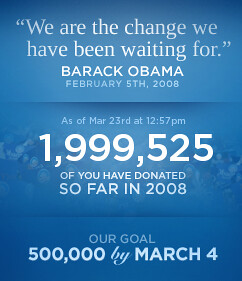
Although the polls said it was close she raced ahead in Ohio on the back of a gaff about trade issues by the Obama camp - very traditional. And although Obama had by far the slickest operation ever seen technically (see Terry Mancour in today's Guardian), especially compared to Hillary's 'command-control', and has completely changed the rules with fundraising (one million have donated online) that didn't push him over the top in Texas. And expectations about that were raised.
He will likely still get there - people who like to bet say it's a 1-7 done deal. But yesterday's vote and a perceived Hillary 'comeback' shows - I think - some real limits to the web's impact and the problem is the lack of real evidence and real numbers on where that limit is.
Obviously the slick online operation and the fundraising has pushed Obama further and energised a lot of people, especially young ones, but just how much further I don't think we know yet. Both of them have pushed turnout up but how much is web-derived and how much to do with the first black/first woman?.
Only Pew has done some real research as far as I'm aware and this is a big gap if web campaigning is really going to get some place, some backing and some real funding elsewhere — I'm talking about the UK here.
Politically it can't be ignored because of its ability to hit you - like with John Edwards haircut and how that made him look like a rich hypocrite or the Macacca incident which defeated a Govenor. Plus everyone will want to copy Obama's fundraising. But, like with Ron Paul, being a web hit, which Obama definitely is, isn't everything.
Exactly where the line is, where web impact ends and 'traditional' takes over, where it's moved to over the past few months? We don't know, we can only make an educated guess.
And that's a problem.
Footnote: I was watching Fox online last night and they had an excellent web stream hosted by - cough - Karl Rove. And, damn, it was good. It ran live complete with silences, bathroom breaks and tekkie interruptions with occasional crosses to TV. A telling moment was when they got a traffic report and wet themselves over 50,000 hits. Plus - bizarrely - they did the TV thing of quadrupling that to 200,000 'viewers'. Er, like web viewers aren't likely to be alone at a PC?!?




 @PubSecBloggers


